
Research Symposium
26th annual Undergraduate Research Symposium, April 1, 2026
Teagan Murphy Poster Session 1: 9:30 am - 10:30 am / Poster #87

BIO
Teagan Murphy is in their final year majoring in Psychology and minoring in Child Development. As a psychology major, they are fascinated by the way people think, feel, and act. Teagan enjoys any research, education, and workshops related to the field. They hold a particular interest for how psychology can help children. Their hope is to continue my education in this field to learn more about myself, the people they want to help, and the best way to do it. Teagan is currently a certified Registered Behavior and have learned how to implement ABA principles and strategies to teach new skills and reduce maladaptive behaviors. They have had the opportunity to work under my Dylann Lowery as part of her dissertation undergraduate team and am pleased to present her findings so far.
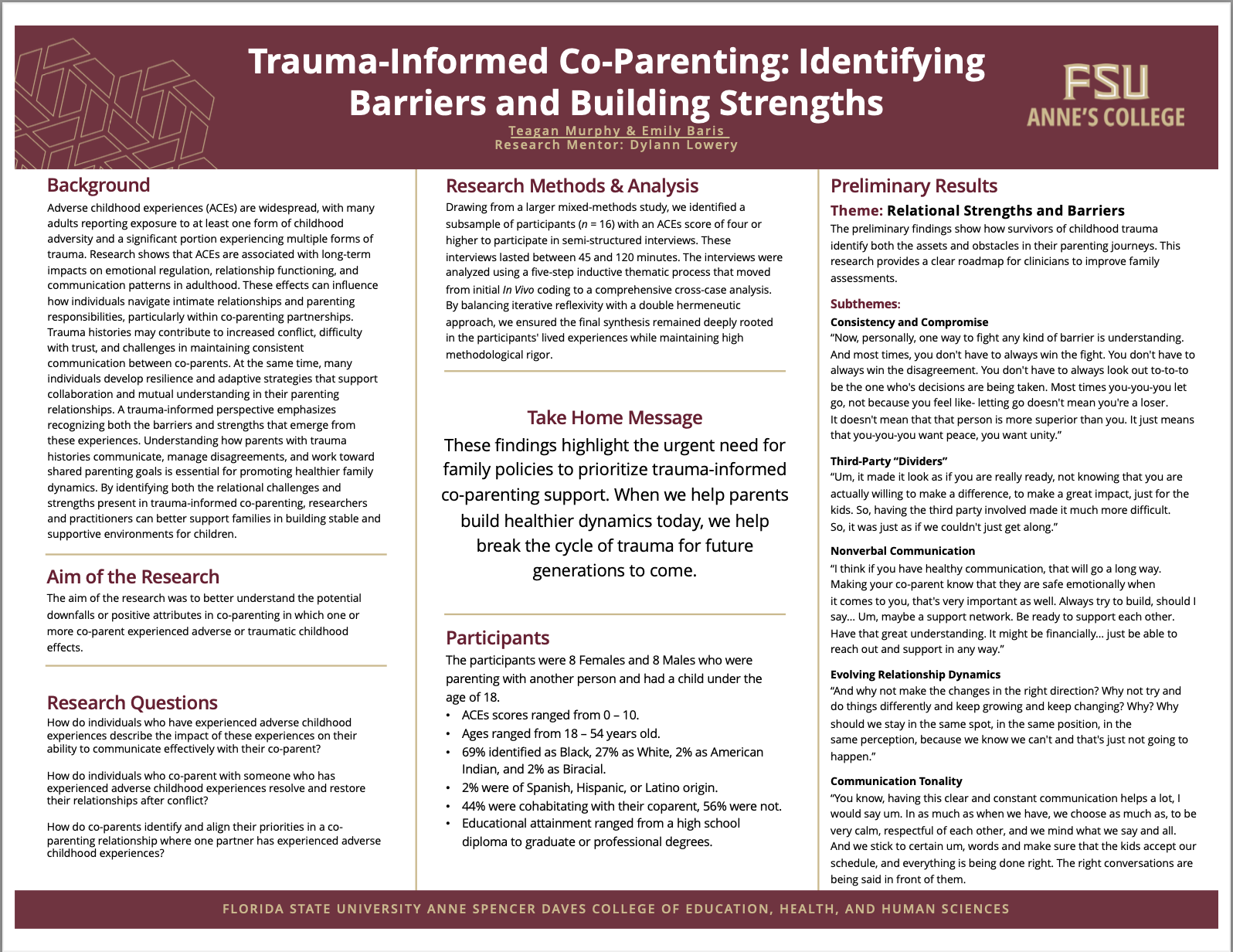
Trauma-Informed Co-Parenting: Identifying Barriers and Building Strengths
Authors: Teagan Murphy, Dylann LoweryStudent Major: Psychology
Mentor: Dylann Lowery
Mentor's Department: Human Development and Family Science Mentor's College: Anne's College of Education, Health, and Human Sciences Co-Presenters: Emily Baris
Abstract
This study presents Phase 2 of an explanatory sequential mixed-methods project investigating how clinically severe Adverse Childhood Experiences (ACEs) shape contemporary co-parenting relationships. Through purposeful subsample recruitment, we identified and interviewed 16 participants (n = 16) who reported an ACE score of 4 or higher. The final subsample was diverse, including 56% identifying as Black or African American, and represented various cohabitation and educational backgrounds.
Our research team used a five-step inductive thematic analysis to process these stories. By employing In Vivo and axial coding, we prioritized our participants’ authentic voices while identifying broader patterns. To maintain high standards of rigor, our team held interactive coding sessions and used reflexivity memos. We analyzed individual cases and compared them across the group to see how personal trauma histories created specific intergenerational effects.
A central theme was Relational Strengths and Barriers, with subthemes of Consistency and Compromise, Third-Party “Dividers,” and Nonverbal Communication. These preliminary findings show how survivors of childhood trauma identify both the assets and the obstacles in their parenting journeys. This research provides a clear roadmap for clinicians to improve family assessments. Additionally, these findings highlight the need for advocacy of family policies that include trauma-informed co-parenting support. By helping parents build healthier dynamics today, we help break the cycle of trauma for future generations.
Keywords: Co-parenting, Trauma, ACEs