
Research Symposium
26th annual Undergraduate Research Symposium, April 1, 2026
Christopher Johnson Poster Session 4: 3:00 pm - 4:00 pm / Poster #250

BIO
Christopher is a fifth-year mechanical engineering student with a strong interest in mechatronics, control systems, and the integration of hardware and software in dynamic systems. His work focuses on developing and analyzing engineered systems through a combination of computational modeling, embedded programming, and mechanical design.
Christopher's current projects include the development and implementation of a control system for a hydraulic-powered bicycle, a machine learning-based data interpretation project, and an optimal controls implementation inspired by the Ice Cold Beer arcade game. Through these experiences, he applies tools such as MATLAB, C++, Python, PCB design (KiCad), and CAD software (SolidWorks, Creo) to design, simulate, and implement real-world systems.
After graduation, Christopher aims to begin his career in robotics, mechatronics, or the broader technology sector, where her can contribute to the design and control of intelligent systems.
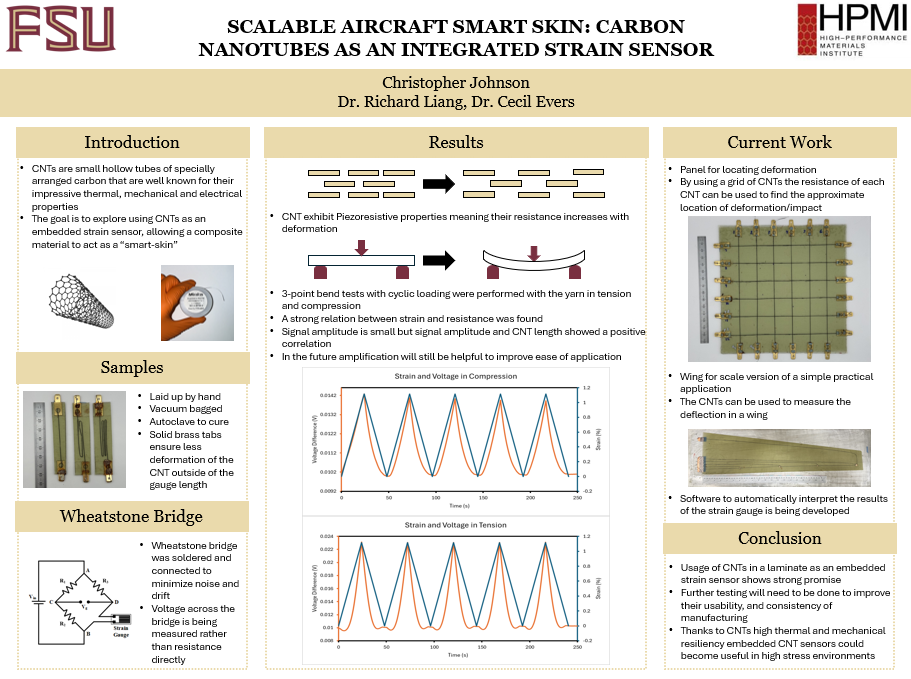
SCALABLE AIRCRAFT SMART SKIN: CARBON NANOTUBES AS AN INTEGRATED STRAIN SENSOR
Authors: Christopher Johnson, Dr. Richard LiangStudent Major: Mechanical Engineering
Mentor: Dr. Richard Liang
Mentor's Department: Material Science and Engineering Mentor's College: Industrial and Manufacturing Engineering Co-Presenters:
Abstract
Carbon nanotubes (CNTs) exhibit measurable changes in electrical resistance when subjected to mechanical deformation. The objective of this study is to evaluate the feasibility and sensitivity of CNT-based self-sensing laminates for applications requiring real-time structural health monitoring, such as detecting deformation in a wing or locating impacts on a structure in harsh environments. This study investigates the use of the piezoresistive properties of carbon nanotubes to develop a glass fiber composite laminate with an integrated strain-sensing capability. By embedding CNT yarns into the laminates as integrated sensing wires, the resulting composite is designed to function as a built-in strain gauge, effectively acting as a “smart skin.” During testing multiple electrical connection strategies were tested to reduce noise and improve reliability. Varying lengths of CNTs were also examined to compare their signal amplitudes and overall sensitivity to deformation. Their lengths will be referred to based upon the number of CNT yarn passes in the sample. A Wheatstone bridge with variable arms was constructed and the voltage difference measured across the bridge resulted in a change in voltage and gauge factor respectively of 0.580mV and 0.037 for 1 pass of yarn, 3.348mV and 0.022 for 3 passes, and 4.589mV and 0.030 for 5 passes of yarn.
Keywords: CNT, Carbon, Strain, Gauge, Sensor