
Research Symposium
26th annual Undergraduate Research Symposium, April 1, 2026
Zoë Cotterell Poster Session 2: 10:45 am - 11:45 am / Poster #163
BIO
Hello! My name is Zoë Cotterell, and I am a first-year Actuarial Science student who is hoping to double major in RMI. I am in the Honors program here at FSU and am currently studying for an actuarial exam that I plan to take in the summer. Although I love math and definitely want to pursue a career in the field of insurance, I love learning about social sciences. I have some previous research experience from high school through the AP Capstone program. I explored college students' attitudes towards current financial literacy initiatives as well as their own individual efforts to better educate themselves with the goal of gaining insight as to how to better prepare the youth on the journey to financial independence. Outside of academics, I enjoy line dancing, listening to music, and playing my instrument!
The AI Diary: Active Use, Beliefs, and Casual Encounters
Authors: Zoë Cotterell, Vanessa DennenStudent Major: Actuarial Science
Mentor: Vanessa Dennen
Mentor's Department: Educational Psychology & Learning Systems Mentor's College: Anne Spencer Daves College of Education, Health and Human Sciences Co-Presenters: Deidre Adams and Ja'launa Reynolds
Abstract
With the development of artificial intelligence and the normalization of its’ use among students,
it is becoming increasingly important to understand what shapes the guidelines for this use.
Existing studies explore what/ how AI is used in an educational context but fail to address how
conflicting messages regarding AI use impact the choices students make when using AI. This
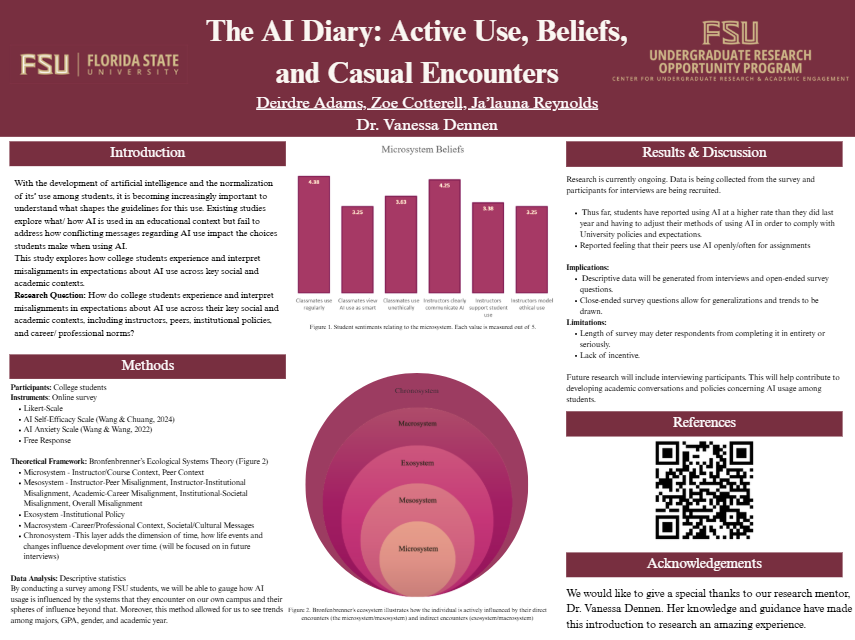
study explores how college students experience and interpret misalignments in expectations
about AI use across key social and academic contexts. Data is being collected through an online
survey using the Bronfenbrenner Ecological Systems Theory to investigate AI’s influence across
multiple layers of interaction, as well as utilizing existing scales to quantify this influence. By
mapping these influences, the findings will highlight drivers and deterrents of AI use. Moreover,
this study contributes to ongoing scholarly conversations about artificial intelligence by offering
insight into how adolescents are forming relationships with this emerging technology which can
be used to formulate policies on various levels to best support student learning.
Keywords: AI, Bronfenbrenner, Education