
Research Symposium
26th annual Undergraduate Research Symposium, April 1, 2026
Aashmi Maru Poster Session 3: 1:45 pm - 2:45 pm / Poster #123

BIO
Aashmi Maru is a first-year student pursuing a Bachelor of Science in Computational Biology. She has earned recognition on the President’s List (Fall 2025) for her academic performance. She is interested in exploring interdisciplinary research at the intersection of biology, neuroscience, and computer science and hopes to gain hands-on research experience under Professor Adam Dewan. In the future, she plans to pursue graduate studies and a career in healthcare.
Investigating the Dorsal Tenia Tecta - an underexplored region of primary olfactory cortex
Authors: Aashmi Maru, Adam DewanStudent Major: Computational Biology
Mentor: Adam Dewan
Mentor's Department: Department of Psychology, Program in Neuroscience Mentor's College: College of Arts and Sciences Co-Presenters:
Abstract
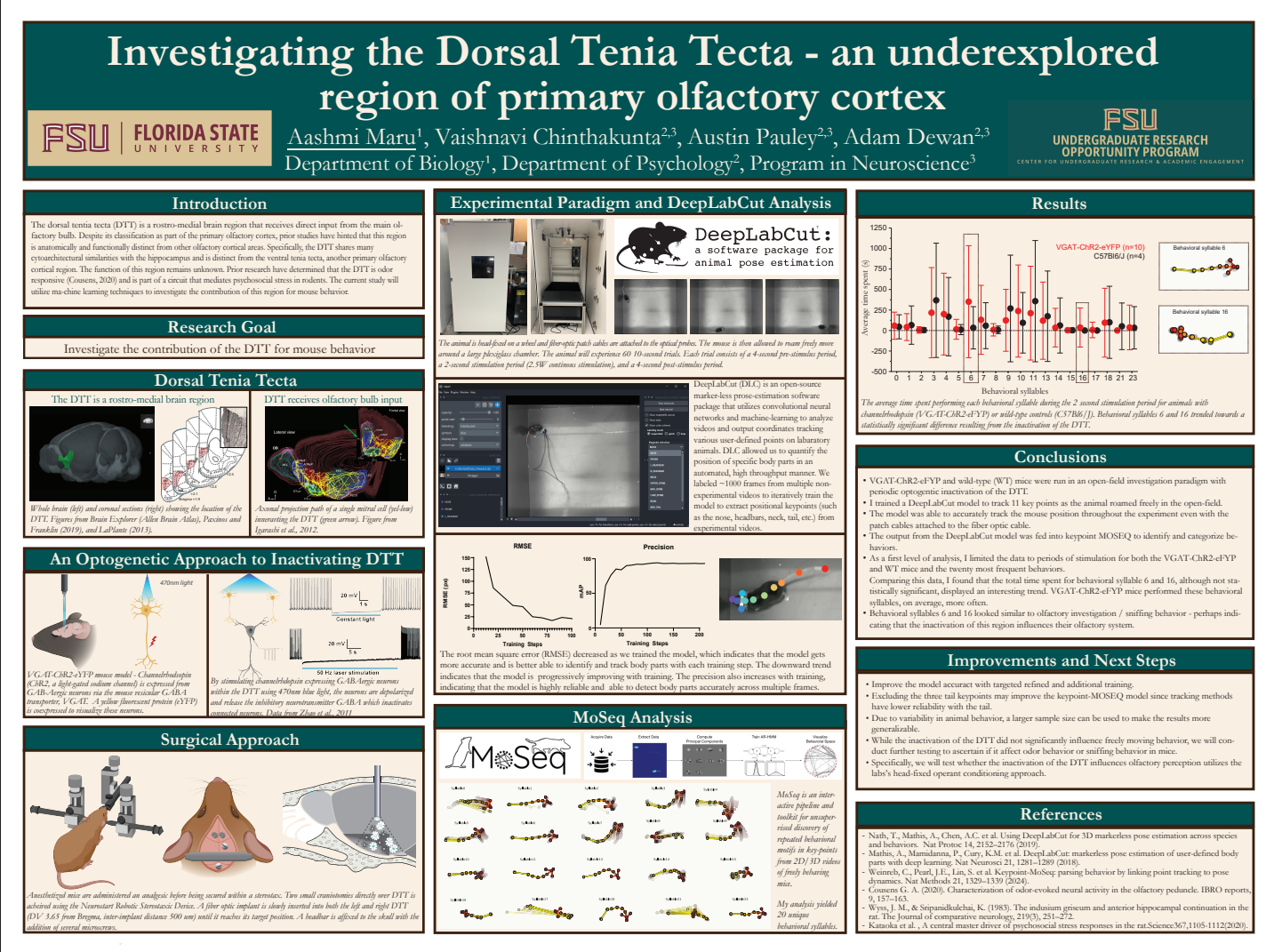
The Dorsal Tenia Tecta (DTT) is a small rostro-medial brain region that receives direct input from the olfactory bulb. Despite being part of the primary olfactory cortex, the contribution of this region is to odor perception and behavior is unknown. In order to investigate the contribution of the DTT for freely moving rodent behavior, we utilized optogenetic stimulation to inhibit this region using a transgenic mouse line that selectively expressed channelrhodopsin in GABAergic inhibitory neurons. To observe changes in movement and behavior, we then used DeepLabCut
(DLC) and iteratively trained a model to extract positional keypoints (such as the nose, probe, left headbar, right headbar, neck, upper spine, middle spine, lower spine, rear, mid tail, and tail tip) from experimental videos. For the model to accomplish this, approximately 1000 frames from multiple nonexperimental videos were expertly labeled and GPU-acceleration was used to train the machine learning model. The output from DLC was then directed to keypoint-MOSEQ, which uses an autoregressive model to automatically identify unique behaviors exhibited by the animals during the behavioral sessions. MOSEQ was thus used to categorize mouse behaviour, and the resultant behaviors were then identified and labeled. These behaviors were then compared between stimulation (inhibition) and nonstimulation (no inhibition) trials to determine if there are any significant differences in the frequency or duration of specific behaviors. This allowed us to determine and assess how inhibiting the DTT influenced mouse movement and behavior.
Keywords: Dorsal Tenia Tecta, DeepLabCut