
Research Symposium
26th annual Undergraduate Research Symposium, April 1, 2026
Hanna Banfield Poster Session 1: 9:30 am - 10:30 am / Poster #113

BIO
Hanna Banfield is a senior at FSU pursuing a Bachelor of Science in Behavioral Neuroscience with a minor in Spanish. She is originally from Conifer, Colorado and will graduate in May 2026. Hanna has been recognized for her academic achievement by earning a place on the Dean’s List for four consecutive semesters and the President’s List once.
Hanna has gained research experience in multiple laboratories within the psychology department at FSU. She previously worked in the ASPIRE Lab under the mentorship of Dr. Sarah Brown, where she contributed to research assessing suicidal behaviors and related psychological factors. She currently works in the Rinaman Lab under Dr. Linda Rinaman, where her research focuses on glucagon-like peptide-1 (GLP-1) neural circuitry and the physiological and environmental factors that influence it.
Through these experiences, Hanna has developed strong interests in neural circuits, the behaviors they influence, and the many factors that shape them. After graduation, she plans to pursue a Ph.D. in Neuroscience and hopes to continue conducting research examining how brain–body circuits shape behavior and health.
Effect of Perinatal Western Diet Exposure on Stress-Induced Neuronal Activation in Rats
Authors: Hanna Banfield, Dr. Linda RinamanStudent Major: Behavioral Neuroscience
Mentor: Dr. Linda Rinaman
Mentor's Department: Department of Psychology Mentor's College: College of Arts and Sciences Co-Presenters: Giovanna Bettega Feitoza
Abstract
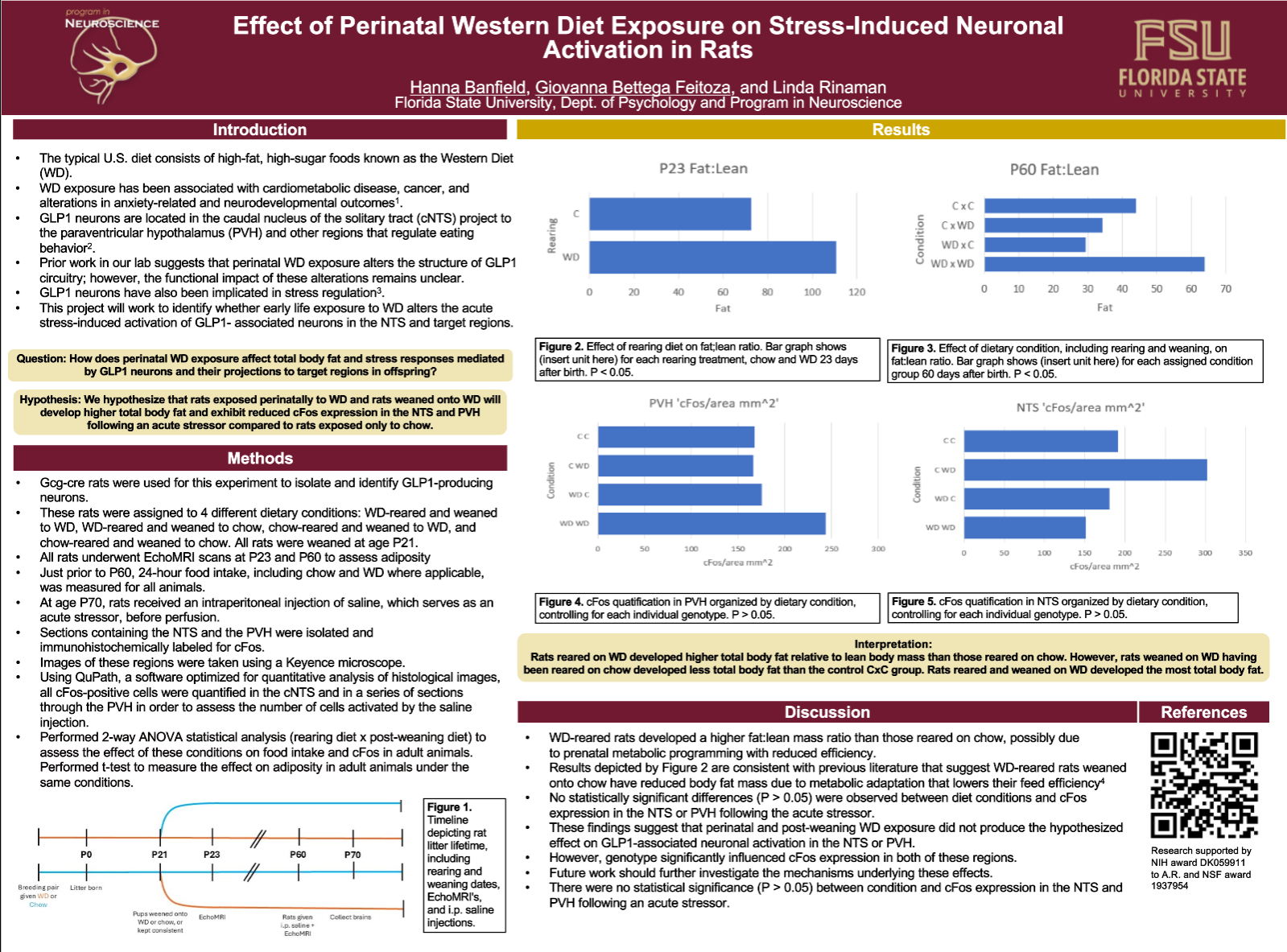
Previous research shows that maternal consumption of a high-fat, high-sugar Western diet (WD) is associated with adverse offspring health outcomes. GLP1 neurons located in the nucleus of the solitary tract (NTS) project to the paraventricular hypothalamus (PVH) and other regions that regulate eating behavior. GLP1 neurons also respond to stressful stimuli and mediate stress-induced hypophagia. Prior work in our lab suggests that perinatal WD exposure alters the structure of GLP1 circuitry; however, the functional impact of these alterations remains unclear. This project investigates whether early life exposure to WD alters neural activation in response to an acute stressor within hindbrain and hypothalamic regions involved in stress and eating behaviors. Rats were assigned to one of four dietary conditions: maternal WD or chow during rearing, followed by either WD or chow after weaning. This allows comparison between the effects of perinatal and/or post-weaning WD exposure. 60-day-old young adult rats received an intraperitoneal saline injection as an acute stressor prior to perfusion. Brain sections were immunohistochemically labeled for cFos, an immediate early gene product used to quantify neuronal activation. cFos-positive neurons within the NTS and PVH regions were quantified. We hypothesized that perinatal exposure and post-weaning consumption of WD would reduce stress-induced cFos activation within these regions. Rats reared on WD showed increased fat-to-lean mass ratios compared to chow-reared controls, whereas rats switched to chow at weaning exhibited reduced body fat relative to controls. Despite these metabolic differences, dietary condition did not significantly alter stress-induced cFos activation in the NTS or PVH.
Keywords: GLP1, Stress, cFos