
Research Symposium
26th annual Undergraduate Research Symposium, April 1, 2026
Sophie Works Poster Session 3: 1:45 pm - 2:45 pm / Poster #245
BIO
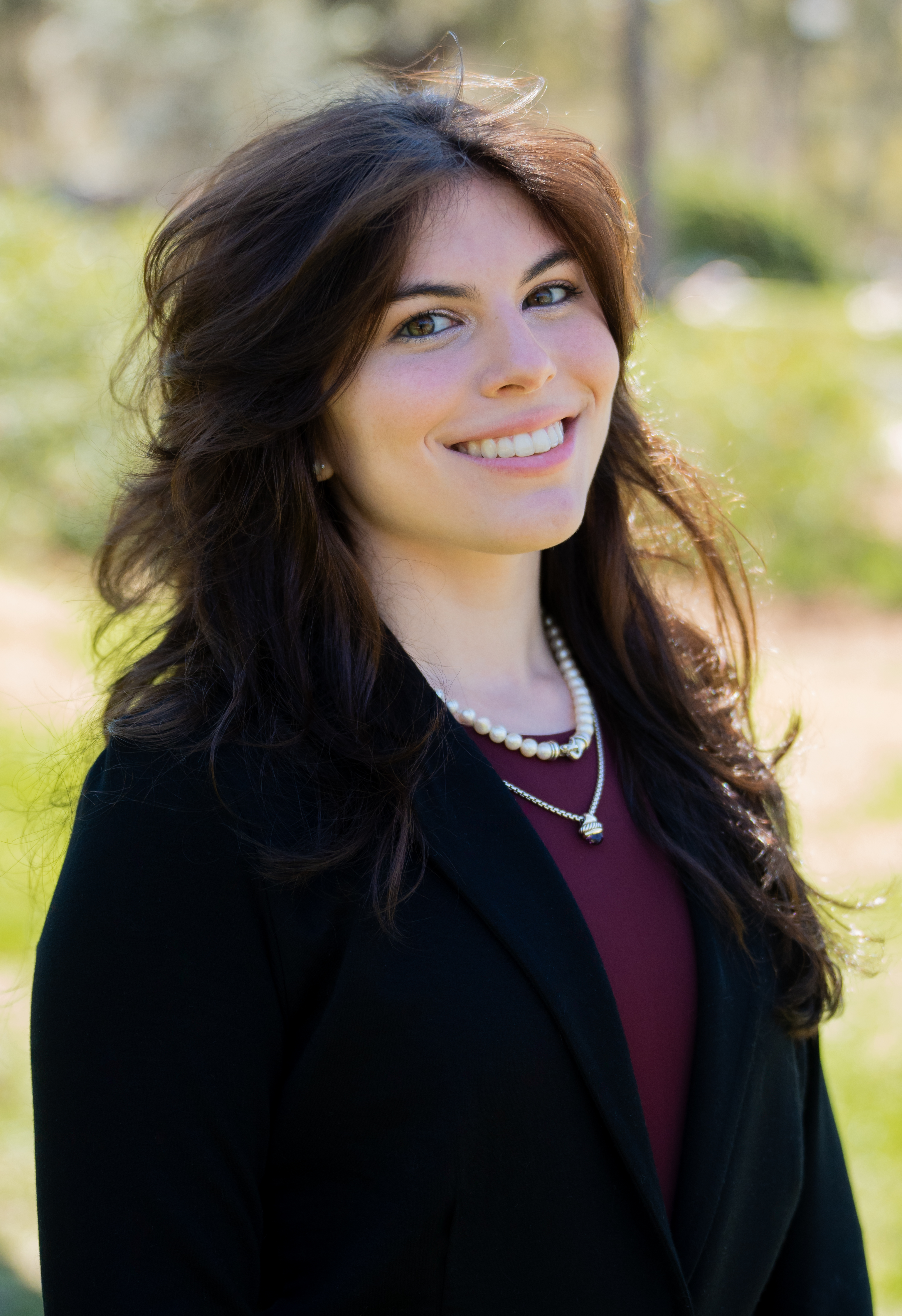
Sophie Works is a third-year honors student pursuing a Bachelor of Arts in Russian (Slavic) Studies and a Bachelor of Science in International Affairs with minors in English and Museum Studies. Inspired by the emotional bond she developed with her mother through Russian lacquer art, Sophie began her current project which investigates the evolving narratives projected onto lacquer art across private and public Latvian spaces. Her work highlights themes of Soviet nostalgia, contested memory, and the digital humanities, combining the antiquity of Russian lacquer and modernity of 3D modeling to curate an interactive archive. Mentored by Dr. Lisa Ryoko Wakamiya, Sophie is a Winthrop-King Russian 2026 Scholar, FSU 2026 Student Star, Tyler Center for Global Studies 2026 and 2025 Fellow, member of the FSU Libraries Digital Research Incubator 2025-2026 cohort, member of the Global Scholars 2025 Cohort, member of the HSF Undergraduate Research Board, and recipient of the Bess H. Ward Honors Thesis and Edna Ranck International Study Award. She is conducting her Honors in the Major Thesis on the same topic while preparing her next honors thesis on multi-scene Russian orthodox icons in Tallinn, Estonia. After graduation, Sophie plans to pursue a Ph.D. in Russian and Slavic Studies, digitally documenting Slavic heritage objects and curating open-access repositories.
Lacquer and Legacy: Opening the Box to Soviet Narratives and Baltic Realities
Authors: Sophie Works, Dr. Lisa Ryoko WakamiyaStudent Major: Russian (Slavic) Studies & International Affairs with a concentration in Russian
Mentor: Dr. Lisa Ryoko Wakamiya
Mentor's Department: Modern Languages and Linguistics Mentor's College: Arts and Sciences Co-Presenters:
Abstract
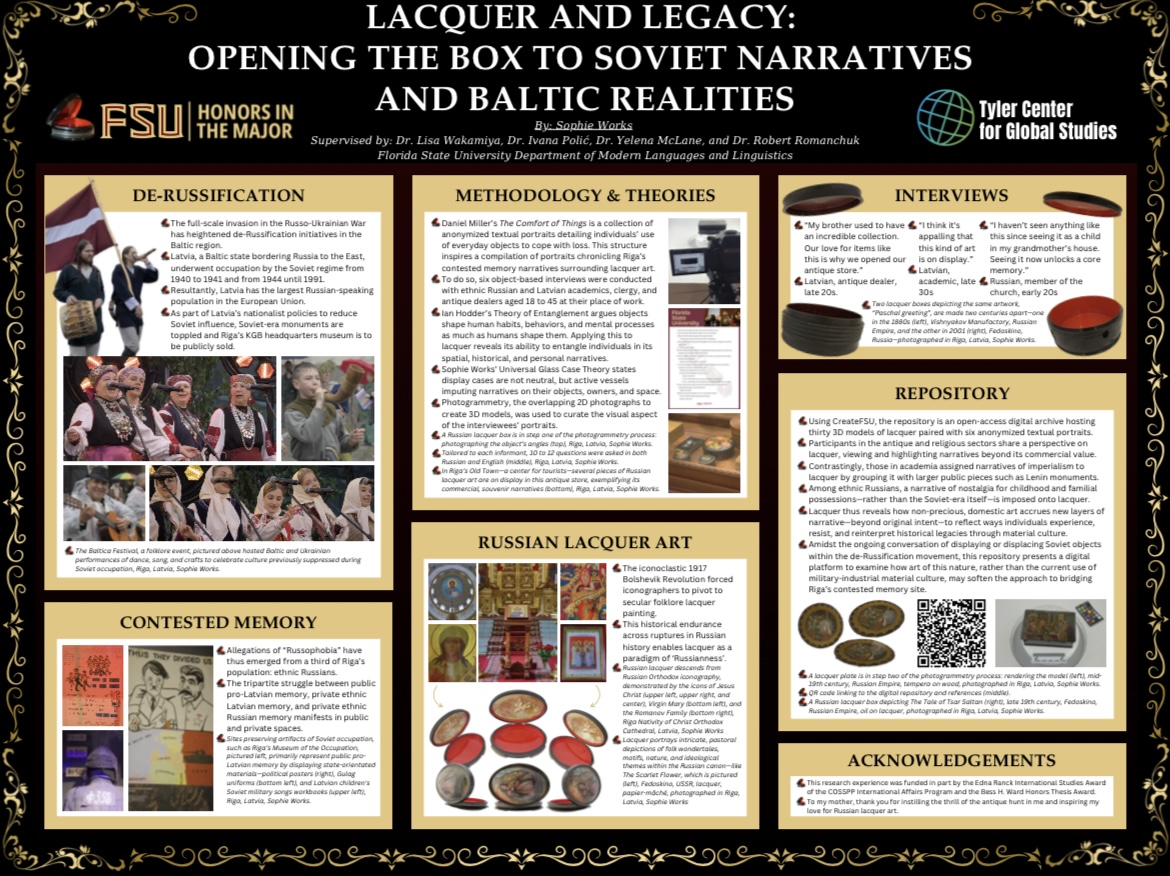
Following the full-scale invasion in the Russo-Ukrainian War, de-Russification initiatives have intensified across the sociopolitical spheres of the Baltics. In Latvia, where nationalist policies reduce Soviet influence, allegations of ‘Russophobia’ have emerged from a third of Riga’s population: ethnic Russians. This project utilizes Russian lacquer art to examine the legacy of Soviet identity, nostalgia, and the tripartite struggle between public pro-Latvian memory, private ethnic Latvian memory, and private ethnic Russian memory through its manifestation in public and private Baltic spaces. Dating back to the 16th century, Russian lacquer originates and persists in the Russian orthodoxy iconography villages of Palekh, Fedoskino, Mstera, and Kholui. The subsequent iconoclasm of the 1917 Bolshevik Revolution forced these iconographers to pivot to secular folklore lacquer painting to supply Soviet Russia with a needed sense of a ‘bucolic’ national identity amidst the revolution’s earlier cultural upheaval. Lacquer’s historical endurance across ruptures in Russian history and pastoral depictions of wondertales, motifs, nature, and ideological themes within the Russian canon positions itself as a paradigm of ‘Russianness’. Becoming more than a Soviet-era antique, lacquer is a living artifact mediating transgenerational relationships between memory, identity, and heritage. Using object-based interviews and photogrammetry, this project pairs six anonymized textual ‘portraits’ of Russian and Latvian academics, clergy, and antiquarians aged 18–45 with forty 3D–models of their lacquer in a digital repository. Examining lacquer’s role in these spaces reveals how art accrues new layers of function—beyond original intent—to reflect ways individuals experience, resist, and reinterpret historical legacies through material culture.
Keywords: Soviet, Baltic, Art, History, Memory