
Research Symposium
26th annual Undergraduate Research Symposium, April 1, 2026
Giovanna Bettega Feitoza Poster Session 1: 9:30 am - 10:30 am / Poster #113

BIO
Giovanna is an undergraduate student in the FSU Honors Program, pursuing a degree in Cell and Molecular Neuroscience on a pre-med track. Originally from Brazil and now based in Jacksonville, FL, she has a passion for both science and the humanities. The combination drives her commitment to empathetic, human-centered medicine.
Giovanna aims to practice as a pediatrician specializing in neonatology; wanting to dedicate herself to the care of newborns and their families during life's most formative moments.
Outside of her coursework or research, Giovanna enjoys playing guitar, traveling, and spending time with friends and family
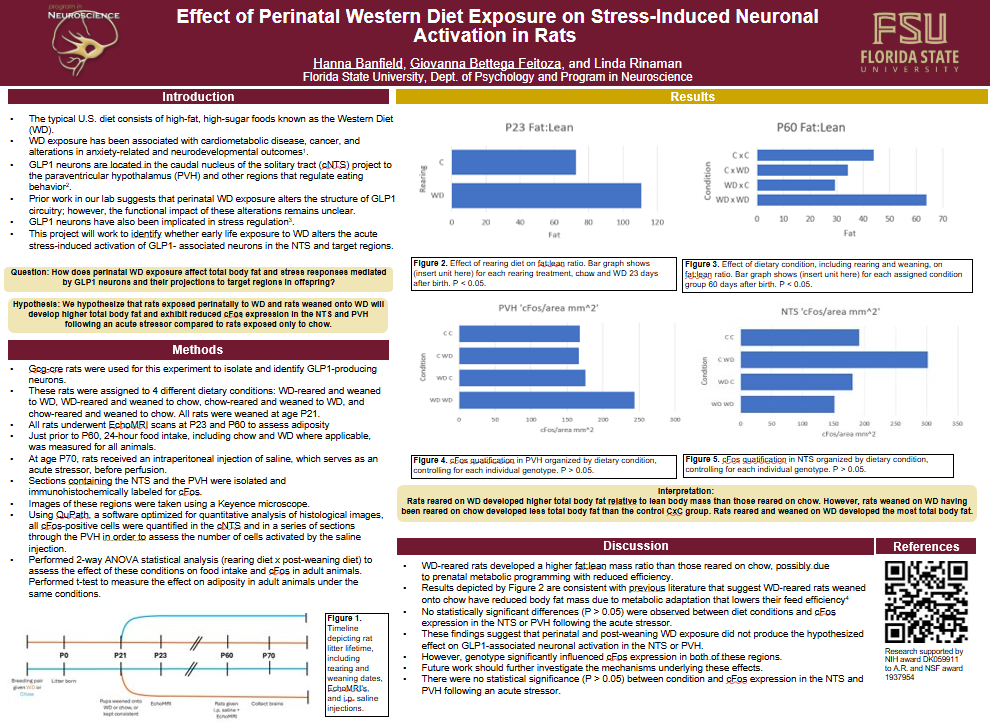
Effect of Perinatal Western Diet Exposure on Stress-Induced Neuronal Activation in Rats
Authors: Giovanna Bettega Feitoza, Linda RinamanStudent Major: Cell and Molecular Neuroscience
Mentor: Linda Rinaman
Mentor's Department: Psychology Mentor's College: Arts and Sciences Co-Presenters: Hanna Banfield
Abstract
Previous research shows that maternal consumption of a high-fat, high-sugar Western diet (WD) is associated with adverse offspring health outcomes. GLP1 neurons located in the nucleus of the solitary tract (NTS) project to the paraventricular hypothalamus (PVH) and other regions that regulate eating behavior. GLP1 neurons also respond to stressful stimuli and mediate stress-induced hypophagia. Prior work in our lab suggests that perinatal WD exposure alters the structure of GLP1 circuitry; however, the functional impact of these alterations remains unclear. This project investigates whether early life exposure to WD alters the ability of acute stress to activate GLP1 neurons and their downstream targets. Rats were assigned to one of four dietary conditions: maternal WD or chow during rearing, followed by either WD or chow after weaning. This allows comparison between the effects of perinatal and/or post-weaning WD exposure. 60-day-old young adult rats received an intraperitoneal saline injection as an acute stressor prior to perfusion. Brain sections were immunohistochemically labeled for GLP1 and cFos, an immediate early gene product used to quantify neuronal activation. Activated (i.e., cFos-positive) hindbrain GLP1 neurons and downstream target neurons in stress-related hypothalamic regions are currently being quantified. We hypothesize that perinatal exposure and post-weaning consumption of WD will reduce the ability of acute stress to activate cFos in GLP1 neurons and within the hypothalamus. These findings may clarify how perinatal diet shapes GLP1 pathway function and stress resilience.
Keywords: GLP1, Stress, Western Diet