
Research Symposium
26th annual Undergraduate Research Symposium, April 1, 2026
Adria Morales Santiago Poster Session 4: 3:00 pm - 4:00 pm / Poster #56

BIO
Adria Morales Santiago is a third-year student at Florida State University pursuing a Bachelor of Science in Biological Sciences. She serves as a UROP Leader within the Undergraduate Research Opportunity Program, where she mentors and supports undergraduate researchers. Adria has gained research experience in laboratory settings focused on gut microbiota, and her current research centers on Alzheimer’s disease and Mild Cognitive Impairment (MCI), where she examines spatial navigation deficits and how these neurodegenerative conditions impact cognitive functions such as memory and orientation. She plans to pursue medical school and a future career in oncology, to become a surgical oncologist and contribute to cancer research and patient care.
Comparing Spatial Navigation Deficits in Mild Cognitive Impairment and Alzheimer's Disease
Authors: Adria Morales Santiago, Dorota Kossowska-KuhnStudent Major: Biological Sciences
Mentor: Dorota Kossowska-Kuhn
Mentor's Department: Psychology Mentor's College: College of Arts and Sciences Co-Presenters:
Abstract
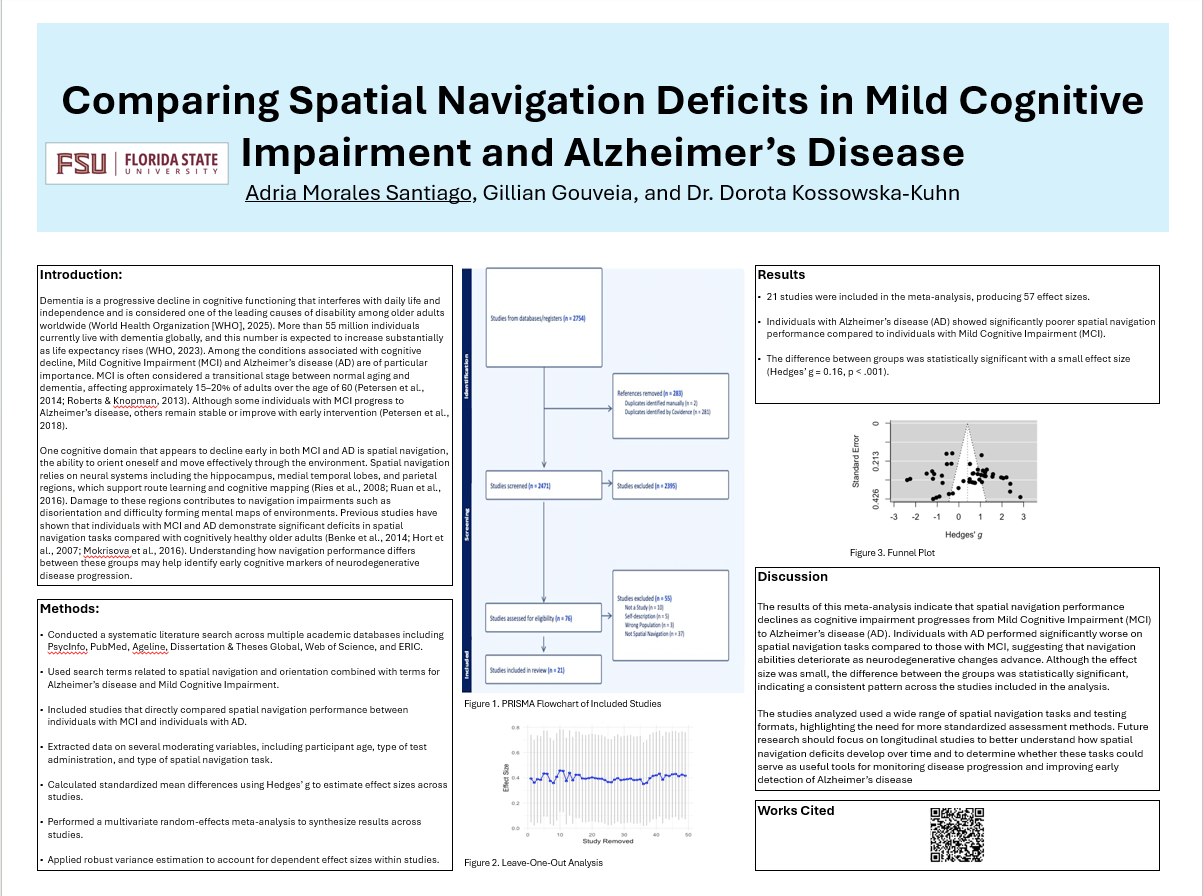
Spatial navigation difficulties are among the early cognitive changes observed in the progression of neurodegenerative conditions such as Mild Cognitive Impairment (MCI) and Alzheimer’s disease (AD). Due to navigation skills being essential for safe and independent functioning, understanding how these abilities decline across diagnostic stages is clinically important. While previous meta-analyses have established that both MCI and AD are associated with significant impairments compared to cognitively healthy older adults, less is known about the magnitude of difference between MCI and AD directly. The research project conducted a literature review synthesizing findings from 21 empirical studies examining spatial navigation performance in individuals diagnosed with MCI and AD. Across these studies, 57 effect sizes were extracted and analyzed using Hedges’ g within a multivariate random-effects framework. Additionally, variance estimation was applied to account for statistical dependence among effect sizes. Tasks included a range of formats, such as virtual reality, real-world navigation, computerized paradigms, and traditional paper-and-pencil measures, capturing diverse navigation domains. The results showed that individuals with AD demonstrated significantly poorer navigation performance compared to those with MCI, though the difference was small in magnitude (g = 0.16, p < .001). These findings suggest that spatial navigation continues to decline from MCI to AD but may do so gradually. Future research should prioritize longitudinal approaches and standardized assessment tools to characterize the trajectory of navigation deficits better and enhance their potential diagnostic utility.
Keywords: spatial navigation, Alzheimer's Disease, Mild Cognitive Impairment