
Research Symposium
26th annual Undergraduate Research Symposium, April 1, 2026
Zane McGill Poster Session 3: 1:45 pm - 2:45 pm / Poster #85
BIO
Zane McGill is a fourth-year transfer student from New College of Florida pursuing dual Bachelors of Arts degrees in International Affairs and Interdisciplinary Social Sciences (Urban Studies). He spent last semester at Mahidol University in Thailand and will be continuing his studies at Cornell's School of Architecture, Art, and Planning this Fall, pursuing a Master of Arts in City and Regional Planning, working closely with Dr. Sophie Oldfield and concentrating on Critical Urban Theory and International Planning. He intends to pursue a PhD in Geography or History thereafter and work in academia and international urban and regional development. Mr. McGill has a special interest in East and Southeast Asia, Post-Structuralism, and education.
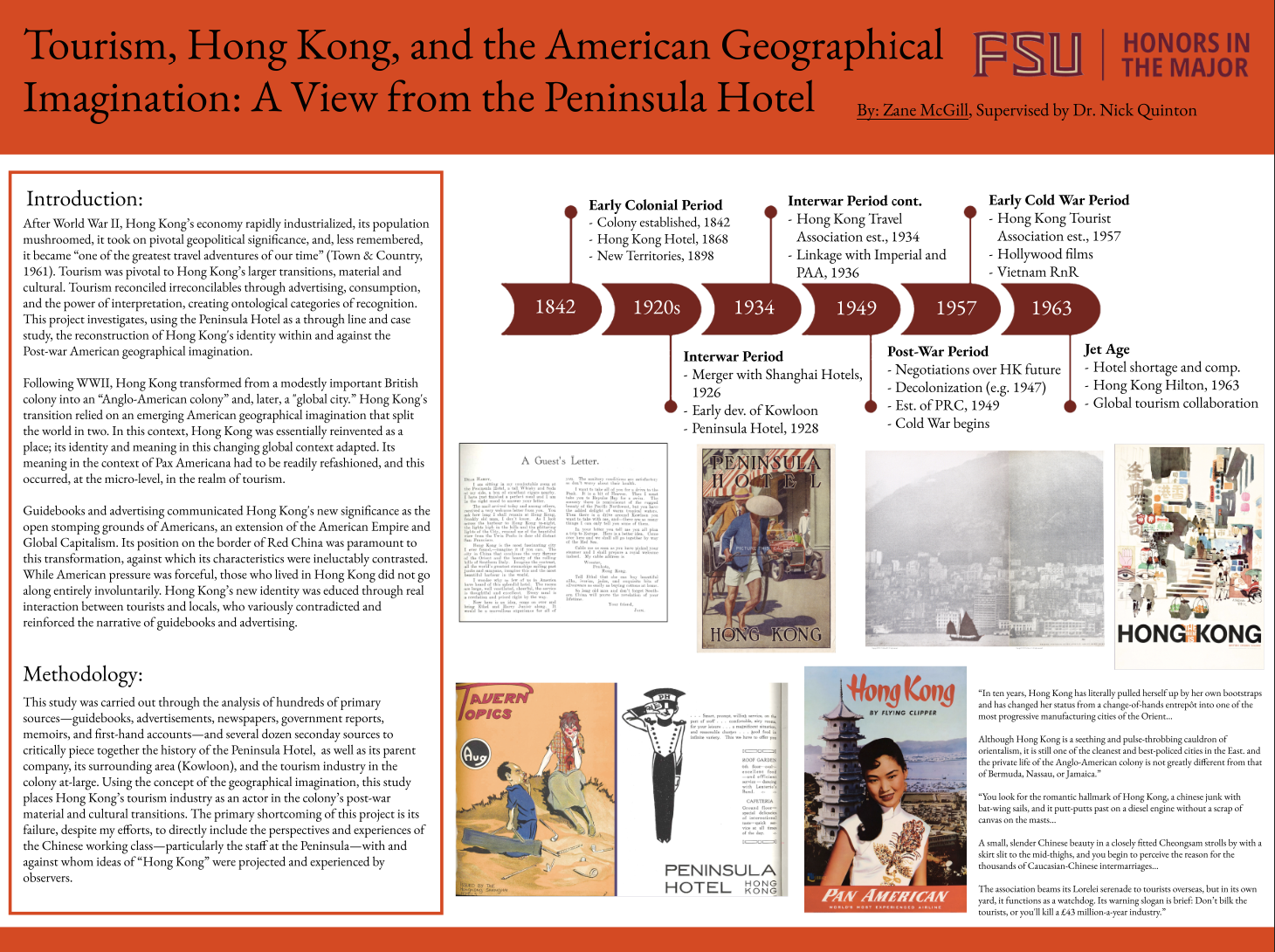
Tourism, Hong Kong, and the American Geographical Imagination: A View from the Peninsula Hotel
Authors: Zane McGill, Nick QuintonStudent Major: International Affairs, Interdisciplinary Social Sciences (Urban Studies)
Mentor: Nick Quinton
Mentor's Department: Geography Mentor's College: Florida State University Co-Presenters:
Abstract
After World War Il, Hong Kong's economy rapidly industrialized, its population mushroomed, it took on pivotal geopolitical significance, and, less remembered, it became "one of the greatest travel adventures of our time" (Town & Country, 1961). Tourism was pivotal to Hong Kong's larger transitions, material and cultural. Tourism reconciled irreconcilables through advertising, consumption, and the power of interpretation, creating ontological categories of recognition. This project investigates, using the Peninsula Hotel as a through line and case study, the reconstruction of Hong Kong's identity within and against the Post-war American geographical imagination. Following WWII, Hong Kong transformed from a modestly important British colony into an "Anglo-American colony" and, later, a "global city." Hong Kong's transition relied on an emerging American geographical imagination that split the world in two. In this context, Hong Kong was essentially reinvented as a place; its identity and meaning in this changing global context adapted. Its meaning in the context of Pax Americana had to be readily refashioned, and this occurred, at the micro-level, in the realm of tourism. Guidebooks and advertising communicated Hong Kong's new significance as the open stomping grounds of Americans, an extension of the American Empire and Global Capitalism. Its position on the border of Red China was paramount to this transformation, against which its characteristics were ineluctably contrasted. While American pressure was forceful, Hongkongers did not participate involuntarily. Hong Kong's new identity was educed through real interaction between tourists and locals, who variously contradicted and reinforced the narrative of guidebooks and advertising.
Keywords: Tourism, Cold War, Hong Kong, Modernity, Identity