
Research Symposium
26th annual Undergraduate Research Symposium, April 1, 2026
Yvette Obediente Poster Session 4: 3:00 pm - 4:00 pm / Poster #130

BIO
Yvette Obediente is a junior pursuing a Bachelor of Science in Biological Sciences on the pre-medicine track at Florida State University. She has been involved in research for the past two years under the mentorship of Dr. Brown, focusing on aging and neurodegenerative diseases. Yvette began her research career as a freshman through the Undergraduate Research Opportunity Program (UROP), which sparked her strong interest in scientific research. She recently attended the Max Planck Symposium in March 2026, where she engaged with leading scientists and expanded her understanding of current advancements in the field. Following graduation, Yvette plans to attend medical school and pursue a career as a physician.
Age-related dysregulation of cAMP signaling in taste circuits in a Drosophila model of Alzheimer’s disease.
Authors: Yvette Obediente, Dr. Elizabeth BrownStudent Major: Biological Sciences
Mentor: Dr. Elizabeth Brown
Mentor's Department: Biological Science and Neuroscience Mentor's College: Arts and Sciences Co-Presenters:
Abstract
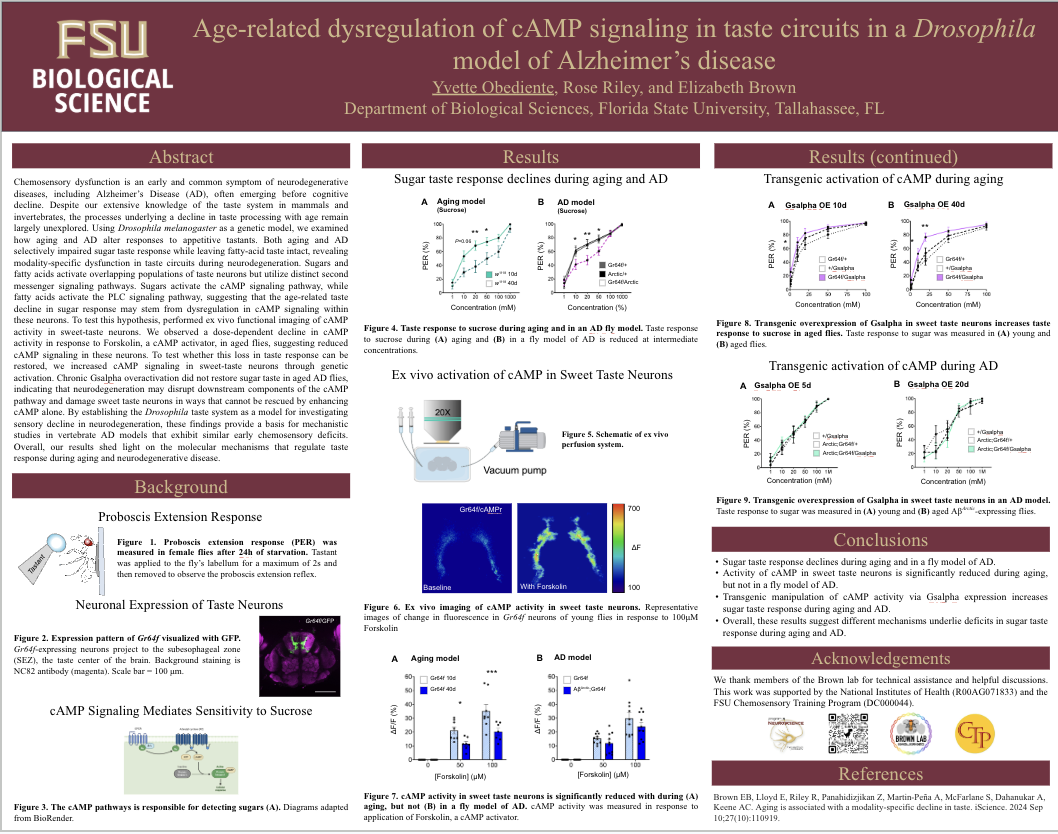
Chemosensory dysfunction is an early and common symptom of neurodegenerative diseases, including Alzheimer’s Disease (AD), often emerging before cognitive decline. Despite extensive knowledge of the taste system in mammals and invertebrates, the processes underlying a decline in taste processing with age remain largely unexplored. Using Drosophila melanogaster as a model, we examined how aging and AD alter responses to appetitive tastants. Aging and AD selectively impaired sugar taste response reveals modality-specific dysfunction in taste circuits during neurodegeneration. Sugars activate the cAMP signaling pathway suggesting the age-related taste decline in sugar response stems from dysregulation in cAMP signaling within these neurons. To test this hypothesis, we performed ex vivo functional imaging of cAMP activity in sweet-taste neurons. We observed a dose-dependent decline in cAMP activity in response to Forskolin, a cAMP activator, in aged flies, suggesting reduced cAMP signaling in these neurons. To test if loss in taste response can be restored, we increased cAMP signaling in sweet-taste neurons through genetic activation. Chronic Gsalpha overactivation did not restore sugar taste in aged AD flies, indicating that neurodegeneration may disrupt downstream components of the cAMP pathway and damage sweet taste neurons in ways that cannot be rescued by enhancing cAMP alone. By establishing the Drosophila taste system as a model for investigating sensory decline in neurodegeneration, these findings provide a basis for mechanistic studies in vertebrate AD models that exhibit similar early chemosensory deficits. Overall, our results shed light on the molecular mechanisms that regulate taste response during aging and neurodegenerative disease.
Keywords: Alzheimers, Drosophila, Imaging