
Research Symposium
26th annual Undergraduate Research Symposium, April 1, 2026
Kayley Prevett Poster Session 4: 3:00 pm - 4:00 pm / Poster #148
BIO
Kayley Prevett is a first-year anthropology student who is interested in archaeology, scuba diving, and photography. Through FSU’s historic postcard archive, she is developing an online exhibit that researches WWII naval postcards. As an aspiring underwater archaeologist, she is particularly interested in maritime history and shipwrecks.
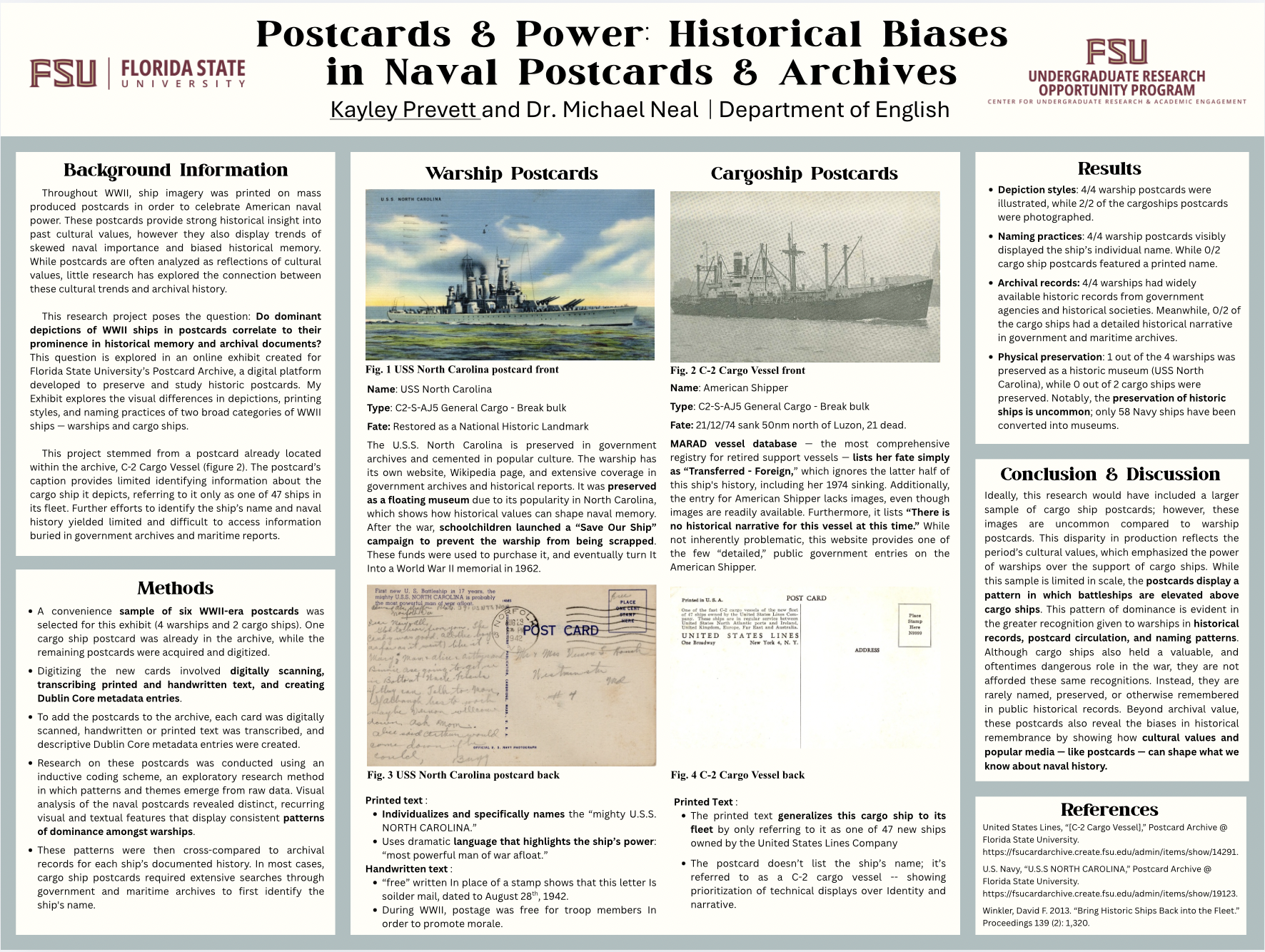
Postcards and Power: Historical Biases in Naval Postcards and Archives
Authors: Kayley Prevett, Michael NealStudent Major: Anthropology
Mentor: Michael Neal
Mentor's Department: Department of English Mentor's College: College of Arts and Sciences Co-Presenters:
Abstract
Throughout WWII, ship imagery was printed on mass produced postcards in order to celebrate American naval power. These postcards provide strong historical insight into past cultural values, however they also display trends of skewed naval importance and biased historical memory. This research seeks to examine the hierarchies of naval importance reflected in WWII ship postcards and explore what this demonstrates about historic remembrance. This research project develops an online exhibit for Florida State University’s Postcard Archive, a digital platform developed to preserve and study historic postcards. This exhibit explores the visual differences in depictions, printing styles, and naming practices of two broad categories of WWII ships: warships and cargo ships. These visual features are then compared to archival documents and historical records to demonstrate historical biases. This analysis revealed a consistent hierarchy in which battleships are deemed more significant than cargo ships. Battleships depicted in postcards were commonly illustrated, dramatized, and visibly named. Comparatively, cargo ships were often photographed, generalized to their fleets, and printed nameless. This visual hierarchy of importance is often reflected in historical narratives and archival records, in which battleships typically have extensive, easily accessible documentation and are more often preserved, while many cargo ships lack historical narratives and remain buried in archives. This highlights a broader issue in wartime remembrance, in which the spectacle of battle is prioritized over support systems that played an equally significant role in the war.
Keywords: Postcards, WWII, Ships