
Research Symposium
26th annual Undergraduate Research Symposium, April 1, 2026
Mary Kissane Poster Session 3: 1:45 pm - 2:45 pm / Poster #209

BIO
I am a driven pre-health student with a strong foundation in clinical care, research, and leadership across hospital and laboratory settings. My passion for healthcare is rooted in seeing how scientific knowledge can directly improve patient outcomes, especially in areas like neurology, physiology, and whole-body wellness.
My research focuses on the impact of alcohol and lifestyle factors on skeletal muscle health and inter-organ communication. Using functional assessments and molecular techniques, I study how behavior influences physiology and disease, reinforcing my interest in the body as an integrated system. Clinically, I serve as a Lead CCAV volunteer on Neurology/Neurosurgery and Orthopedic units, where I mentor new volunteers and support patients recovering from strokes, traumatic brain injuries, and surgical procedures. In addition, my experience as a Clinical Medical Assistant has provided hands-on skills in phlebotomy, EKGs, and patient care across emergency medicine, OB/GYN, and dermatology settings. I am passionate about combining scientific rigor with compassionate care and aspire to become a physician who bridges research and patient-centered medicine.
Chronic Alcohol Use Does Not Exacerbate the Effects of Existing Obesity in Female Mice
Authors: Mary Kissane, Jennifer SteinerStudent Major: Biological Science
Mentor: Jennifer Steiner
Mentor's Department: Health, Nutrition and Food Sciences Department Mentor's College: Annes College Co-Presenters:
Abstract
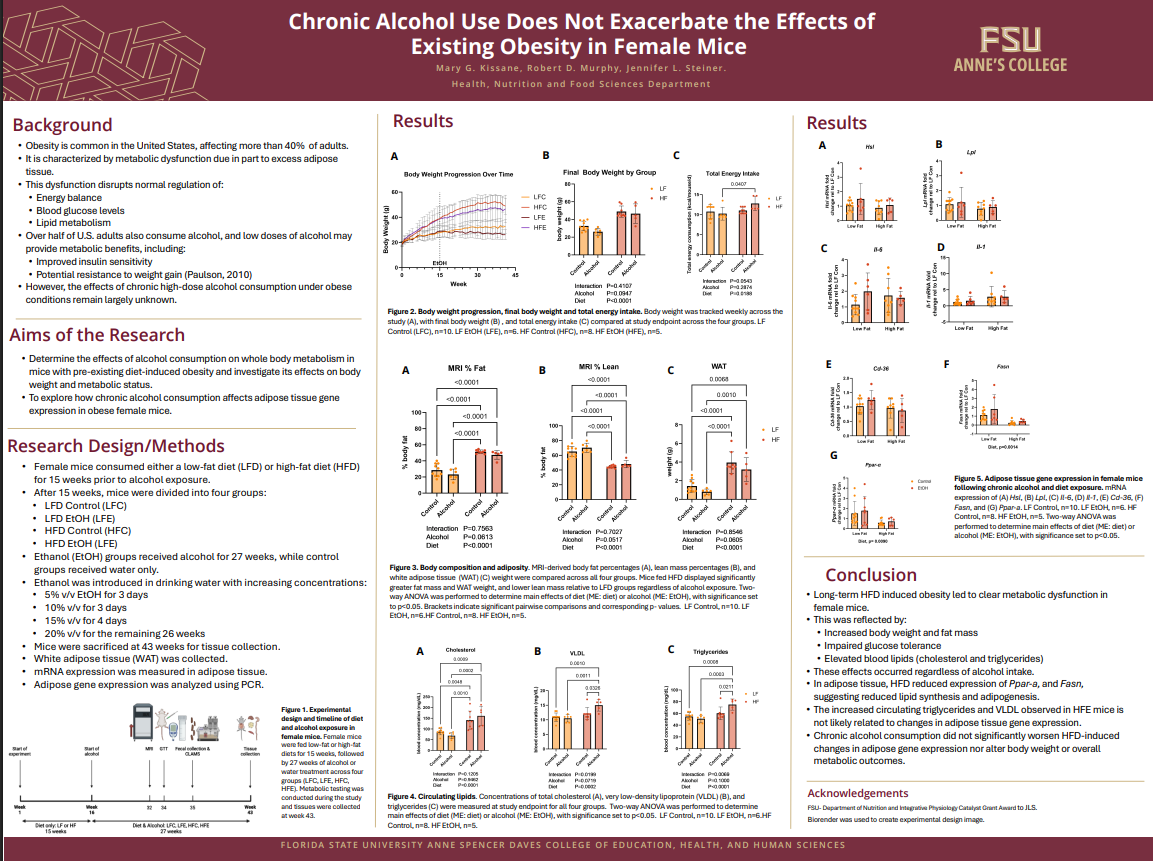
Obesity is a major contributor to metabolic dysfunction in the United States, driven in part by excess adipose tissue. While moderate alcohol consumption has been associated with potential metabolic benefits, the impact of chronic high-dose alcohol intake under obese conditions remains poorly understood. Female mice were maintained on a low-fat (LFD) or high-fat diet (HFD) for 15 weeks, followed by progressive ethanol (EtOH) exposure up to 20% (v/v) for 27 weeks. HFD significantly increased body weight, adiposity, impaired glucose tolerance, and circulating lipids, independent of alcohol intake. Chronic alcohol exposure did not further exacerbate these metabolic impairments. At the molecular level, HFD reduced adipose expression of Ppar-α, Fasn, and Cd36, suggesting altered lipid metabolism, while Lpl, Hsl, and IL-6 remained unchanged. Collectively, these findings indicate that prolonged alcohol consumption does not potentiate HFD-induced metabolic dysfunction or adipose tissue gene expression alterations in female mice.
Keywords: Obesity, Alcohol consumption, Adipose tissue