
Research Symposium
26th annual Undergraduate Research Symposium, April 1, 2026
Grady Anderson Poster Session 3: 1:45 pm - 2:45 pm / Poster #135

BIO
Grady Anderson is a senior double-majoring in Political Science and Interdisciplinary Social Sciences with a Political Science Research-Intensive Bachelor's Certificate. His research focuses on political behavior and survey experiments, with a particular emphasis on affective polarization and identity politics. Grady completed an Honors in the Major thesis examining how policy preferences shape affective polarization and is collaborating on a project investigating how passive exposure to cross-partisan dialogue on social media influences polarization. His work has been presented at the 2026 Southern Political Science Association and supported by the Bess H. Ward Honors Thesis Award and the Institute for Governance and Civics. Grady will begin a Ph.D. in Political Science this upcoming fall.
Policy, Not Partisanship, Drives Affective Polarization
Authors: Grady Anderson, Dr. Andrew BallardStudent Major: Political Science and Interdisciplinary Social Sciences
Mentor: Dr. Andrew Ballard
Mentor's Department: Department of Political Science Mentor's College: College of Social Sciences and Public Policy Co-Presenters:
Abstract
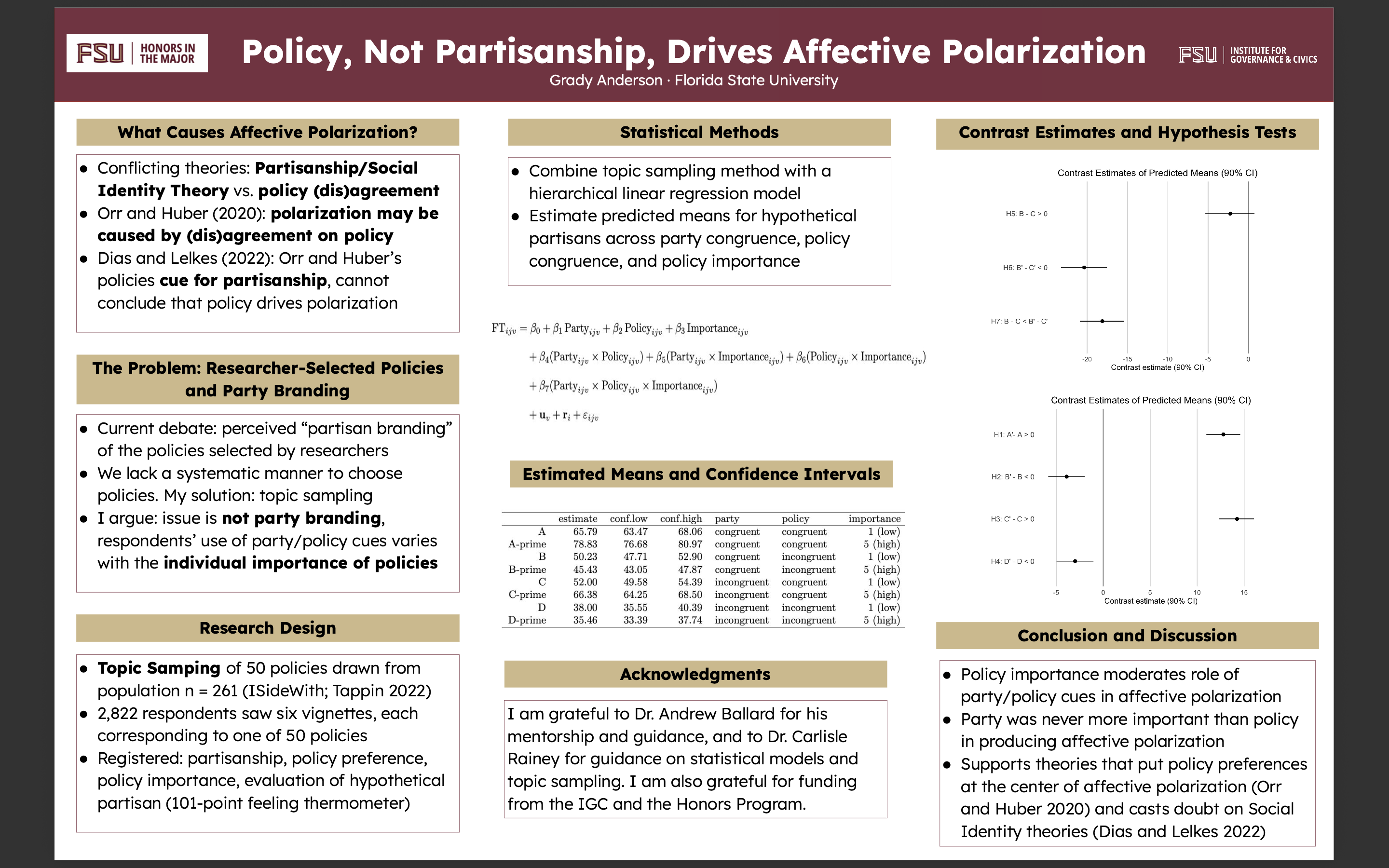
There is debate over the mechanisms underlying affective polarization. Some scholars (e.g., Iyengar et al. 2019; Dias and Lelkes 2022) argue that affective polarization stems primarily from partisanship, with out-partisans viewed as an out-group. Others suggest that (dis)agreement on policy also shapes affect (e.g., Orr and Huber 2020). I argue that this relationship is moderated by the importance of the policy itself. Ciuk and Yost (2016) show that citizens engage in heuristic processing on low-importance issues, and systematic processing on more important issues. When respondents evaluate hypothetical non-elite partisans, they rely on two distinct cues: the partisan identity of the protagonist and the policy preference the protagonist expresses. I fielded a novel survey in which 2,822 people evaluated six hypothetical partisans, yielding nearly 18,000 unique evaluations of hypothetical partisans. I combine the logic of topic sampling (Clifford, Leeper, and Rainey 2024) and a hierarchical linear regression model (Clifford and Rainey 2024) and demonstrate that respondents rely more on policy (dis)agreement as the importance of the policy increases. Additionally, there was no instance in which partisanship had a greater effect than policy preferences on affective polarization, giving credence to the growing body of literature arguing that policy preferences play a substantive role in the formation of affective polarization.
Keywords: affective polarization, survey experiments, topic sampling