
Research Symposium
26th annual Undergraduate Research Symposium, April 1, 2026
Claire Sullivan Poster Session 1: 9:30 am - 10:30 am / Poster #173

BIO
Claire Sullivan is a sophomore majoring in Community Patient Care. An undergraduate research assistant at FSU’s Complementary Health Innovation Lab, Claire is interested in patient-centered approaches to pain management. Claire is curious about the ways complementary therapies can be used to improve patient comfort, well-being, and satisfaction. She is particularly excited by the potentially large-scale, low-cost applications of complementary therapies in clinical practice. An IDEA Grant Awardee and former UROP mentee at the lab, Claire is currently exploring how the lab’s interventions could benefit free clinic patients back home in Orlando.
A Brief Digital Health Intervention Was Associated with Less Pain and Anxiety in the Clinic Waiting Room
Authors: Claire Sullivan, Adam HanleyStudent Major: Community Patient Care
Mentor: Adam Hanley
Mentor's Department: College of Nursing Mentor's College: College of Nursing Co-Presenters:
Abstract
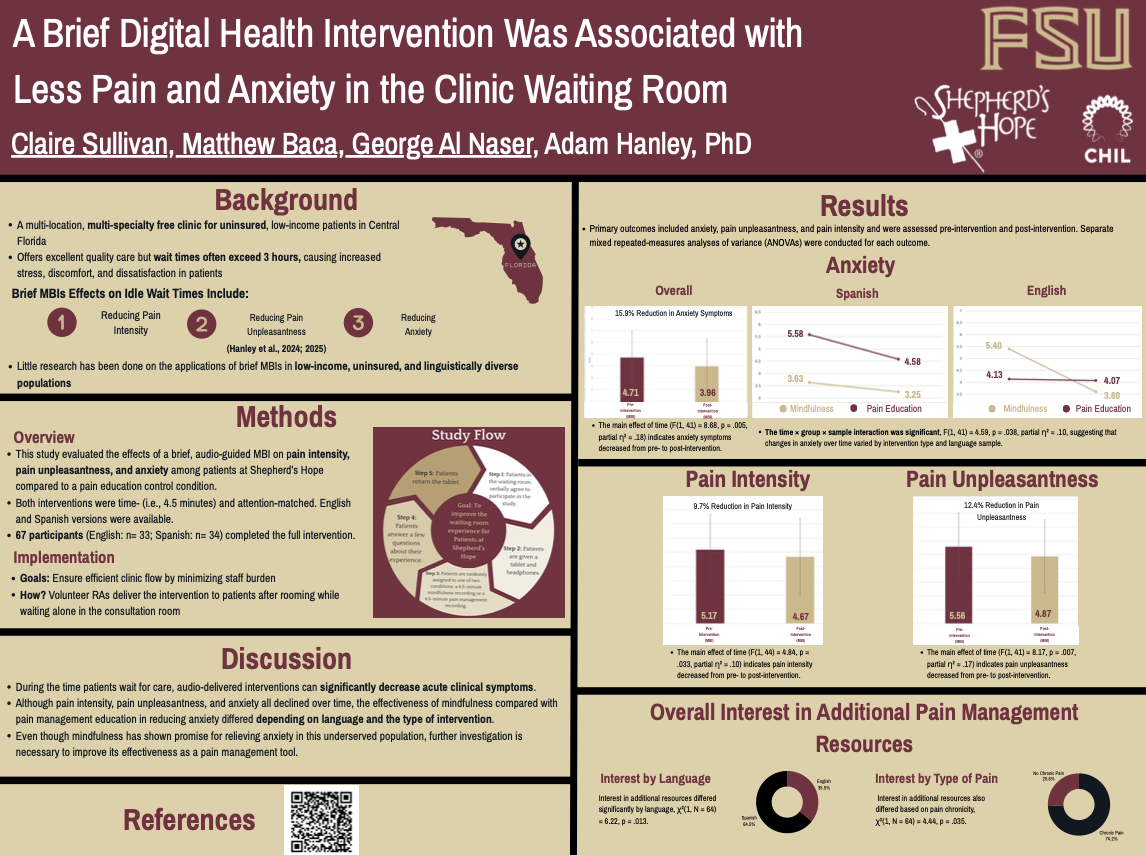
Shepherd’s Hope is a multi-specialty free clinic serving uninsured, low-income patients in Central Florida. While the quality of care is excellent, wait times at the clinic often exceed 3 hours, contributing to stress, discomfort, and dissatisfaction in patients. Brief mindfulness-based interventions are effective in reducing pain intensity, pain unpleasantness, and anxiety during idle wait times, though little research has been done on the efficacy of brief MBIs in low-income, uninsured, and linguistically diverse populations. This study evaluated the effects of a 4.5-minute, audio-guided MBI on acute pain and anxiety symptoms among patients at Shepherd’s Hope (n=67) relative to a pain education control condition. The main effect of time for anxiety, (F(1, 41) = 8.68, p = .005, partial η² = .18), pain unpleasantness (F(1, 41) = 8.17, p = .007, partial η² = .17), and pain intensity (F(1, 44) = 4.84, p = .033, partial η² = .10) indicates that anxiety and pain symptoms decreased from pre- to post-intervention. For anxiety, there was a significant time × group × sample interaction (F(1, 41) = 4.59, p = .038, partial η² = .10), indicating that changes in anxiety over time varied by intervention type and language sample. Interest in additional pain management resources also differed significantly depending on language (χ²(1, N = 64) = 6.22, p = .013) and pain chronicity (χ²(1, N = 64) = 4.44, p = .035). The results suggest that brief, audio-delivered interventions can meaningfully decrease clinical symptoms during the idle time spent waiting for care.
Keywords: Waiting Room, Mindfulness, Integrative Medicine, Anxiety, Acute Pain