
Research Symposium
26th annual Undergraduate Research Symposium, April 1, 2026
Derek Zdanowski Poster Session 1: 9:30 am - 10:30 am / Poster #115

BIO
Derek Zdanowski is a senior from Tampa, Florida pursuing a Bachelor of Science in Exercise Physiology. He has developed a strong interest in preventive health and the impact of lifestyle on disease. After graduation, he will attend medical school in the fall, where he plans to further explore the use of lifestyle-based approaches in clinical care.
Investigating the Effect of microRNA-21 Deletion on Western Diet–Induced SMAD Signaling and Fibrotic Marker Expression in Mice
Authors: Derek Zdanowski, Dr. Justin La FavorStudent Major: B.S. Exercise Physiology
Mentor: Dr. Justin La Favor
Mentor's Department: Department of Health, Nutrition and Food Sciences Mentor's College: Anne College of Education, Health, and Human Sciences Co-Presenters:
Abstract
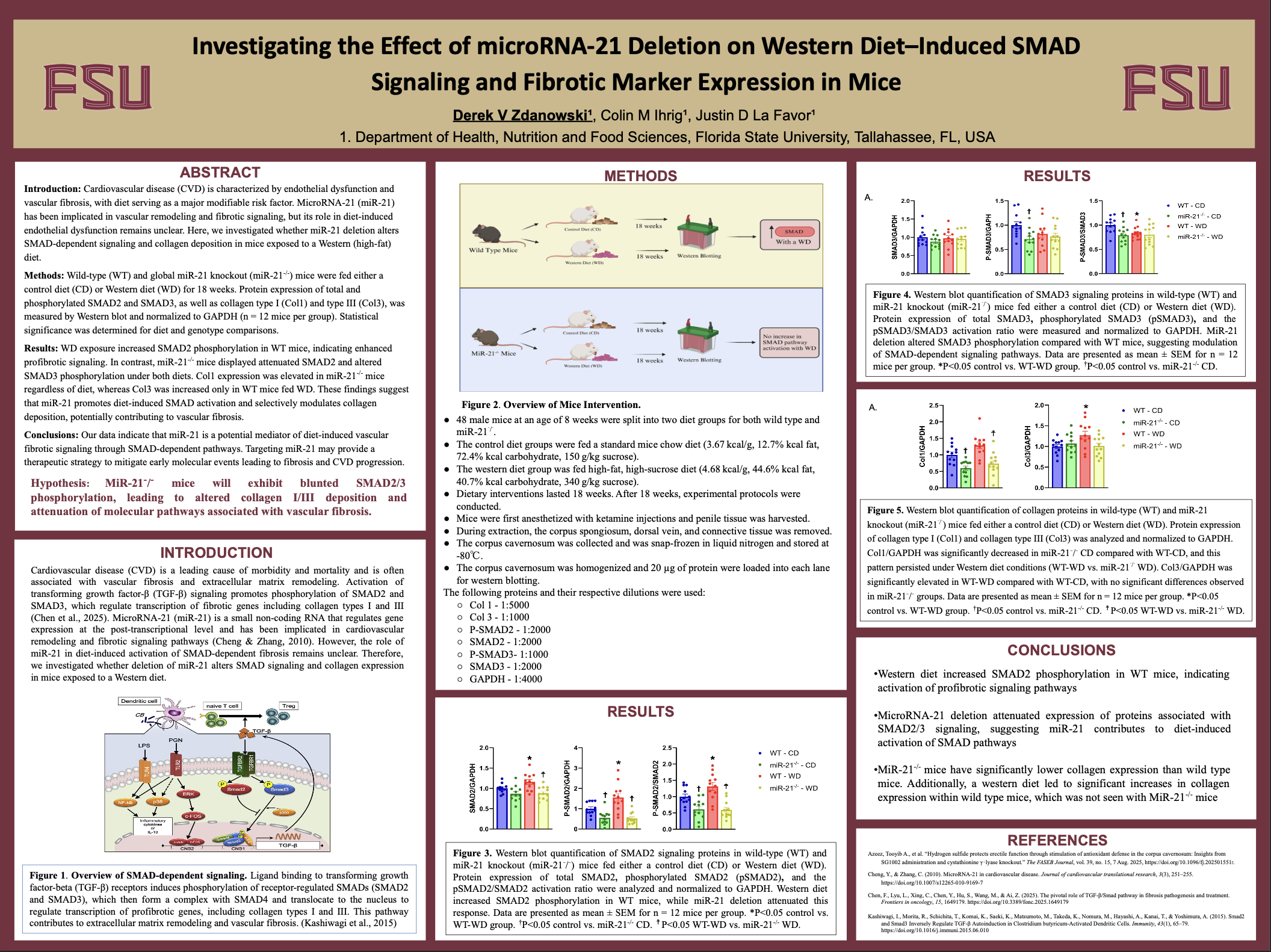
Introduction: Cardiovascular disease (CVD) is characterized by endothelial dysfunction and vascular fibrosis, with diet serving as a major modifiable risk factor. MicroRNA-21 (miR-21) has been implicated in vascular remodeling and fibrotic signaling, but its role in diet-induced endothelial dysfunction remains unclear. Here, we investigated whether miR-21 deletion alters SMAD-dependent signaling and collagen deposition in mice exposed to a Western (high-fat) diet.
Methods: Wild-type (WT) and global miR-21 knockout (miR-21-/-) mice were fed either a control diet (CD) or Western diet (WD) for 18 weeks. Protein expression of total and phosphorylated SMAD2 and SMAD3, as well as collagen type I (Col1) and type III (Col3), was measured by Western blot and normalized to GAPDH (n = 12 mice per group). Statistical significance was determined for diet and genotype comparisons.
Results: WD exposure increased SMAD2 phosphorylation in WT mice, indicating enhanced profibrotic signaling. In contrast, miR-21-/- mice displayed attenuated SMAD2 and altered SMAD3 phosphorylation under both diets. Col1 expression was elevated in miR-21-/- mice regardless of diet, whereas Col3 was increased only in WT mice fed WD. These findings suggest that miR-21 promotes diet-induced SMAD activation and selectively modulates collagen deposition, potentially contributing to vascular fibrosis.
Conclusions: Our data indicate that miR-21 is a potential mediator of diet-induced vascular fibrotic signaling through SMAD-dependent pathways. Targeting miR-21 may provide a therapeutic strategy to mitigate early molecular events leading to fibrosis and CVD progression.
Keywords: MicroRNA-21, SMAD Signaling, Vascular Fibrosis