
Research Symposium
26th annual Undergraduate Research Symposium, April 1, 2026
Analia Castellanos Poster Session 3: 1:45 pm - 2:45 pm / Poster #171
BIO
Analia is a senior pursuing a dual degree in Computer Science B.S. and International Affairs B.S., with minors in Economics and Mathematics. She is a part of Honors in the Major (HITM) for Computer Science under the mentorship of Dr. Daniel Schwartz. Her academic and professional interests lie at the intersection of technology and global policy, particularly in how emerging technologies can be leveraged to address complex international challenges. Analia has gained experience in both technical and policy-focused environments, including internships in Washington, D.C., and professional experience in Bolivia. Her HITM project consists of developing a “Possibilistic Planning System,” a program designed to evaluate decision-making under uncertainty by incorporating both probability and practical feasibility. After graduating in May, she plans on beginning her Master's in Global Technology Policy at Georgetown University and working in D.C. in a related field.
Possibilistic Planning System
Authors: Analia Castellanos, Daniel SchwartzStudent Major: Computer Science and International Affairs
Mentor: Daniel Schwartz
Mentor's Department: Computer Science Mentor's College: Arts and Sciences Co-Presenters:
Abstract
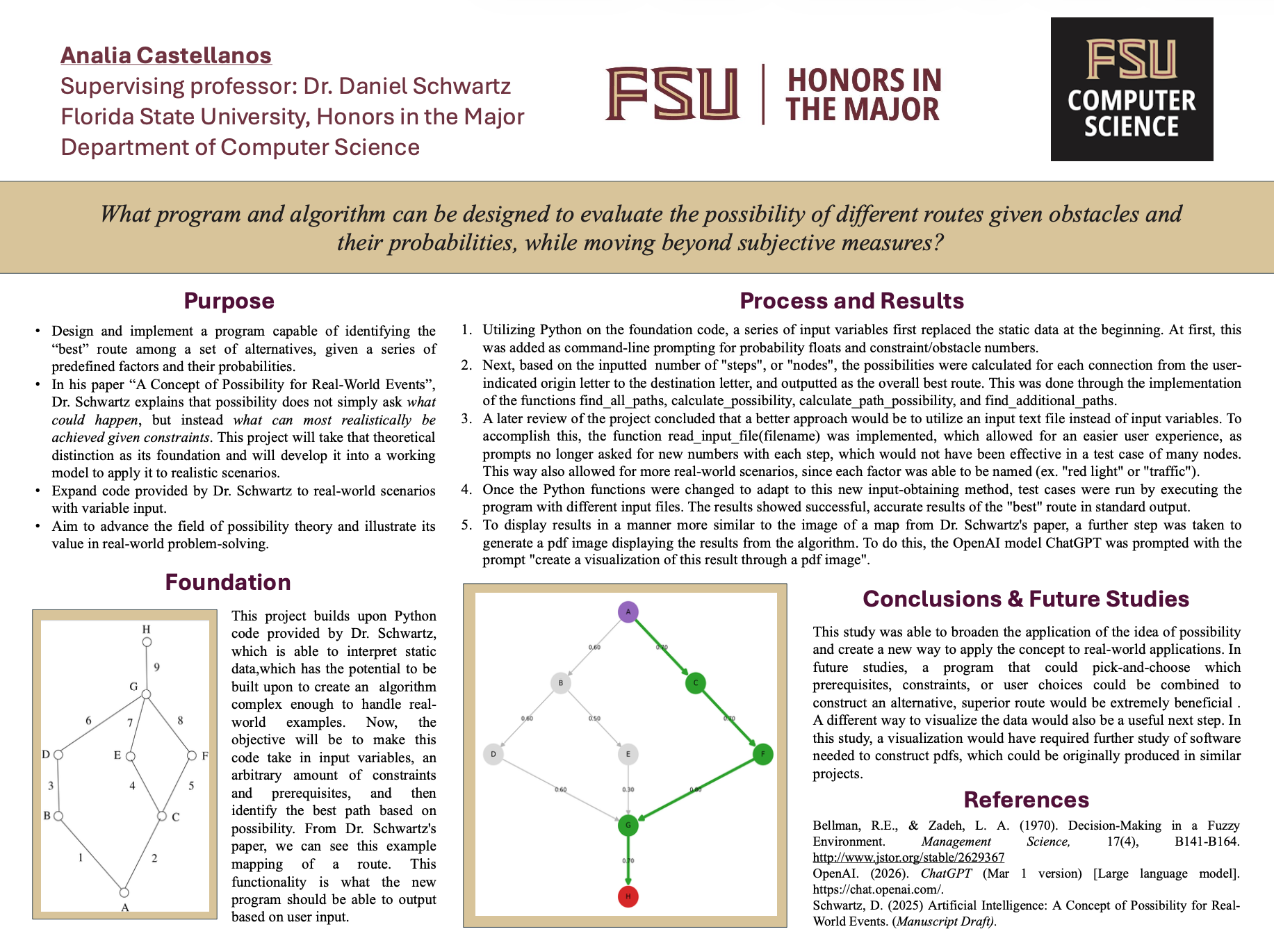
The concept of probability and its utilization in statistics, decision-making, and mathematics have historically generated substantial opportunities for advancement. For an extended period, probability has been incorporated into formulas and models designed to address real-world situations. Now, a new concept that could complement probability and would benefit from further study is that of possibility. Although the two are similar in that they both address uncertainty, possibility focuses on accessibility and practical feasibility, extending beyond probability’s emphasis on likelihood alone. The concept of possibility offers a significant advantage, though translating this abstract idea into a practical application presents a challenge. This leads directly to the core research question: "What program can be designed to evaluate the possibility of different routes given obstacles and their probabilities, while moving beyond subjective measures?" By developing a program to implement possibility in real-world scenarios, this possibilistic planning system will not only deepen the understanding of the concept but also establish a more concrete methodology for its application.
Keywords: Possibility, Programming, Algorithm