
Research Symposium
26th annual Undergraduate Research Symposium, April 1, 2026
Olivia Pielak Poster Session 2: 10:45 am - 11:45 am / Poster #270

BIO
Olivia is junior at Florida State University majoring in Interdisciplinary Medical Sciences on the pre medical track. Olivia is a research assistant in Dr. Thomas Joiner’s Suicide Lab, where they study suicide risk and prevention by examining how social isolation and oxytocin levels interact across individuals with varying levels of vulnerability using phlebotomy and virtual reality. Olivia is deeply interested in understanding why people struggle the way they do and how research can translate into meaningful prevention and compassionate care.
Outside of research, Olivia works as a Medical Assistant for TMHPP and previously competed as a Division I soccer player at Rice University; experiences that have shaped their resilience and commitment to service. Olivia volunteers with the Alzheimer’s Project and has a strong passion for teaching. Olivia currently serves as a Learning Assistant for Organic Chemistry and will be teaching middle school students science this summer at Berkeley Academy. Olivia is working towards a career in medicine, potentially in emergency medicine or psychiatry, where they can continue integrating research, patient care, and education.
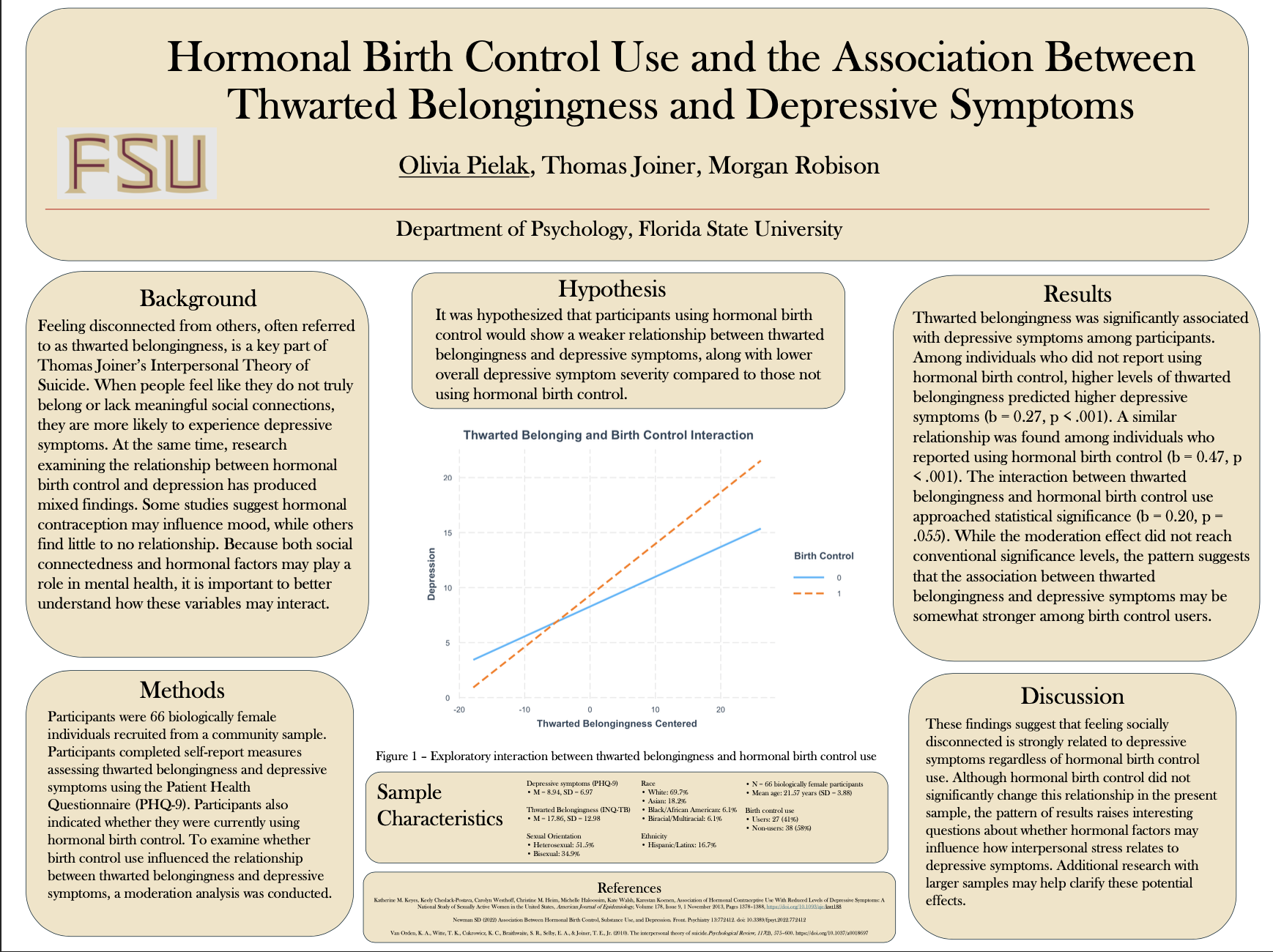
Hormonal Birth Control Use and the Association Between Thwarted Belongingness and Depressive Symptoms
Authors: Olivia Pielak, Morgan RobisonStudent Major: interdisciplinary Medical Sciences : Clinical Professions
Mentor: Morgan Robison
Mentor's Department: Psychology Mentor's College: College of Arts and Sciences Co-Presenters:
Abstract
Thwarted belongingness, a sense of not feeling connected to others and a central part of Thomas Joiner’s Interpersonal Theory of Suicide (Van Orden et al., 2010), has been linked to depressive symptoms. Research on hormonal birth control and depression is mixed, and it’s still unclear whether birth control use changes how strongly thwarted belongingness relates to depressive symptoms. In this project, a community sample of biologically female participants (n = 64) completed measures of thwarted belongingness and depressive symptoms (PHQ-9), and hormonal birth control use (yes/no) was tested as a moderator. I hypothesized that birth control users would show a weaker association between thwarted belongingness and depressive symptoms and lower overall symptom severity. The interaction between thwarted belongingness and birth control use was not significant but approached significance (b = 0.19760, p = .0549). Probing simple slopes showed that thwarted belongingness significantly predicted depressive symptoms among those who did not report birth control use (0) (b = 0.27106, p = .00005) and among those who reported use (1) (b = 0.46866, p < .001). Although the interaction did not reach conventional significance, the pattern suggests social disconnection may be more strongly linked to depressive symptoms among birth control users. Larger, well powered studies are needed to clarify whether hormonal contraceptive use shapes interpersonal risk processes related to depression.
Keywords: Thwarted Belongingness, Depressive Symptoms, Birth Control Use, Interpersonal Theory of Suicide, Social Disconnection