
Research Symposium
26th annual Undergraduate Research Symposium, April 1, 2026
Angelina Files Poster Session 1: 9:30 am - 10:30 am / Poster #93

BIO
Angelina Files is a junior pursuing a Bachelor of Science in Biomedical Engineering with a minor in Chemistry and conducting research in the Nanobio Materials and Robotics Lab. Her research experiences include collaborating with Mayo Clinic clinicians to develop an intraoperative medical device, working with the Computing Research Association to establish and validate machine-learning-assisted image analysis workflows, and investigating cellular responses to simulated microgravity through the FAMU-FSU EUREKA Fellowship program.
She is an Assembly and Integration Lead with the Generational Relief in Prosthetics group, contributes to fundraising efforts for the Society of Women Engineers, and serves on the executive board of the Biomedical Engineering Society to design prosthetic and non-traditional medical device prototypes.
Her main interests lie in nanofabrication, drug delivery, and translational medical device development, and her goal is to pursue a PhD at the intersection of nanotechnology, biotransport, and cellular/tissue design. Ultimately, she plans to build a career in the development of innovative biomedical devices and drug delivery systems and continues to seek research opportunities that allow her to integrate fabrication, biophysical analysis, and translational applications in biomedical engineering.
Microscale Helical Swimmers: Two-Photon Fabrication and Magnetic Actuation
Authors: Angelina Files, Dr. Jamel AliStudent Major: Biomedical Engineering
Mentor: Dr. Jamel Ali
Mentor's Department: CBE - Chemical & Biomedical Engineering, MSE - Materials Science & Engineering Mentor's College: FAMU-FSU College of Engineering Co-Presenters:
Abstract
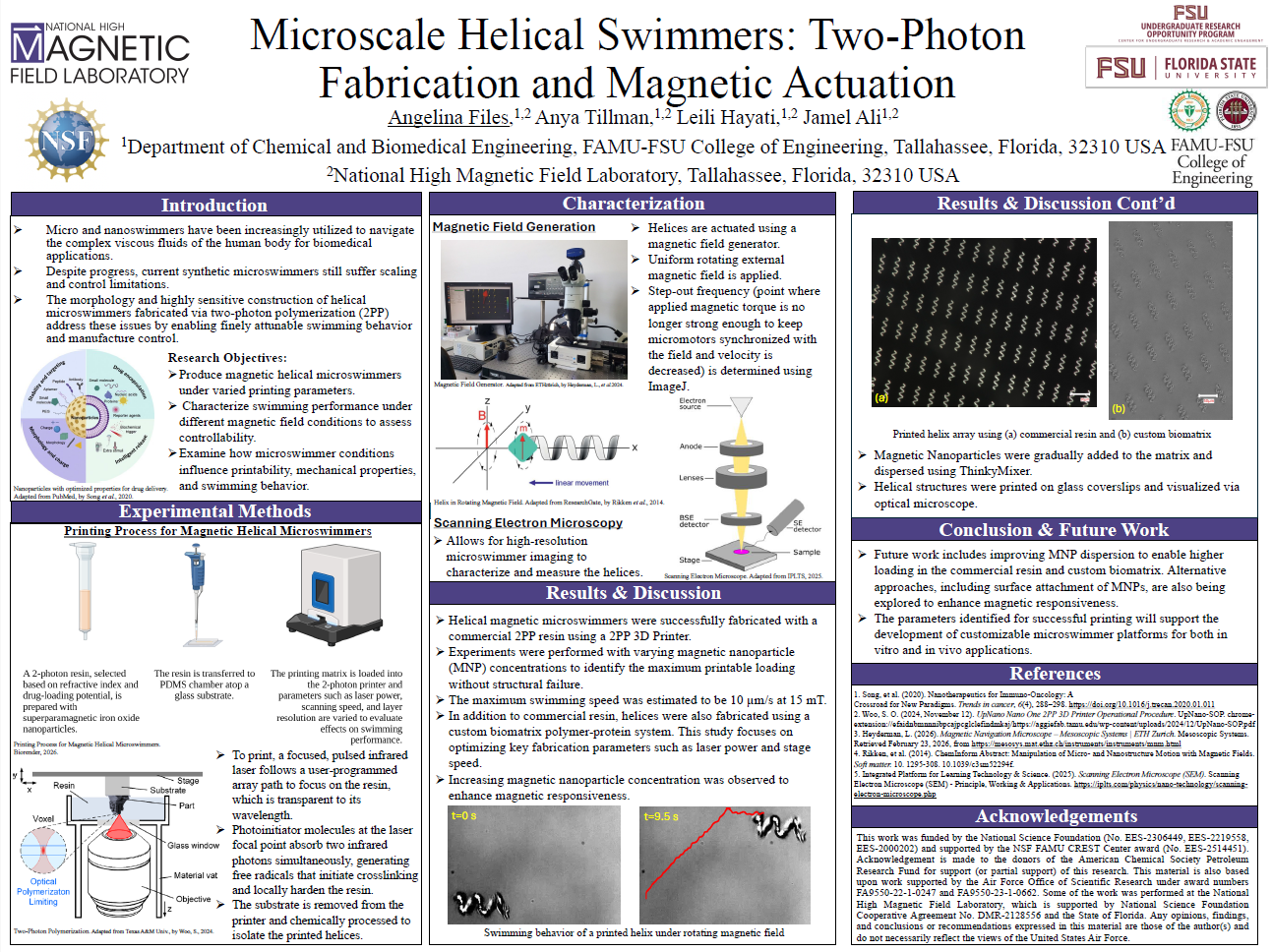
Nano and microscale robotics have shown great potential over the past few decades to programmably traverse the intricate biological environments of the human body. They hold possible applications in targeted drug delivery, biomedical imaging, and minimally invasive surgery. Yet, existing synthetic systems are not optimized for finely attunable scalability or control. In this project, a novel mode of fabrication, two-photon polymerization (2PP), is utilized to produce helical microswimmers using a refractive index-matched 2-photon resin as a printing matrix. The use of this resin specifically explores microswimming drug transport through its strong drug-loading potential and its implementation of superparamagnetic iron oxide nanoparticles to enable precise magnetic steering. The actuation of this control is accomplished using externally applied uniform rotating magnetic fields, whose strengths are varied to examine deviations in available maneuverability. We also identify and optimize other printing parameters, such as laser power, scanning speed, and layer resolution, to characterize their impact on swimming properties. Magnetic nanoparticle concentration is then tested to assess effects on printability, mechanical behavior, and swimming precision. Indicators of controllability, like magnetically induced deviations in step-out frequency, allow us to establish the most compatible design conditions to influence the desired functionality of 2PP printed microswimmers. Ultimately, these determinations will open new capabilities to customize microswimmer properties for targeted drug delivery in vitro and in vivo.
Keywords: Nanorobotics,