
Research Symposium
26th annual Undergraduate Research Symposium, April 1, 2026
Allison Casanova Poster Session 1: 9:30 am - 10:30 am / Poster #77

BIO
Allison is a sophomore at Florida State University majoring in Chemical Engineering. They were born and raised in Miami, Florida. Allison’s current research focuses on superconducting materials, which is critical for many technologies such as MRIs and fusion energy reactors. Outside of research, Allison enjoys being involved in community service and the American Institute of Chemical Engineers (AICHE). After graduation, Allison looks forward to developing their skills and applying their background in chemical engineering to solve practical problems.
Understanding the Correlation Between the Melting Behavior of Bi-2212 Powder and the Wire Performance
Authors: Allison Casanova, Eric HellstromStudent Major: Chemical Engineering
Mentor: Eric Hellstrom
Mentor's Department: Mechanical Engineering Mentor's College: College of Engineering Co-Presenters:
Abstract
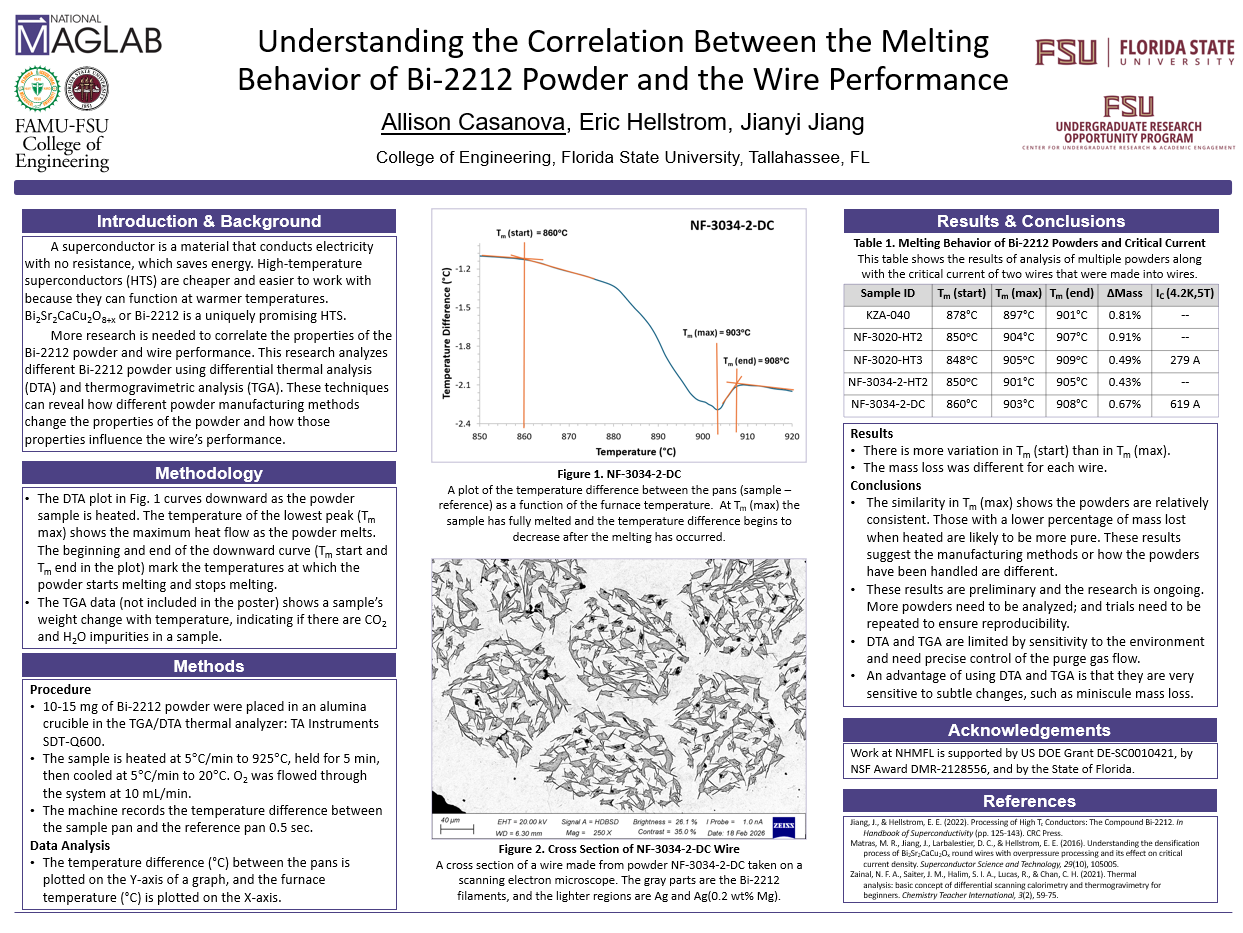
Superconductors are materials that conduct electricity with zero resistance and expel magnetic fields. If superconductors were universally applicable, it would revolutionize modern technology, particularly in MRIs and particle accelerators. However, most superconducting materials require extreme cooling, usually below -269°C. But high-temperature superconductors (HTS) can function at higher temperatures, like below -196°C, which is cheaper and easier to work with. Bismuth-2212 is an HTS material. It is unique because it is the only HTS material that can be manufactured into a round wire shape, and it does not rely on scarce and expensive rare-earth elements like many other HTS materials. Despite being a promising HTS, the performance still needs to improve. Many characteristics of Bi-2212 wires are being investigated to find ways to improve it. However, more research is needed on the Bi-2212 powder itself. This research seeks to investigate the properties of the powder itself, before being manufactured into a wire. In this study, the powder is investigated through differential thermal analysis (DTA) and thermogravimetric analysis (TGA). This provides thermal characterization data, such as the melting point and crystallization temperature. This can explain how the powders’ properties can be used to optimize the manufacturing process and provide insight on the powder quality. Some powder varieties have been tested and shown different characteristics, indicating some are more pure than others. However, many powder variants still need to be explored. Through revealing thermal characteristics and powder composition, the Bi-2212 wire manufacturing process can be improved, progressing towards applications in high-field magnets.
Keywords: Superconductivity, Magnets, Materials Science, Heat Treatment