
Research Symposium
26th annual Undergraduate Research Symposium, April 1, 2026
Kenneth Withers Poster Session 3: 1:45 pm - 2:45 pm / Poster #177

BIO
Kenneth Withers is a freshman at Florida State University pursuing a Bachelor of Science in Computational Biology. His academic interests focus on the intersection of biology, technology, and data analysis, particularly how computational tools can be used to analyze complex biological systems and improve human health. At Florida State, he is involved in undergraduate research through UROP, where he studies how horror video games influence cognitive engagement using the Elaboration Likelihood Model (ELM). Through this research experience, Kenneth has developed skills in research design, coding frameworks, and data analysis. After completing his undergraduate degree, he plans to attend medical school and pursue a career as a physician, where he hopes to integrate computational approaches with clinical practice to improve diagnostics, treatment strategies, and patient care.
An Elaboration Likelihood Model Analysis of Persuasion in Interactive Horror Games: A Literature Review
Authors: Kenneth Withers, Gabrielle LamuraStudent Major: Computational Biology
Mentor: Gabrielle Lamura
Mentor's Department: School of Communication Mentor's College: College of Communication and Information Co-Presenters: Jada Davidson
Abstract
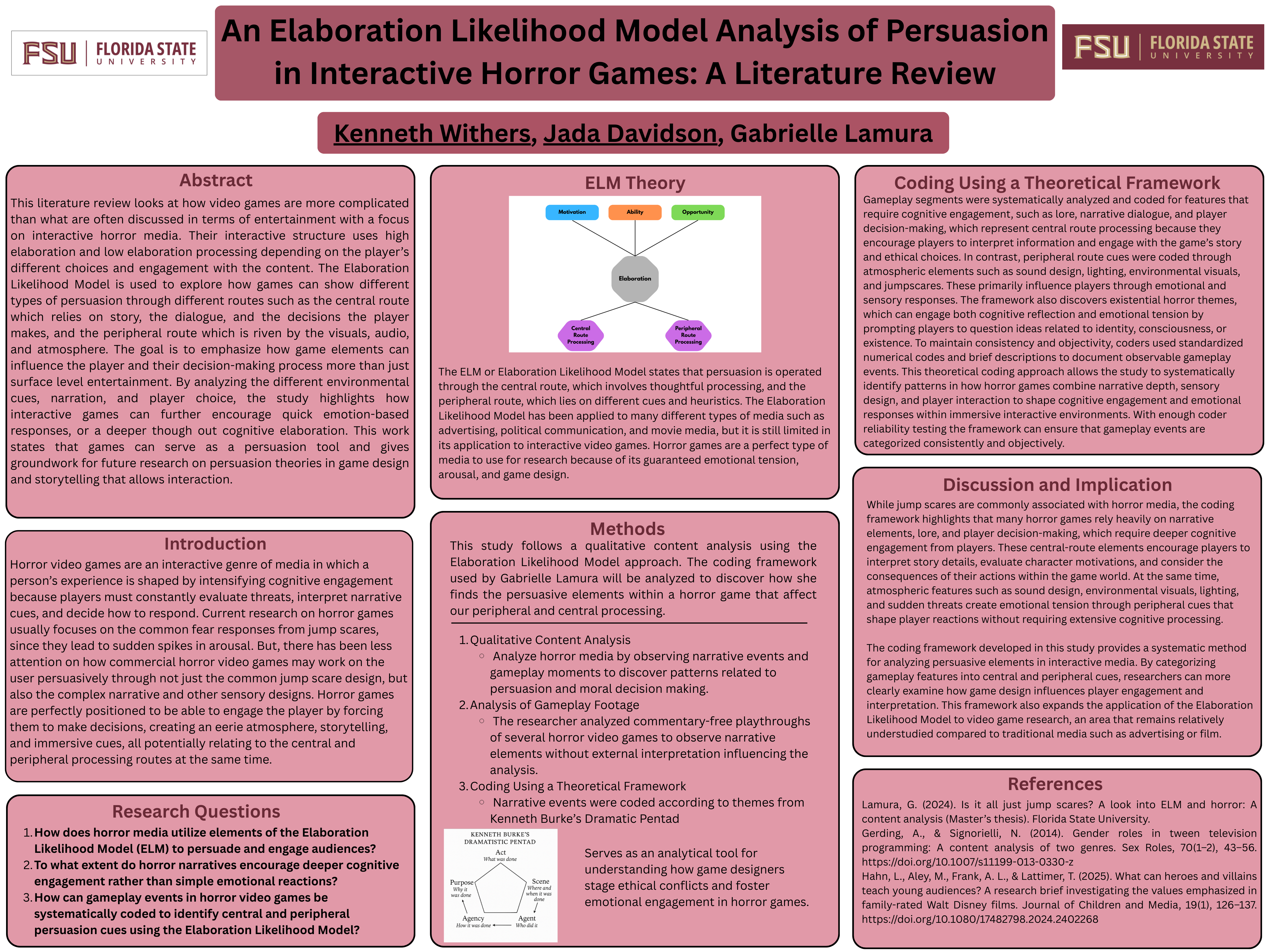
This literature review looks at how video games are more complicated than what are often discussed in terms of entertainment with a focus on interactive horror media. Their interactive structure uses high elaboration and low elaboration processing depending on the player’s different choices and engagement with the content. The Elaboration Likelihood Model is used to explore how games can show different types of persuasion through different routes such as the central route which relies on story, the dialogue, and the decisions the player makes, and the peripheral route which is riven by the visuals, audio, and atmosphere. The goal is to emphasize how game elements can influence the player and their decision-making process more than just surface level entertainment. By analyzing the different environmental cues, narration, and player choice, the study highlights how interactive games can further encourage quick emotion-based responses, or a deeper though out cognitive elaboration. This work states that games can serve as a persuasion tool and gives groundwork for future research on persuasion theories in game design and storytelling that allows interaction.
Keywords: Communication, Media Psychology, Video Games