
Research Symposium
26th annual Undergraduate Research Symposium, April 1, 2026
Evangelia Gianino Poster Session 1: 9:30 am - 10:30 am / Poster #104

BIO
My name is Eva Gianino and I am an undergraduate student at Florida State University with research interests in psychology and medical research. My current research explores how reflecting on Family of Origin experiences can promote Earned Secure Attachment by helping individuals develop greater insight and integration of early caregiving relationships. I am originally from St. Louis, Missouri and plan to pursue a career in medicine while continuing to engage in research that bridges psychological and medical perspectives on mental health. Through both research and clinical work, I hope to better understand how early life experiences shape emotional well-being and to contribute to improved approaches to mental health care.
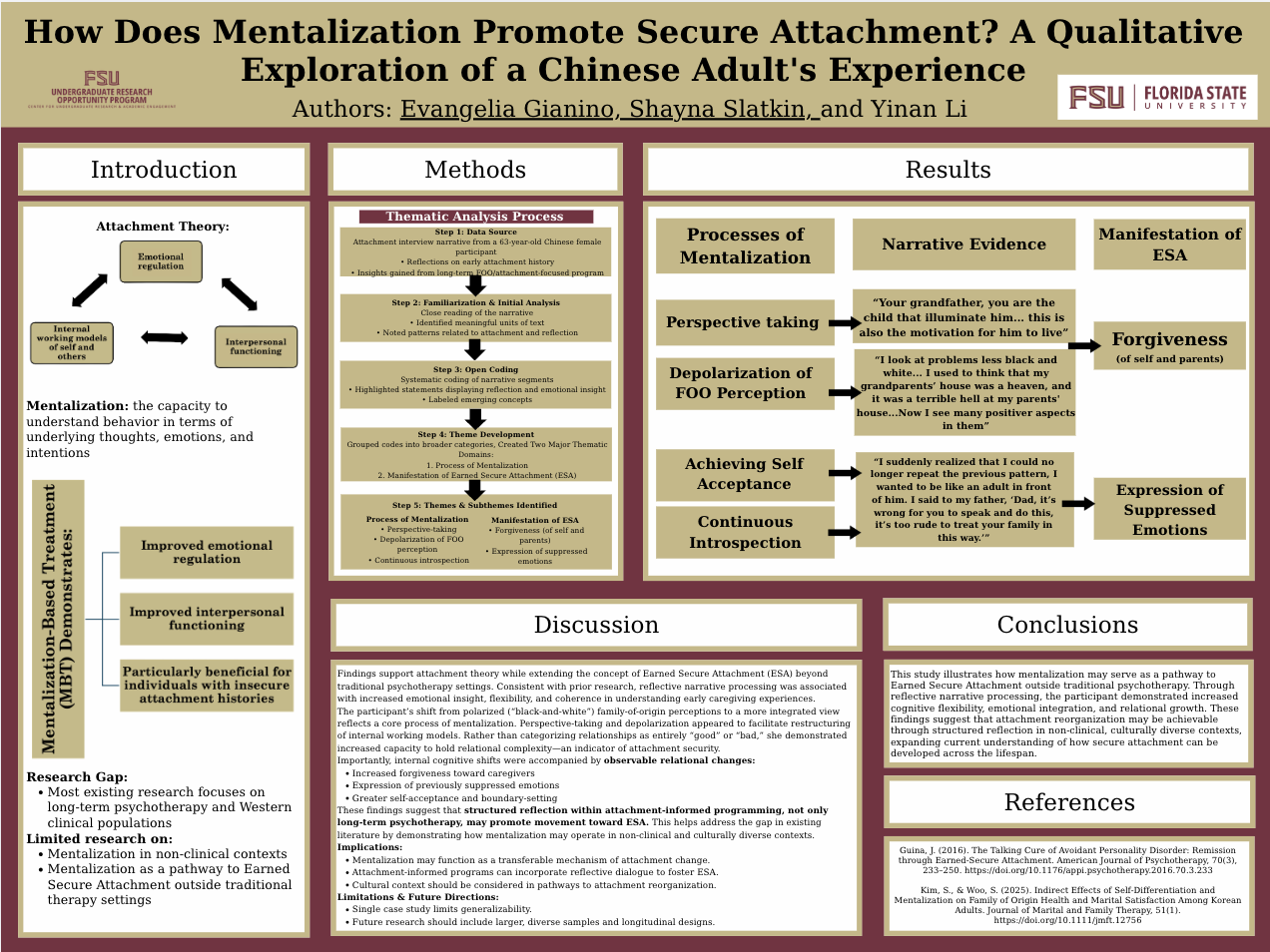
How Does Mentalization Promote Secure Attachment? A Qualitative Exploration of a Chinese Adult's Experience
Authors: Evangelia Gianino, Yinan LiStudent Major: Biological Sciences
Mentor: Yinan Li
Mentor's Department: Human Development and Family Science Mentor's College: Anne Spencer Daves College of Education, Health, and Human Sciences Co-Presenters: Shayna Slatkin
Abstract
Earned Secure Attachment (ESA) challenges the idea that early insecure attachment patterns remain fixed throughout life by suggesting that attachment can change over time. One pathway that may support this change is mentalization, or the ability to understand behavior in terms of thoughts, feelings, and intentions. Much of the existing research on this process has focused on adults in long term psychotherapy and has been conducted primarily within Western, Educated, Industrialized, Rich, and Democratic (WEIRD) populations. Less is known about how mentalization may operate in non clinical settings or in non WEIRD cultural contexts. This qualitative study explores how mentalization may function as a pathway toward ESA outside traditional therapy by analyzing the attachment narrative of a 63 year old Chinese woman who participated in a long term Family of Origin and attachment focused program. Using thematic analysis, we identified themes related to the development of mentalization, including perspective taking, reinterpretation of parental behavior, and emotional insight, as well as manifestations of ESA such as self compassion, self acceptance, and positive changes in family relationships. These findings contribute to a broader understanding of how mentalization may support attachment change and highlight the potential for culturally responsive attachment informed programs outside traditional clinical settings.
Keywords: Mentalization, Family of Origin, Earned Secure Attachment