
Research Symposium
26th annual Undergraduate Research Symposium, April 1, 2026
Riya Robin Poster Session 4: 3:00 pm - 4:00 pm / Poster #264

BIO
Riya Robin is a sophomore at Florida State University double majoring in Psychology and Public Health with a minor in Chemistry. As an Undergraduate Research Opportunity Program (UROP) scholar in Dr. Aaron Wilber’s lab, Riya studies spatial navigation and neural representations of space through electrophysiological methods in rodent models. Riya is passionate about psychology and neuroscience, and I am especially interested in learning how research can lead to stronger preventative health measures. Riya's goal is to contribute to discoveries that improve early intervention, reduce the long-term cost of care, and improve overall quality of life. Riya plans to attend medical school and pursue a career integrating research with clinical practice.
Dynamic Interfacing Between Allocentric and Egocentric Frames via the Parietal-Hippocampal Network During Spatial Navigation
Authors: Riya Robin, Aaron WilberStudent Major: Psychology, Public Health
Mentor: Aaron Wilber
Mentor's Department: Neuroscience Mentor's College: College of Arts and Sciences Co-Presenters: Bianca Maresma
Abstract
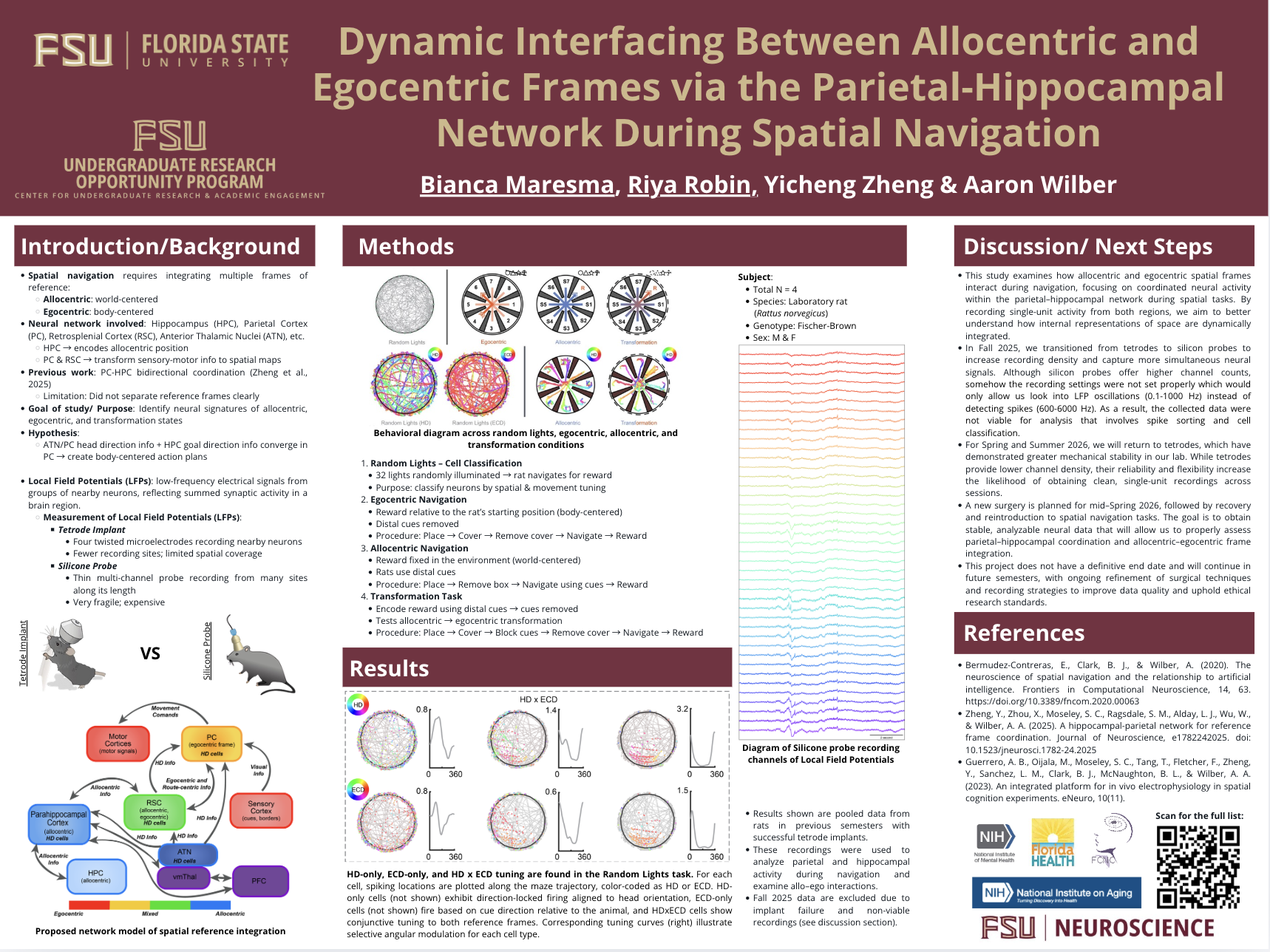
Spatial navigation deficits are an early and prominent feature of Alzheimer’s disease, yet the neural mechanisms underlying these impairments remain unclear. This project investigates how different spatial reference frames, including allocentric, egocentric, and transformations between them, are represented in the brain and how disruptions to these processes may contribute to spatial disorientation in neurodegenerative disease. Rats were trained on four navigation tasks designed to separate different aspects of spatial processing to investigate these systems.
Rats moved toward randomly lit signals in the Random Lights task to evaluate brain tuning across a range of movement parameters. In the egocentric task, when distal cues were unavailable, rats learnt a fixed movement path to a reward zone defined relative to their starting position. In the Allocentric challenge, rats used distal environmental cues to identify an unmarked reward zone. In the Transformation task, rats had to translate allocentric information into egocentric movement plans after initially encoding the reward location using distal cues that were subsequently hidden. To investigate how spatial
Information was encoded across various situations, and behavioral and neural data were collected while the task was being performed.
Preliminary findings suggest that distinct neural activity patterns are associated with each reference frame, with coordinated hippocampal and parietal activity playing a critical role in successful navigation. These results highlight the importance of reference frame coordination in spatial cognition and provide insight into mechanisms that may be disrupted in Alzheimer’s disease.
Keywords: Spatial Navigation; Local Field Potentials