
Research Symposium
26th annual Undergraduate Research Symposium, April 1, 2026
Abhyuthan Srivastava Poster Session 2: 10:45 am - 11:45 am / Poster #300

BIO
Abhyuthan Srivastava is a second-year Vires Scholar with a deep interest in science, especially in understanding the concepts and fundamental principles that shape how we understand the world. He enjoys not only learning science, but also teaching it and helping others appreciate it more clearly. For him, research is meaningful because it allows scientific knowledge to move beyond theory and become something that can genuinely benefit people.
He is pursuing medicine because he wants science to have real human impact. Abhyuthan believes scientific knowledge is most valuable when it is applied in ways that improve lives, relieve suffering, and serve those who are often overlooked. His interest in research is not simply academic or professional, but rather it comes from a sincere desire to use science in practical, compassionate, and lasting ways.
In the future, he hopes to attend medical school and become a physician, serving others through both scientific skill and compassionate care, especially in underserved communities. Whether through research, teaching, or patient care, he wants his work to reflect a commitment to intellectual curiosity, meaningful service, and a life of simple living and high thinking.
In Vitro Motility Assay, Analyzing the Full-Length α-Actinin-2 Wild-Type and Phosphomimic Variants
Authors: Abhyuthan Srivastava, Dr. Helene TigroStudent Major: Clinical Professions (IMS)
Mentor: Dr. Helene Tigro
Mentor's Department: Department of Health, Nutrition, and Food Sciences Mentor's College: Anne's College Co-Presenters: Isabelle Rodriguez
Abstract
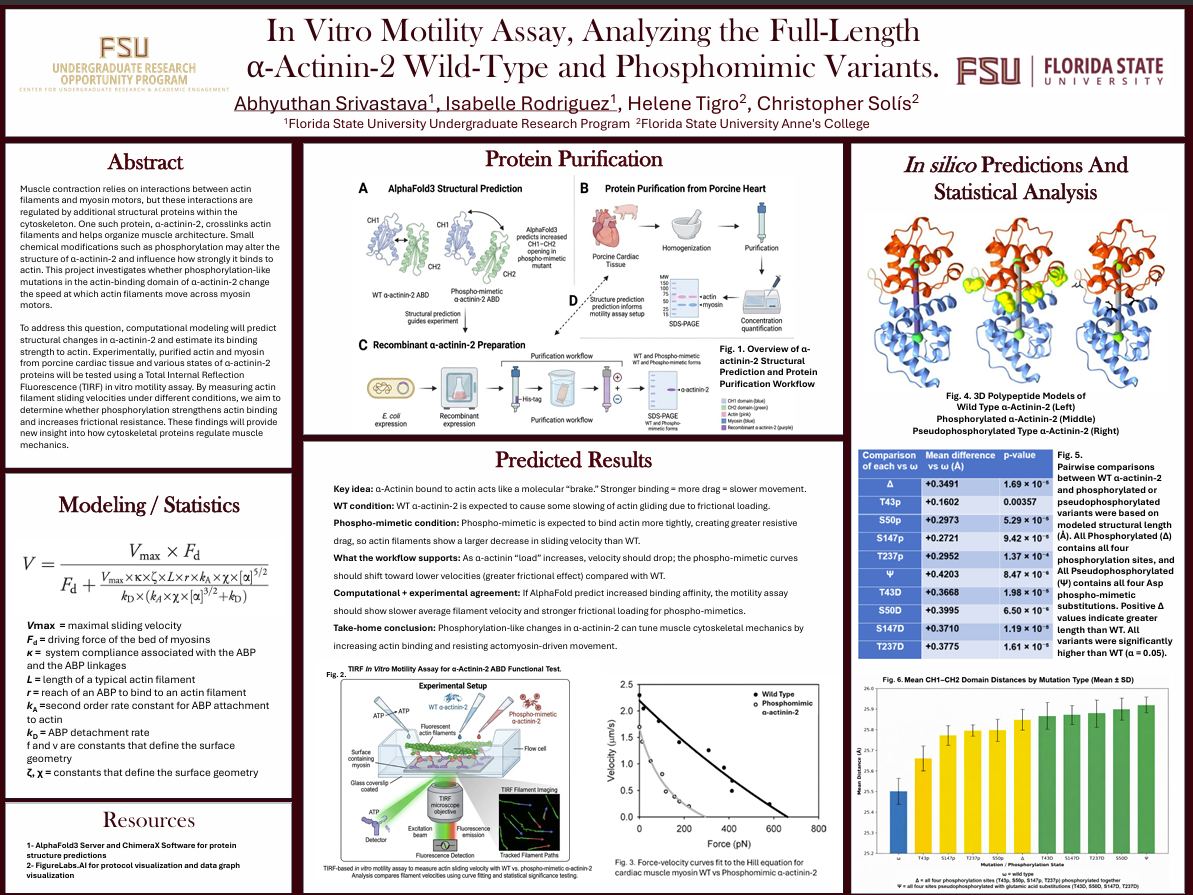
Muscle contraction relies on interactions between actin filaments and myosin motors, but these interactions are regulated by additional structural proteins within the cytoskeleton. One such protein, α-actinin-2, cross-links actin filaments and helps organize muscle architecture. Small chemical modifications such as phosphorylation may alter the structure of α-actinin-2 and influence how strongly it binds to actin. This project investigates whether phosphorylation-like mutations in the actin-binding domain of α-actinin-2 change the speed at which actin filaments move across myosin motors.
To address this question, computational modeling will predict structural changes in α-actinin-2 and estimate its binding strength to actin. Experimentally, purified actin and myosin from porcine cardiac tissue and recombinant α-actinin-2 proteins will be tested using a Total Internal Reflection Fluorescence (TIRF) in vitro motility assay. By measuring actin filament sliding velocities under different conditions, we aim to determine whether phosphorylation strengthens actin binding and increases frictional resistance. These findings shall provide new insight into how cytoskeletal proteins regulate muscle mechanics.
Keywords: alpha-actinin, sliding filament theory, In Vitro Motility Assay