
Research Symposium
26th annual Undergraduate Research Symposium, April 1, 2026
Oluwadara Soremi Poster Session 1: 9:30 am - 10:30 am / Poster #263

BIO
Oluwadara Soremi is in her second year studying at Florida State University within the honors program. She is a student athlete majoring in computational biology with an interest in understanding how she can use the intersection between computation and biology to help others. After she finishes undergrad, she plans to continue her education in medical school. Oluwadara's current research lab employs human blood, assays, coagulants, and anticoagulants to build a standard of care for those suffering from Cannabinoid-Associated Coagulopathy. She enjoys volunteering at local schools when she can and spending summers working at a vein clinic in her hometown.
Clotting Under the Influence: a Coagulation Assay for Cannabinoid Research
Authors: Oluwadara Soremi, Dr. Rojan SaghianStudent Major: Computational Biology
Mentor: Dr. Rojan Saghian
Mentor's Department: Chemical and Biomedical Engineering Mentor's College: FAMU-FSU College of Engineering Co-Presenters: Domenica Jaramillo
Abstract
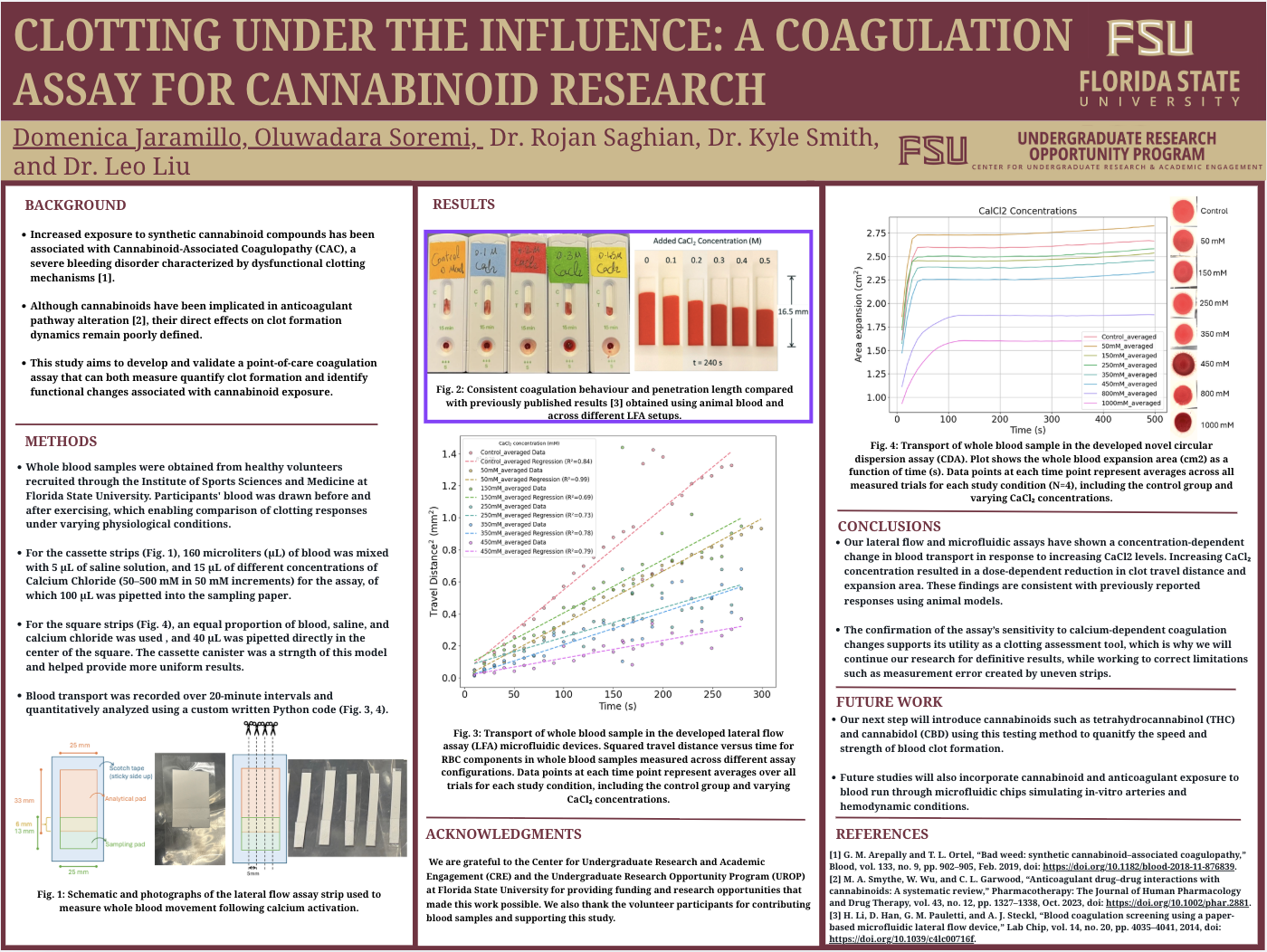
Cannabinoid-Associated Coagulopathy (CAC), a bleeding disorder linked to the use of synthetic cannabis, has seen a recent surge in cases that indicates an urgent need for rapid and personalized tools to assess coagulation risks. This research investigates the clinical implications of CAC and help develop a point-of-care coagulation assay that can measure a patient’s clotting capacity and detect changes in anticoagulant therapy efficacy brought about by cannabinoid exposure.
Investigating the interaction between cannabinoids (THC [tetrahydrocannabinol] and CBD [cannabidiol]) and anticoagulants (heparin and citrate) will provide insight into concerns surrounding the safety and use of Medical Marijuana in patients undergoing anticoagulant therapies. A lateral-flow-based microfluidic technique, designed to simulate blood flow conditions that favor clotting, was used. Different concentrations of calcium chloride and protamine are the established methods utilized in controlling coagulation. Samples of the blood were transferred onto the lateral flow assays to be analyzed by the length taken up on each strip and the time it took to do so.
Consistent coagulation behavior throughout the trial’s results showed the length that the blood traveled decreased as the coagulant concentration increased over a set time span. Considering the viscosity of blood changes with its coagulation ability, the distance blood travels is directly related to clotting rate. Also seen was clear CBD-dependent anticoagulation after heparinized and citrated blood were neutralized with their respective counterparts.
This study’s findings aim to make treatment of CAC patients and monitoring of anticoagulant therapies safer and more efficient in a growing population of cannabis users.
Keywords: Coagulation, Cannabinoid, and disorder