
Research Symposium
26th annual Undergraduate Research Symposium, April 1, 2026
Brooklyn Zappin Poster Session 4: 3:00 pm - 4:00 pm / Poster #220

BIO
Brooklyn Zappin is a freshman at Florida State University pursuing a Bachelor of Science in Statistics. She is passionate about mathematics and data analysis and enjoys applying statistical thinking to real-world problems. At Florida State, Brooklyn conducts research with Dr. Aleksandra Zimmerman, where she is developing early experience in academic research and strengthening her analytical skills. She is also an active member of the sorority Alpha Gamma Delta, where she serves as Director of Senior Experiences and helps organize events that foster community within the chapter. Outside the classroom, Brooklyn plays club tennis and has a strong interest in the sport. She has also worked for nearly two years as a social media manager for Cracked Racquets, where she creates digital content focused on college tennis and developments in the professional tennis world. Looking ahead, Brooklyn hopes to combine her passion for statistics with her interest in tennis by pursuing a career that connects data, sports, and analytics.
Do Nonprofits Benefit from Being Audited by Issuer Audit Partners?
Authors: Brooklyn Zappin, Dr. Aleksandra ZimmermanStudent Major: Statistics
Mentor: Dr. Aleksandra Zimmerman
Mentor's Department: Accounting Mentor's College: College of Business Co-Presenters: Megi Gvinjilia, Peyton Zawodzinski
Abstract
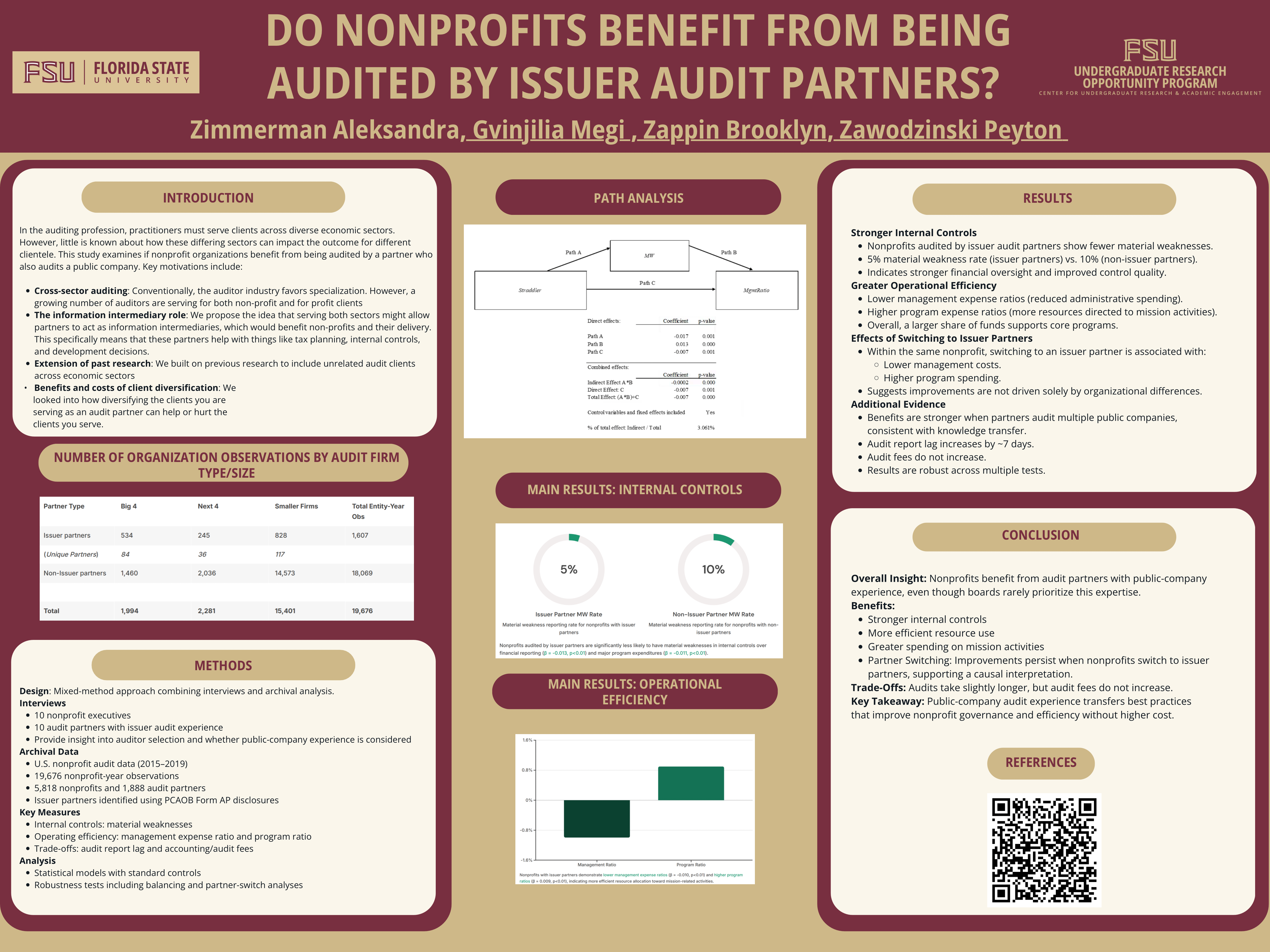
This study examines whether nonprofits benefit from being audited by partners who also audit public companies (“issuer partners”). Based on interviews with 20 nonprofit directors and issuer audit partners, we explore how cross-sector audit experience may shape nonprofit outcomes. Although nonprofit directors consistently prioritize nonprofit-specific expertise and rarely consider public company experience in their selection process, issuer partners describe sharing best practices in internal controls and operations learned from their public company clients.
We then test these ideas using 19,676 nonprofit-year observations from 2015–2019. Compared to nonprofits audited by non-issuer partners, those audited by issuer partners are significantly less likely to report material weaknesses in financial reporting and major programs. They also exhibit greater operational efficiency, reflected in lower management expense ratios and higher program ratios. These effects are more pronounced when partners have deeper public company experience, consistent with cross-sector knowledge transfer.
While nonprofits with issuer partners experience slightly longer audit report lags, we find no evidence of higher audit fees. Our results remain robust to entropy balancing, partner-switch analyses with organization fixed effects, and additional sensitivity tests. Overall, the findings suggest that issuer partners act as information intermediaries across sectors, generating measurable benefits for nonprofits while introducing modest reporting delays.
Keywords: Accounting, auditing, nonprofit