
Research Symposium
26th annual Undergraduate Research Symposium, April 1, 2026
Ryan Coudurier Poster Session 4: 3:00 pm - 4:00 pm / Poster #234

BIO
Ryan Coudurier is a second year chemistry undergraduate at Florida State University. He has strong interest in nanoplastic separation and polymer chemistry. He spent the summer of 2025 at Louisiana State University researching the polymerization of a polypeptoid capable of surpassing the leading polymer in drug delivery applications with Anuja Thapa and Dr. Donghui Zhang. As of 2026, he works with Dr. Jizhe Cai and Taylor Joseph to optimize carbon nanofiber filters capable of removing nanoplastic particles from drinking water. He finds deep satisfaction in work combatting environmental destruction and preserving human health.
Electrospinning, Characterization, and Testing of Carbon Nanofibrous Filters for Nanoplastic Filtration
Authors: Ryan Coudurier, Jizhe CaiStudent Major: Chemistry
Mentor: Jizhe Cai
Mentor's Department: Mechanical Engineering Mentor's College: FSU-FAMU College of Engineering Co-Presenters:
Abstract
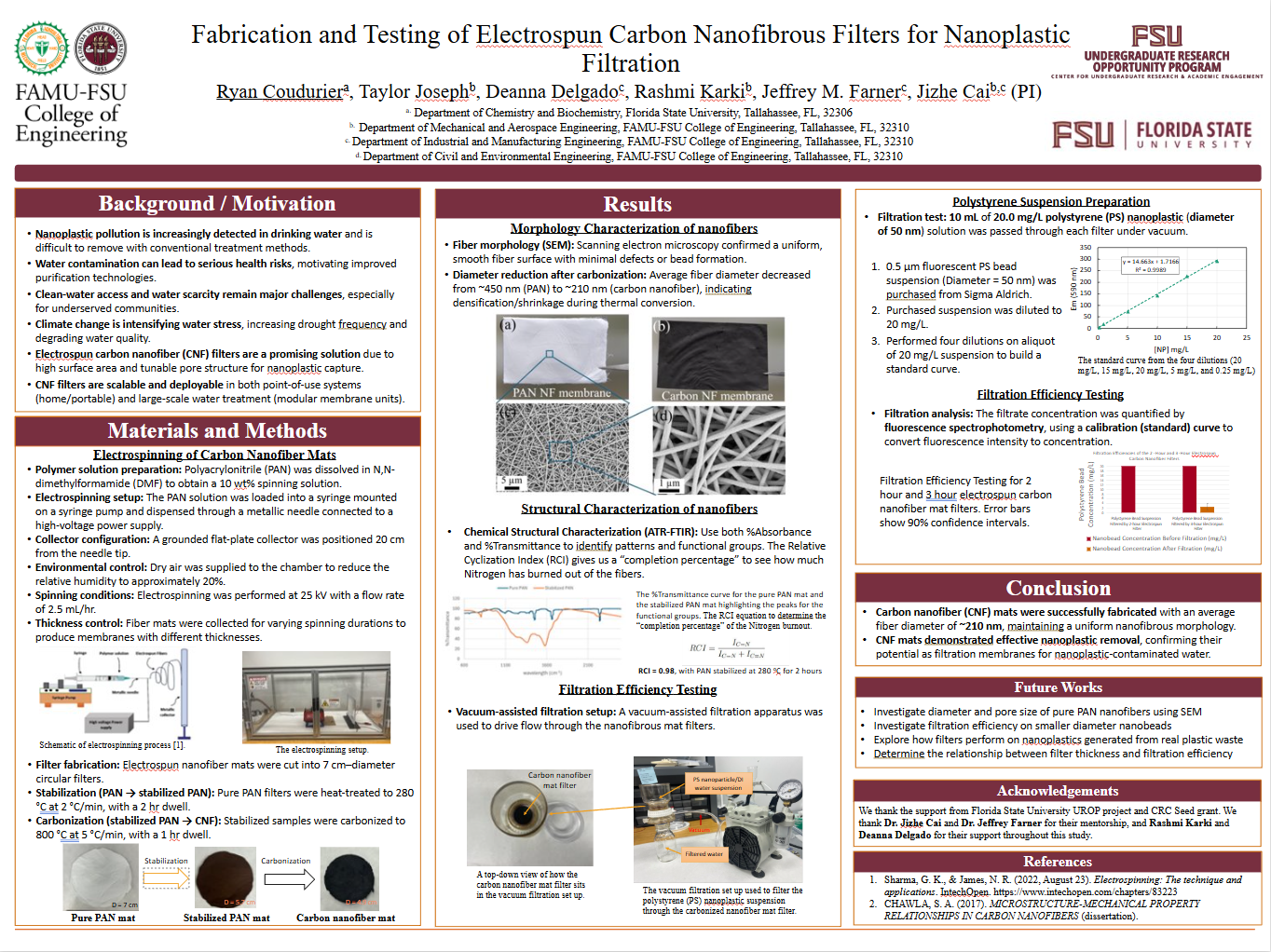
Nanoplastic pollution has become ubiquitous in drinking water globally. A consequence of this is the buildup of nanoplastic particles in almost every human organ, causing potential health complications. Nanoplastic filtration systems could significantly reduce human exposure. Cellulose fiber filters have shown success in filtering nanoplastic particles, but they fail to completely filter water with higher nanoplastic concentrations in one passage. Carbon nanofibers produced by electrospinning poly(acrylonitrile) (PAN) onto a flat plate collector are promising candidates for nanoplastic filters because their random distribution may aid in trapping small particles. We electrospun different diameters of PAN nanofibers and carbonized them to obtain carbon nanofibers, whose filtration efficiencies were measured using 0.5 μm fluorescent polystyrene suspensions of various concentrations. We then introduced poly(methyl methacrylate) into PAN nanofibers of the same diameters to obtain porous carbon nanofibers, whose filtration efficiencies were tested in the same manner. We also used different collectors to alter the alignment of both types of fibers and tested their filtration efficiencies. Carbon nanofiber filters produced in this study achieved filtration efficiencies greater than or equal to 98.75% when filtering a 20 mg/L suspension of 0.5 μm-diameter polystyrene particles. Experimentation is ongoing, but filters made from porous carbon nanofibers are expected to have greater flux than those made from non-porous carbon nanofibers. High-efficiency carbon nanofiber filters could be distributed as individual filtration devices, or they could be employed at water treatment facilities.
Keywords: Filtration, Nanofiber, Nanoplastic, Spectrophotometry, Flux