
Research Symposium
26th annual Undergraduate Research Symposium, April 1, 2026
Alexander Bayramov Poster Session 3: 1:45 pm - 2:45 pm / Poster #69

BIO
Alexander Bayramov is a first-year honors student in the Undergraduate Research Opportunity Program (UROP) pursuing a Bachelor of Science in Exercise Physiology. Through UROP, he has gained research experience working on a finance-based project, which provided him with a strong foundation in data analysis, critical thinking, and the research process. As an honors student, Alexander is eager to apply the research skills he developed to future work in the medical field. His academic interests center on human physiology, health, and the role of exercise in improving overall well-being. After completing his undergraduate degree, he plans to attend medical school, where he hopes to combine clinical practice with research to contribute to advancements in patient care and health outcomes.
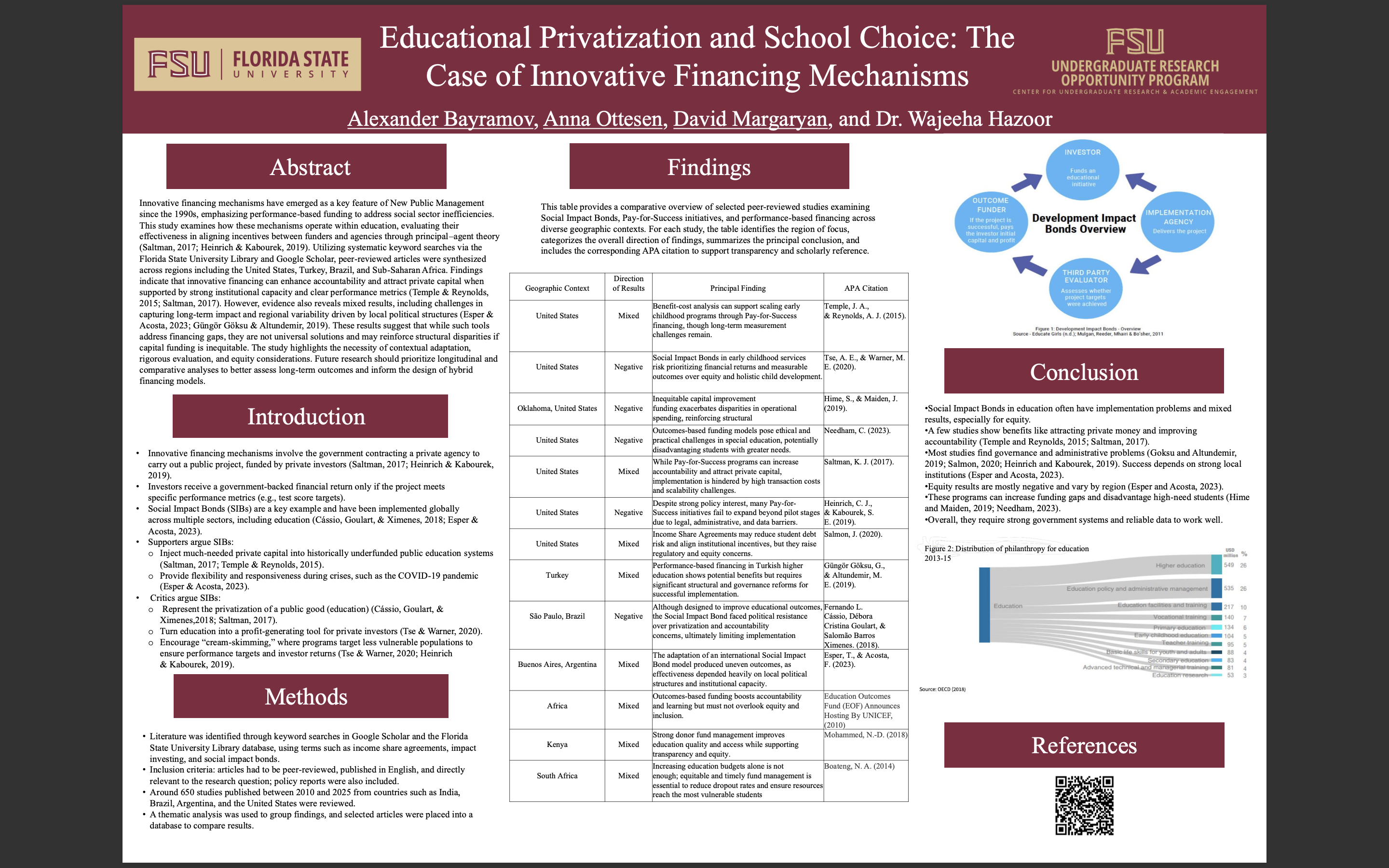
Educational Privatization and School Choice: The Case of Innovative Financing Mechanisms
Authors: Alexander Bayramov, Dr. Wajeeha Hazoor BajwaStudent Major: Exercise physiology
Mentor: Dr. Wajeeha Hazoor Bajwa
Mentor's Department: Office of Research Mentor's College: Anne's College Co-Presenters: Anna Ottesen, David Margaryan
Abstract
Innovative financing mechanisms have emerged as a key feature of New Public Management since the 1990s, emphasizing performance-based funding to address social sector inefficiencies. This study examines how these mechanisms operate within education, evaluating their
effectiveness in aligning incentives between funders and agencies through principal–agent theory (Saltman, 2017; Heinrich & Kabourek, 2019). Utilizing systematic keyword searches via the Florida State University Library and Google Scholar, peer-reviewed articles were synthesized
across regions including the United States, Turkey, Brazil, and Sub-Saharan Africa. Findings indicate that innovative financing can enhance accountability and attract private capital when supported by strong institutional capacity and clear performance metrics (Temple & Reynolds,
2015; Saltman, 2017). However, evidence also reveals mixed results, including challenges in capturing long-term impact and regional variability driven by local political structures (Esper & Acosta, 2023; Güngör Göksu & Altundemir, 2019). These results suggest that while such tools
address financing gaps, they are not universal solutions and may reinforce structural disparities if capital funding is inequitable. The study highlights the necessity of contextual adaptation, rigorous evaluation, and equity considerations. Future research should prioritize longitudinal and comparative analyses to better assess long-term outcomes and inform the design of hybrid financing models.
Keywords: Financial Mechanisms, Social Impact Bonds