
Research Symposium
26th annual Undergraduate Research Symposium, April 1, 2026
Cameron Goodwin Poster Session 4: 3:00 pm - 4:00 pm / Poster #14

BIO
Cameron Goodwin is a sophomore in the Honors Program studying Nutritional Science and obtaining a minor in Spanish Language. She is on a Pre Medical track in hopes to become a doctor and currently works as a Optometrists Technician at a local private practice. Cameron's desire to be involved in research stemmed from her interest in Immunology, specifically because her chronic autoimmune disease and past experience as an Allergy Technician.
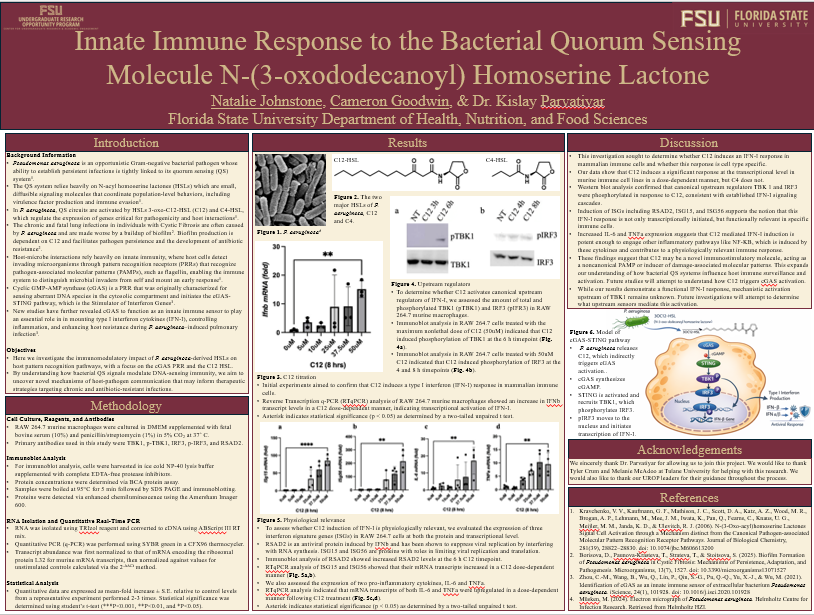
Innate Immune Response to the Bacterial Quorum Sensing Molecule N-(3-oxododecanoyl) Homoserine Lactone
Authors: Cameron Goodwin, Dr. Kislay ParvatiyarStudent Major: Food and Nutritional Science
Mentor: Dr. Kislay Parvatiyar
Mentor's Department: Health, Nutrition, and Food Sciences Mentor's College: Anne Spencer Daves College of Education, Health, and Human Sciences Co-Presenters: Natalie Johnstone
Abstract
The chronic lung disease, Cystic Fibrosis, is caused by a buildup of biofilm produced by Pseudomonas aeruginosa. The production of this biofilm is dependent on the specific bacterial quorum sensing (QS) molecule, N-(3-oxo-dodecanoyl) homoserine lactone, known as C12. QS molecules are increasingly recognized as critical mediators of host-pathogen interactions, yet their direct impact on innate immune signaling remains incompletely defined. Utilizing the murine macrophage cell line RAW 264.7, we tested how C12 and N-butyryl homoserine lactone (C4) produce type 1 Interferon (IFN-I) cytokine expression. Our data demonstrated that C12, not C4, robustly induces IFN-I cytokine expression, revealing a previously underappreciated facet of QS-mediated host signaling. Immunoblot analyses further revealed that C12 promotes the phosphorylation and activation of interferon regulatory factor 3 (IRF3), a transcription factor necessary to IFN-I gene induction. To define the upstream signaling pathways responsible for IRF3 activation, we employed selective small-molecule inhibitors targeting pattern recognition receptor (PRR) pathways in order to detect their effects on the entire interferon production process. Through more data analysis it was found that C12 can lead to the production of IFN-I, which mediates the JAK-STAT pathway allowing for interferon signature gene production. This may indicate that C12 is a pathogen associated molecular pattern detected by PRRs, which allows us to study how interferons can support or hinder P. aeruginosa. These results provide new insight into the molecular mechanisms by which P. aeruginosa manipulates macrophage responses and highlight QS molecules as potential modulators of STING-driven inflammatory pathways.
Keywords: Immunology, Human Health, Microbiology, Disease, Immune system