
Research Symposium
26th annual Undergraduate Research Symposium, April 1, 2026
Yoonho Hwang Poster Session 2: 10:45 am - 11:45 am / Poster #252

BIO
My name is Yoonho Hwang, and I am a first-year student majoring in Exercise Physiology. I am currently on the pre–physical therapy track with the goal of becoming a physical therapist in the future. While providing physical treatment is an important part of healthcare, I believe that understanding patients’ emotions and building trust are equally essential for effective therapy and recovery.This perspective led me to choose a project related to student–teacher interactions through the Teaching Through Interaction Framework. By studying how supportive communication and meaningful interactions influence learning environments, I hope to better understand the role how empathy and communication play in helping others to succeed.
Large Class Pedagogy: Teaching Through Interactions Framework
Authors: Yoonho Hwang, Adrienne Barnes-StoryStudent Major: Exercise Physiology
Mentor: Adrienne Barnes-Story
Mentor's Department: Learning Systems Institute (LSI) Mentor's College: College of Education, Health, and Human Sciences Co-Presenters: Sydney Feldman
Abstract
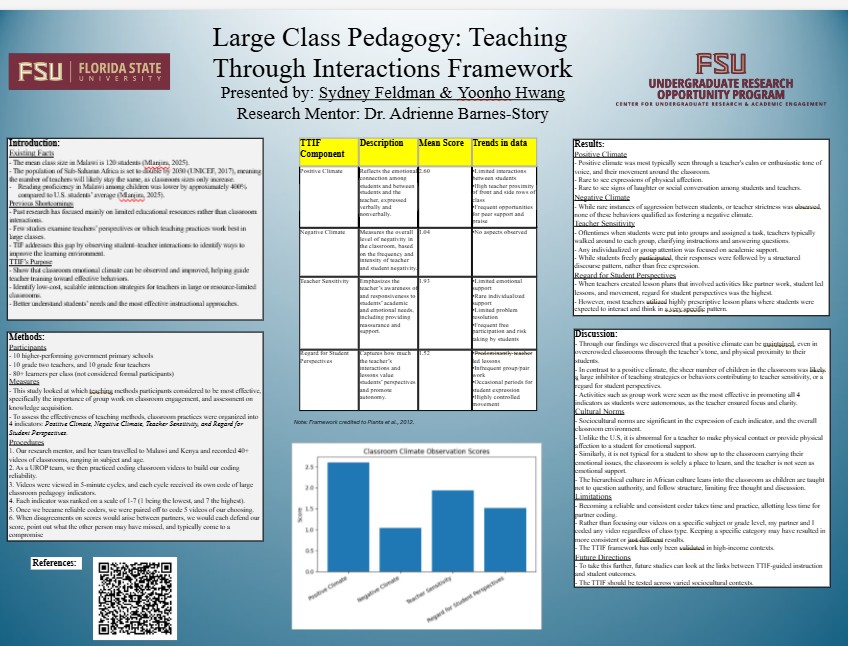
Large class sizes are a significant challenge in Sub-Saharan Africa, where rapid population growth and limited government support strain educational systems. In countries such as Malawi, and Kenya average classrooms are considerably larger than typical American schools, creating barriers to effective instruction and equitable access to quality education. Despite the prevalence of large classrooms, limited research has examined effective large-class pedagogical practices within this regional context.
This study aims to explore educators’ perspectives on large-class pedagogy, identifying perceived barriers and instructional strategies used to promote student engagement and learning. Participants were sampled from 6 Teacher Training Colleges, and 9 Teacher Training Schools, representing urban, peri-urban and rural schools. Patterns of instruction were observed in these classroom settings, and organized into four categories: Positive Climate, Negative Climate, Teacher Sensitivity and Regard for Student Perspectives.
Future research should assess the effectiveness of instructional strategies on student outcomes and inform policy support for large-class environments.
Keywords: Teaching, Large Class, Interactions