
Research Symposium
26th annual Undergraduate Research Symposium, April 1, 2026
Zaya Owen Poster Session 4: 3:00 pm - 4:00 pm / Poster #166

BIO
Zaya is earning her Bachelor of Science in neuroscience, with psychology and chemistry minors, in May of 2026! She is completing her Honors in the Major thesis in the Hermiller Lab and is presenting her research from the project here. She hopes to eventually earn a PhD in neuroscience and become a full-time researcher.
Understanding memory through the lenses of imagination and familiarity
Authors: Zaya Owen, Molly HermillerStudent Major: Behavioral Neuroscience
Mentor: Molly Hermiller
Mentor's Department: Psychology Department Mentor's College: College of Arts and Sciences Co-Presenters:
Abstract
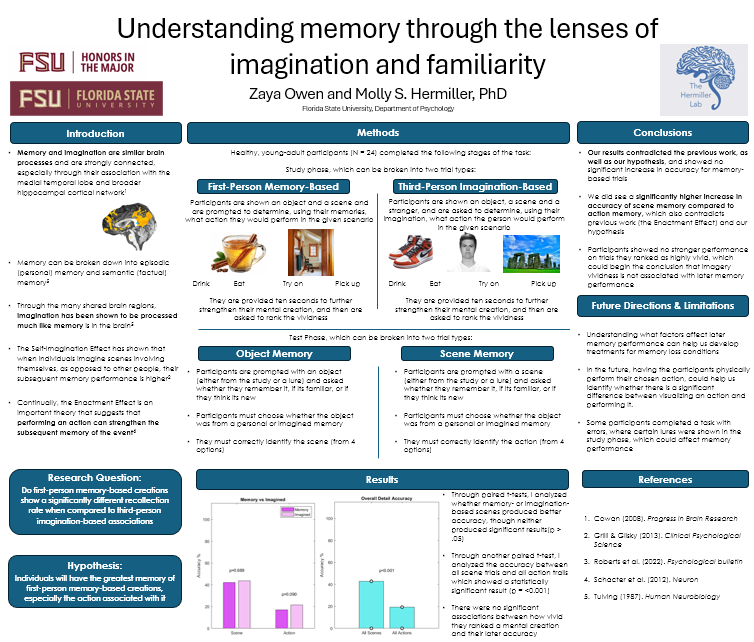
Imagination and memory are strongly tied together, and ultimately are controlled by similar brain regions. This includes the medial temporal lobe and broader hippocampal cortical network. Understanding how memory and imagination are similar, but also how they differ, can lead to a deeper understanding of how we engage with and form memories for encountered stimuli. To test these variables, healthy young adult participants were prompted to create first-person memory-based mental creations and third-person imagination-based associations, incorporating cued background scenes, a verb associated with an item, and a person (either self or another character). Following the creation of these associations, participants were tested on their recollection of both the scenes and the verb. We hypothesized that accuracy for self-based associations would be significantly stronger than those imagined for other characters, and that the verbs would be recalled significantly greater than scenes. Our preliminary results suggest that participants had nearly identical accuracy when recalling the correct scene, both from self-based creations and character-based associations, while the same was found in the identification of the accurate action. Participants also were more likely to accurately identify the scene rather than the verb they incorporated. Moving forward, we could further test this hypothesis by having participants physically do the action, as opposed to visualizing it in their mind. Understanding how imagination- versus memory-based scenario formations are later retrieved may provide insight to memory impairments and inform future efforts to diagnose and/or treat disorders.
Keywords: Memory, Neuroscience, TMS, Behavior