
Research Symposium
26th annual Undergraduate Research Symposium, April 1, 2026
Fallon Kimbler Poster Session 3: 1:45 pm - 2:45 pm / Poster #239

BIO
Fallon Kimbler is a first year junior majoring in Clinical Professions and pursuing a Bachelor of Science degree. She plans to attend medical school after completing her undergraduate studies. Fallon is passionate about patient advocacy and has participated in several cancer support and women's health initiatives, being an active member of AMWA , facilitating blood drives on campus, and working very closely with Moffitt Cancer Center in Tampa, Florida by volunteering, participating in their ASPIRE program, and shadowing doctors at the hospital. She is also apart of the QUEST program on campus.
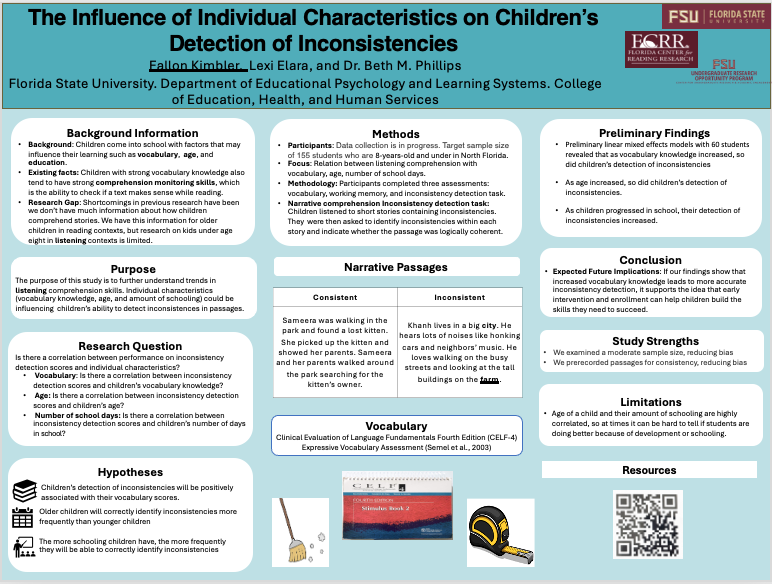
The Influence of Individual Characteristics on Children’s Detection of Inconsistencies
Authors: Fallon Kimbler, Lexi ElaraStudent Major: Interdisciplinary Medical Sciences, Clinical Professions
Mentor: Lexi Elara
Mentor's Department: Educational Psychology & Learning Systems Mentor's College: College of Education, Health, and Human Sciences Co-Presenters:
Abstract
Students come into school with different factors that may affect their learning, such as their vocabulary, age, and the amount of schooling they’ve had. Research suggests that kids with strong vocabulary also tend to have strong comprehension monitoring skills, which is important because it promotes active reading. As kids get older, these skills usually improve, but there isn't much information on how students under age eight actually comprehend stories in listening contexts. Most research focuses on older students who are already reading, which doesn’t apply to young children’s developing minds. We believe individual characteristics- vocabulary, age, and amount of schooling - are key to understanding a student's ability to detect inconsistencies in a story. This information is important because it could help fill the gaps between how teachers teach and what students actually understand. In our study, we focused on elementary students who are eight years old or younger. We used three assessments: an extensive vocabulary test with pictures, a working memory test where they put objects in size order, and a series of stories. Half of the stories had inconsistencies, and we asked the students to tell us if the story made sense. Our hypotheses were that higher vocabulary, older age, and more days in school would all correlate with better inconsistency detection scores. By quantifying these results, we can see trends, like whether a certain vocabulary level leads to more inconsistencies in stories being identified incorrectly.
Keywords: Education, Children, Vocabulary