
Research Symposium
26th annual Undergraduate Research Symposium, April 1, 2026
Mehna Lakshminarayanan Poster Session 1: 9:30 am - 10:30 am / Poster #31
BIO
Mehna is a Cyber Criminology major at FSU from St. Augustine, Florida. Mehna pland to minor in Data Analytics. Mehna works as an undergraduate researcher under Md. Rakibul Ahasan, with a focus on building and evaluating machine learning models for cyberattack detection in cyber-physical systems, including water distribution networks and EV charging stations. As this research sits at the intersection of cybersecurity and data science, areas Mehna is deeply passionate about and is hopeful to continue down this path of cybersecurity.
Identifying Cyber Attacks in Water Distribution Systems Using AI Models
Authors: Mehna Lakshminarayanan, Md. Rakibul AhasanStudent Major: Cyber Criminology
Mentor: Md. Rakibul Ahasan
Mentor's Department: CPML Mentor's College: Cyber Physical Machine Learning Lab Co-Presenters:
Abstract
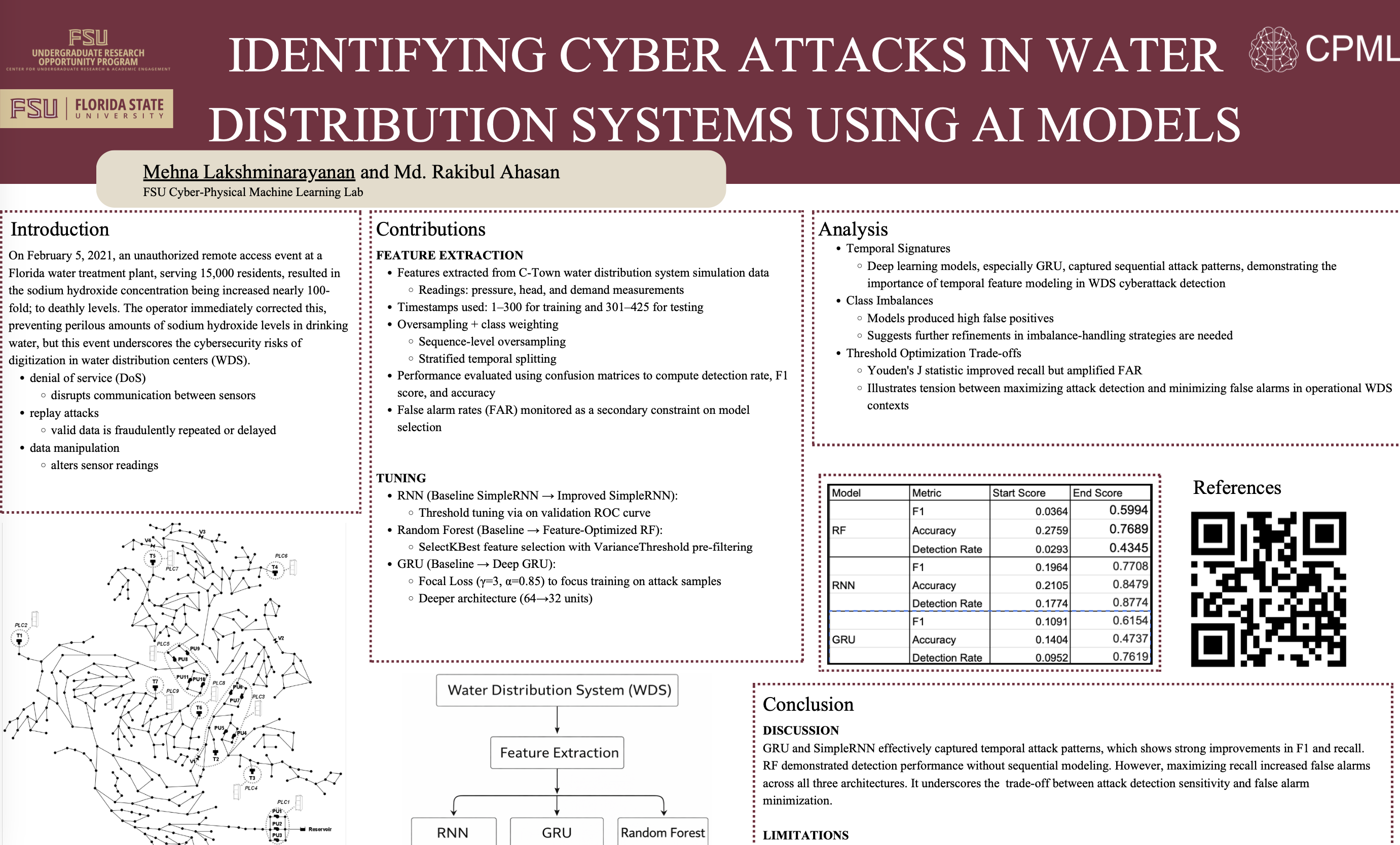
On February 5, 2021, an unauthorized remote access event at a Florida water treatment plant, serving 15,000 residents, resulted in the sodium hydroxide concentration being increased nearly 100-fold; to deathly levels. The operator immediately corrected this, preventing perilous amounts of sodium hydroxide levels in drinking water, but this event underscores the cybersecurity risks, such as denial of service (DoS) and replay attacks, of digitization in water distribution centers (WDS). Many traditional intrusion detection systems struggle with multi-dimensional sensor data and are improperly balanced between classes of a normal operation and an attack scenario. A solution to current problems in WDS is using machine learning (ML) to predict attacks prematurely by using four classifiers: Random Forest, Recurrent Neural Network, and Gated Recurrent Unit. All the models’ AUC and F1-scores dramatically improved after hyperparameter tuning and implementing decision thresholds to the base models. Deep learning models effectively provide insights into WDS cyber attacks by analyzing temporal attack signatures present in sensor data. This methodological structure is also applicable to other domains within cyber-physical systems where a proactive, precautionary approach is preferred over reactive prevention.
Keywords: AI Learning Models, Cyber-Physical Systems