
Research Symposium
26th annual Undergraduate Research Symposium, April 1, 2026
Christopher Horak Poster Session 2: 10:45 am - 11:45 am / Poster #148

BIO
Hello! My name is Christopher Horak. I am a freshman Honors student in the College of Arts and Sciences. Once I graduate, I plan to get a job in Dallas.
Analyzing 3rd- and 5th-Grade Morpheme Types and Tokens
Authors: Christopher Horak, Audrey HendrixStudent Major: Actuarial Science
Mentor: Audrey Hendrix
Mentor's Department: Modern Languages and Linguistics Mentor's College: Arts and Sciences Co-Presenters:
Abstract
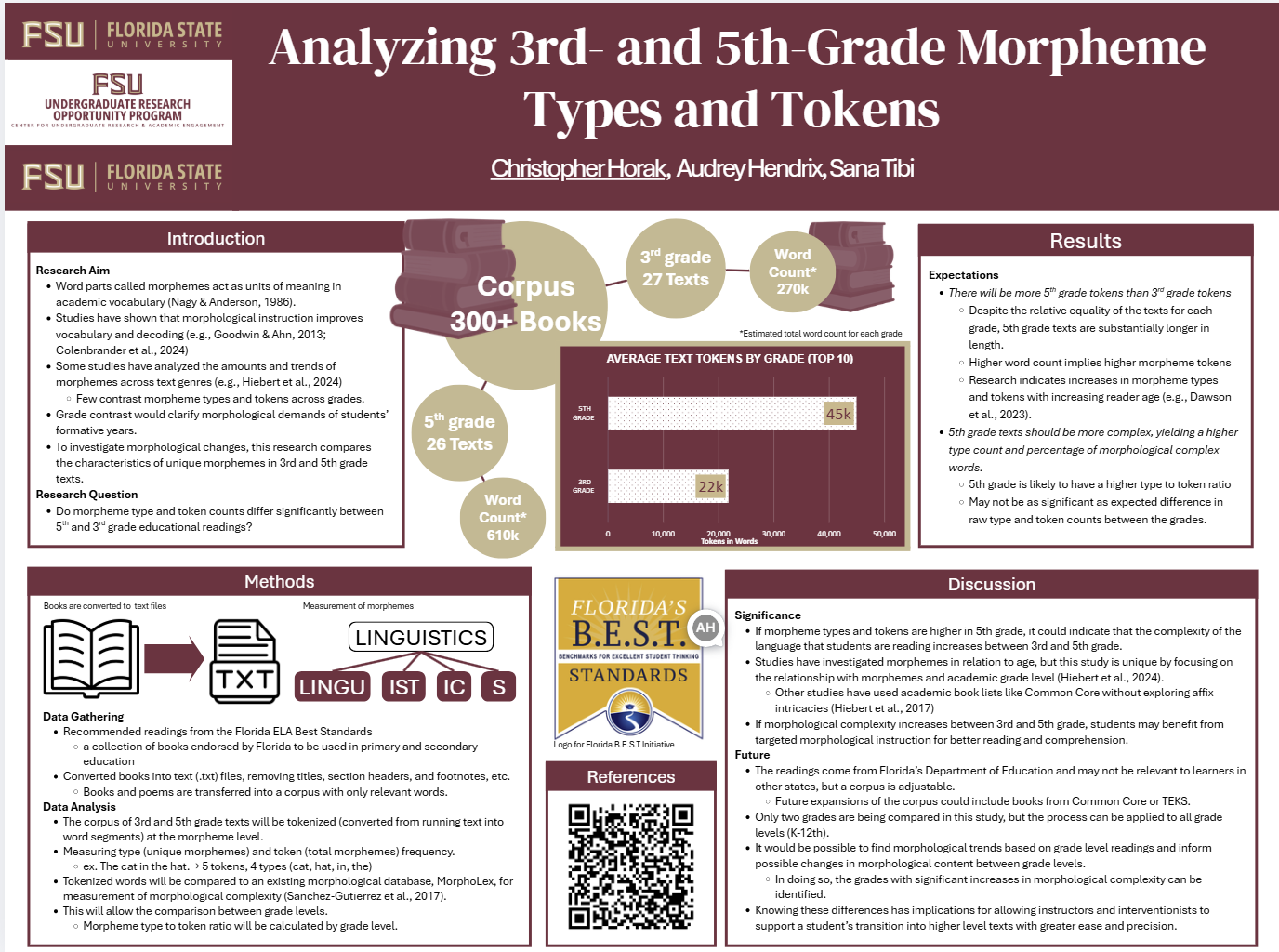
Introduction: Word parts called morphemes act as units of meaning in academic vocabulary (Nagy & Anderson, 1986). Studies have shown that morphological instruction improves learners’ ability in decoding and vocabulary knowledge (e.g., Goodwin & Ahn, 2013; Colenbrander et al., 2024). Recently, studies began analyzing the amounts and trends of morphemes across text genres (e.g., Hiebert et al., 2024). However, there are few that contrast morpheme types and tokens across grades which would allow a clearer understanding of how morphological demands change through students’ formative years. To investigate morphological changes occurring as American students begin to independently explore increasingly complex American English Language Arts (ELA) readings, this research compares the characteristics of unique morphemes in 3rd and 5th grade texts.
Methods: In this study, recommended readings from the Florida ELA Best Standards (n = 27 3rd, n = 26 5th) will be combined into a corpus, then broken down into morphemes. Afterwards, we will compare morpheme types and tokens between 3rd grade and 5th grade texts.
Results: We expect to find that type and token frequencies for 5th grade morpheme texts will be greater than those in the 3rd grade texts aligning with prior literature which has shown increases in morpheme types and tokens with increasing reader age (e.g., Dawson et al., 2023).
Conclusion: Findings will inform possible changes in morphological content between grade levels. Knowing these differences has implications for allowing instructors and interventionists to support a student’s transition into higher level texts with greater ease and precision.
Keywords: morphemes