
Research Symposium
26th annual Undergraduate Research Symposium, April 1, 2026
Ta'Nyiah Golson Poster Session 1: 9:30 am - 10:30 am / Poster #157
BIO
Ta'Nyiah Golson is a Biological Science major with research interests in computational modeling to study how high-gradient magnetic fields can steer and capture drug-carrying magnetic nanoparticles in blood flow. Ta'Nyiah's hometown is in Orlando, Fl and Ta'Nyiah's future career goals are to get into medical school and become a Trauma Surgeon.
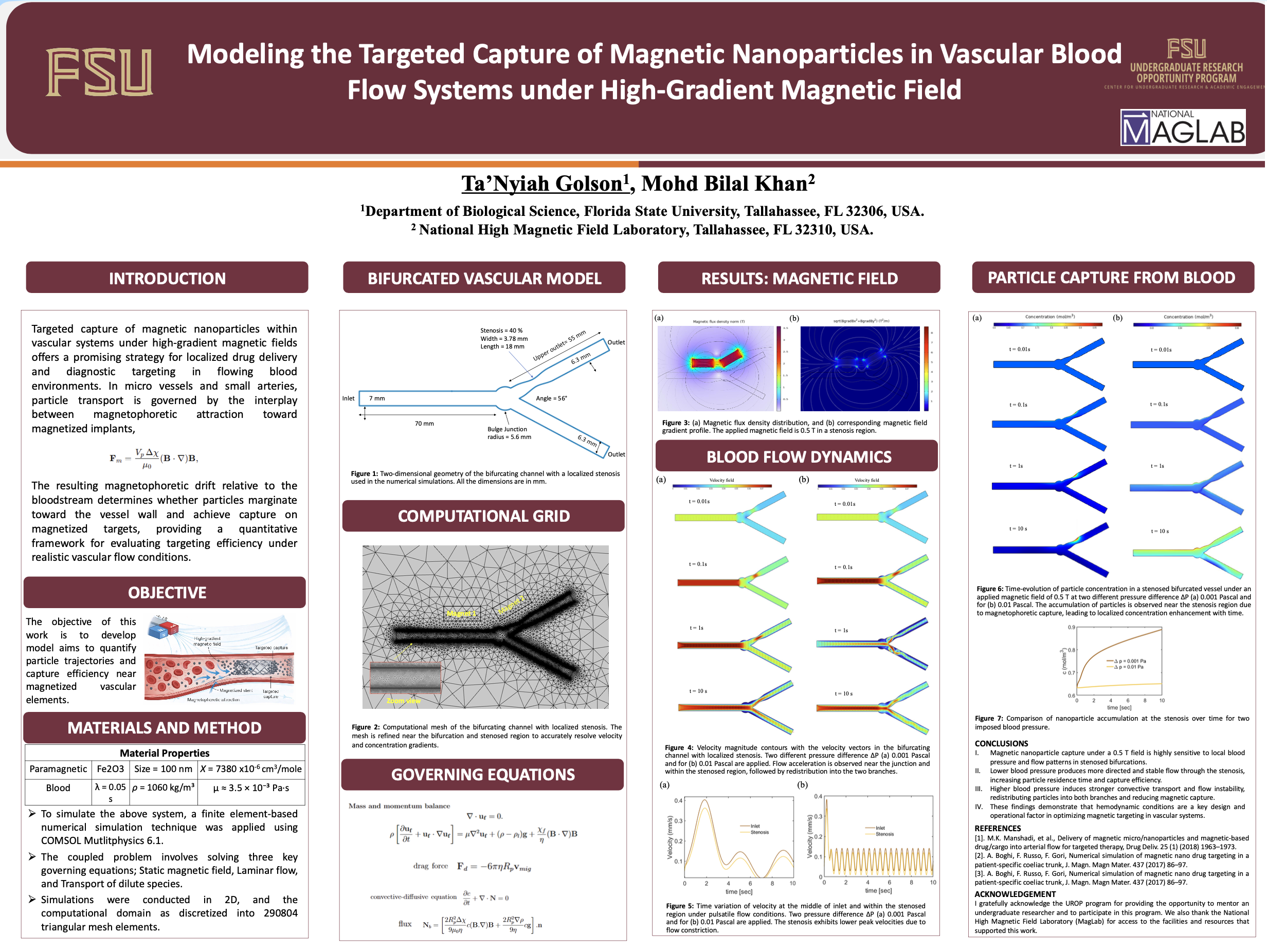
Modeling the Targeted Capture of Magnetic Nanoparticles in Vascular Blood Flow Systems under High-Gradient Magnetic Field
Authors: Ta'Nyiah Golson, Mohd KhanStudent Major: Biological Science
Mentor: Mohd Khan
Mentor's Department: Natl High Magnetic Field Lab Mentor's College: Natl High Magnetic Field Lab Co-Presenters:
Abstract
Targeted delivery of magnetic nanoparticles within vascular systems using externally applied high-gradient magnetic fields offers a promising strategy for localized drug delivery and diagnostic targeting. In this study, we present a computational investigation of magnetically guided nanoparticle capture in a bifurcated vascular model representative of arterial blood flow conditions. A two dimensional stenosed bifurcation geometry was developed to examine the coupled effects of magnetic forces, hydrodynamic transport, and particle–flow interactions on capture efficiency.
Simulation results reveal that magnetic field gradients significantly alter particle trajectories relative to the background flow field. In the absence of magnetic forcing, nanoparticles predominantly follow streamlines through the bifurcation with minimal wall interaction. Upon application of a high-gradient magnetic field, particles exhibit pronounced deviation toward magnetized vascular walls, leading to localized accumulation near the stenosed region and branch junction. Capture efficiency increases with magnetic field strength and gradient magnitude, while flow velocity and bifurcation geometry strongly influence deposition patterns. These findings demonstrate the critical interplay between hydrodynamics and magnetic forces in determining nanoparticle capture within complex vascular geometries. The study provides quantitative insight into optimizing magnetic targeting strategies for biomedical applications, including site-specific drug delivery and minimally invasive therapeutic interventions.
Keywords: high-gradient magnetic fields