
Research Symposium
26th annual Undergraduate Research Symposium, April 1, 2026
Jenna Sparling Poster Session 1: 9:30 am - 10:30 am / Poster #295

BIO
Jenna Sparling is a second-year student at Florida State pursuing Dual Bachelor’s Degrees in Geography and Economics with minors in Urban and Regional Planning and Political Science. Her academic interests include urban planning, economic development, and spatial data analysis. She currently conducts research with Dr. Veronica M. White, an Assistant Professor of Data Science in Health Systems Engineering at the FAMU-FSU College of Engineering. Jenna is currently working on Dr. White’s crisis planning tool project, collecting data for a case study in Honolulu, Hawaii. Alongside the crisis planning tool project, she is also involved in a separate research project examining the effects of college sports on economic and urban development. This project is overseen by Dr. Victor Mesev, a professor in the Department of Geography. In the summer, she plans to continue working for her research mentor, Veronica White, on a new project studying holistic defense outcomes. She plans to attend graduate school and may pursue academia in the future.
The Data Behind Deployment: Simulating Crisis Response in Honolulu
Authors: Jenna Sparling, Veronica WhiteStudent Major: Geography and Economics
Mentor: Veronica White
Mentor's Department: Industrial and Manufacturing Engineering Mentor's College: FAMU-FSU College of Engineering Co-Presenters:
Abstract
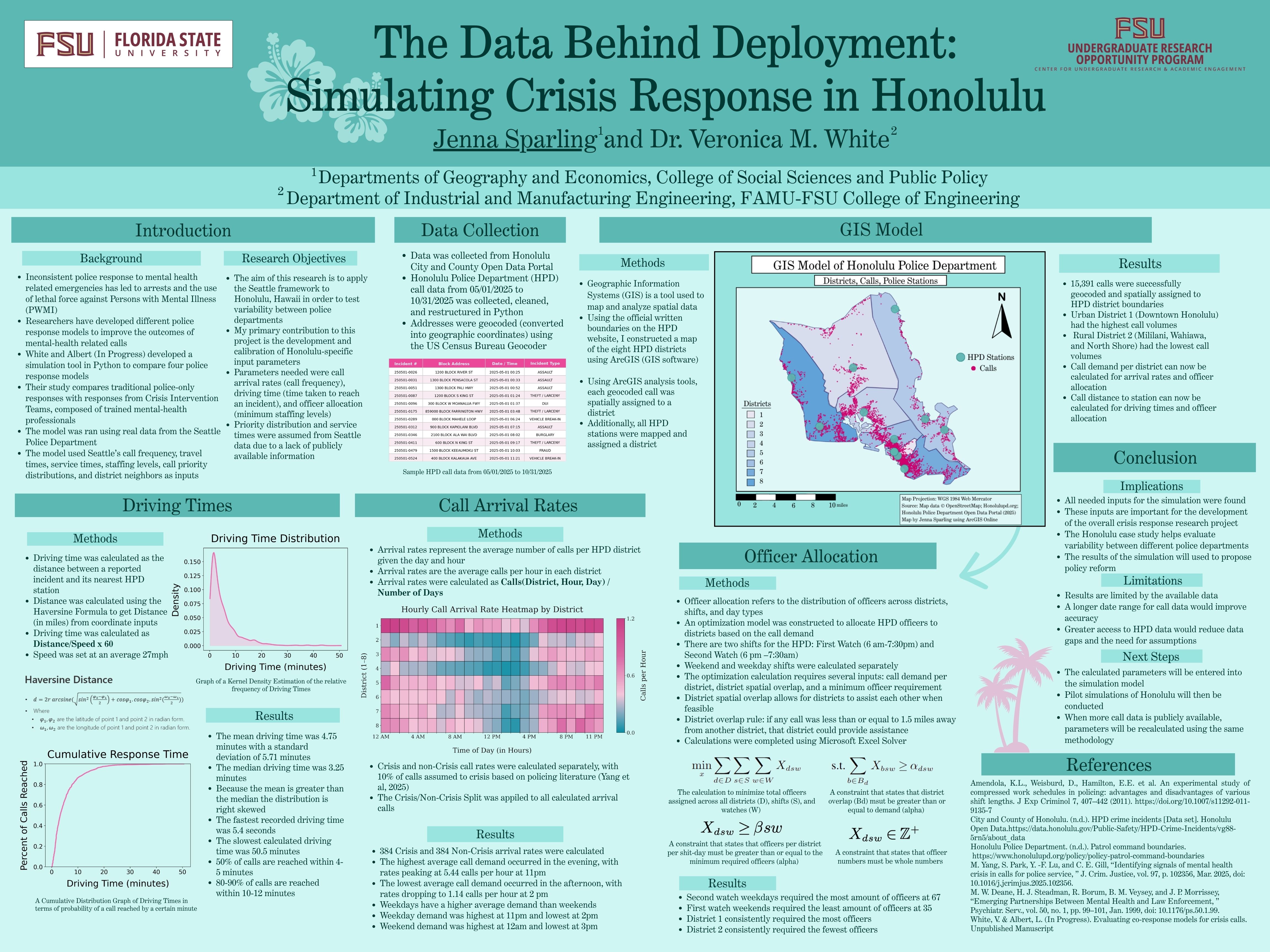
Inconsistent police response to mental health related emergencies in the United States has led to extreme and, at times, deadly outcomes. Police response to mental health crises has resulted in arrests, mercy bookings, and even the use of lethal force among Persons with Mental Illness (PWMI). Different police response models have been constructed to propose alternative response plans for crisis calls. To compare these different models, a simulation-based planning tool was constructed with Python. The planning tool requires several input parameters constructed from real police department data. This research explores Honolulu and the data collection needed to construct input parameters for future simulations. Data was derived from the Honolulu Police Department incident portal. Data was analyzed using spatial and statistical modeling. The models displayed demand and call distance in relation to HPD districts and stations. Using this information, the average frequency of crisis related and non-crisis related calls was calculated in Python. Additionally, the travel times were calculated for each call. Call demand was also utilized in an Excel optimization model to allocate police staffing across districts. The results show that policing demand in Honolulu varies heavily across urban and rural districts. Driving times were relatively short, with a few taking longer due to delays. Highest call volumes were recorded on weekdays, particularly during night shifts. These results will be used as inputs in future test simulations. The results of the simulation will assist policy makers in crafting data-driven crisis response systems.
Keywords: Crisis Response, Simulation, Police, Honolulu