
Research Symposium
26th annual Undergraduate Research Symposium, April 1, 2026
Tvisha Sarkar Poster Session 1: 9:30 am - 10:30 am / Poster #203

BIO
My name is Tvisha Sarkar, and I am a senior majoring in Psychology and Statistics. My primary research interests lie in PTSD and cognitive ability, with a growing passion for clinical psychology. I aspire to pursue a Ph.D. in Clinical Psychology, integrating my background in neuroscience research to explore innovative approaches to assessment and treatment.
From Trauma to Addiction: Understanding Gender Differences in Suicide Risk Among U.S Military Personnel
Authors: Tvisha Sarkar, Dr. Thomas JoinerStudent Major: Psychology and Statistics
Mentor: Dr. Thomas Joiner
Mentor's Department: Psychology Mentor's College: Arts and Science Co-Presenters:
Abstract
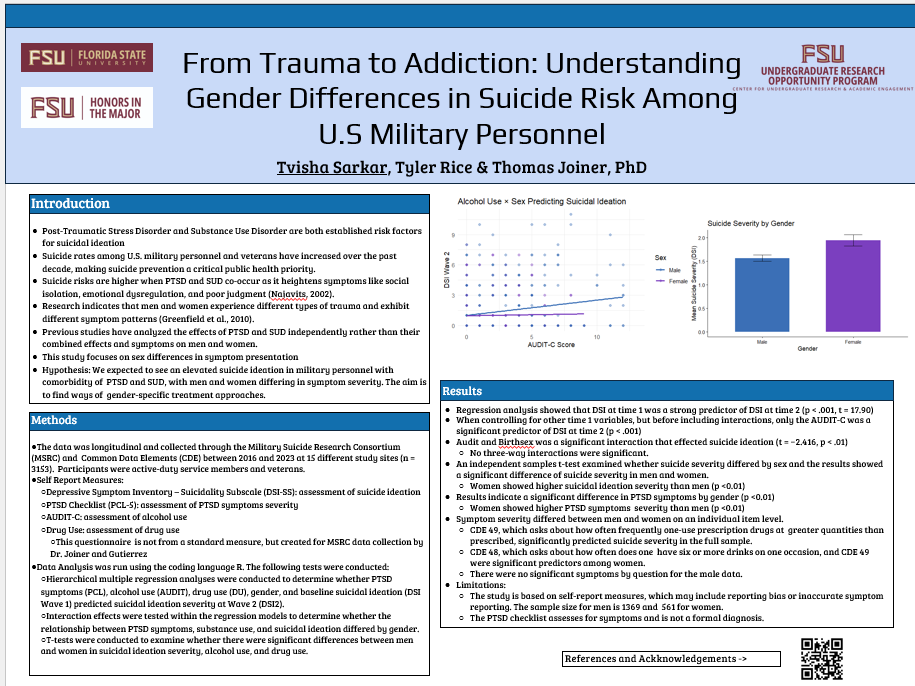
Studies have shown that individuals with posttraumatic stress disorder (PTSD) and comorbid substance use disorder (SUD) are at increased risk for suicide. These two disorders are more prevalent in military personnel compared to civilians, largely due to heightened trauma exposure. Thus, understanding how PTSD and SUD contribute to suicide risk is critical for this population. Furthermore, males and females with PTSD and SUD have been shown to differ in their suicide risk presentations. Yet, how assigned sex at birth (ASAB) moderates the longitudinal effects of comorbid PTSD and SUD symptoms on suicide risk in military personnel is currently understudied. This project aims to investigate this gap, potentially leading to effective, sex-specific suicide prevention strategies.
Regressions were tested with longitudinal data from active and Veteran U.S. military personnel (N=1,930). Specifically, time one (T1) suicidal ideation, substance use, PTSD symptoms, ASAB, and their two-way interactions were tested as predictors of time two (T2) suicidal ideation. Results indicated that T1 alcohol use (p<0.001) and the interaction between T1 alcohol use and ASAB (p=0.016) were significant predictors of T2 suicidal ideation. When probing this interaction, results indicated that women show more significant results of drinking per occasion and more frequently than men. However, these scores do not predict suicide severity for women as it does for men, as the Alcohol use was not seen as a significant factor for women when running the regression test. This work has implications for military suicide prevention efforts, particularly via sex-specific interventions.
Keywords: PTSD, Gender, Substance Use