
Research Symposium
26th annual Undergraduate Research Symposium, April 1, 2026
Sid Nguyen Poster Session 4: 3:00 pm - 4:00 pm / Poster #230

BIO
Sid Nguyen is an honors undergraduate student at Florida State University pursuing a Bachelor of Science in Computer Science and Applied Mathematics. His academic interests center on artificial intelligence, machine learning, and computational modeling, particularly in understanding complex systems through data-driven methods.
Sid’s research explores predictive modeling and sequence learning, with current work focused on modeling human mobility patterns using large-scale spatiotemporal data. By studying how populations move through space over time, his work investigates probabilistic approaches to forecasting movement flows and understanding the structure underlying seemingly irregular real-world behavior. He has also developed projects in reinforcement learning, evolutionary learning systems, and AI-driven simulations, reflecting a broader interest in building adaptive and interpretable intelligent systems.
Beyond research, Sid has worked in technical roles including IT support and web development, and has contributed to computing education through teaching and mentorship. Following graduation, Sid hopes to pursue graduate study and research in artificial intelligence and machine learning, with a focus on developing computational systems that help model and understand complex real-world processes.
Learning Predictive Representations of Human Mobility Flows
Authors: Sid Nguyen, Guang WangStudent Major: Bacholer's of Science in Computer Science and Applied Math
Mentor: Guang Wang
Mentor's Department: Computer Science Mentor's College: College of Arts and Sciences Co-Presenters:
Abstract
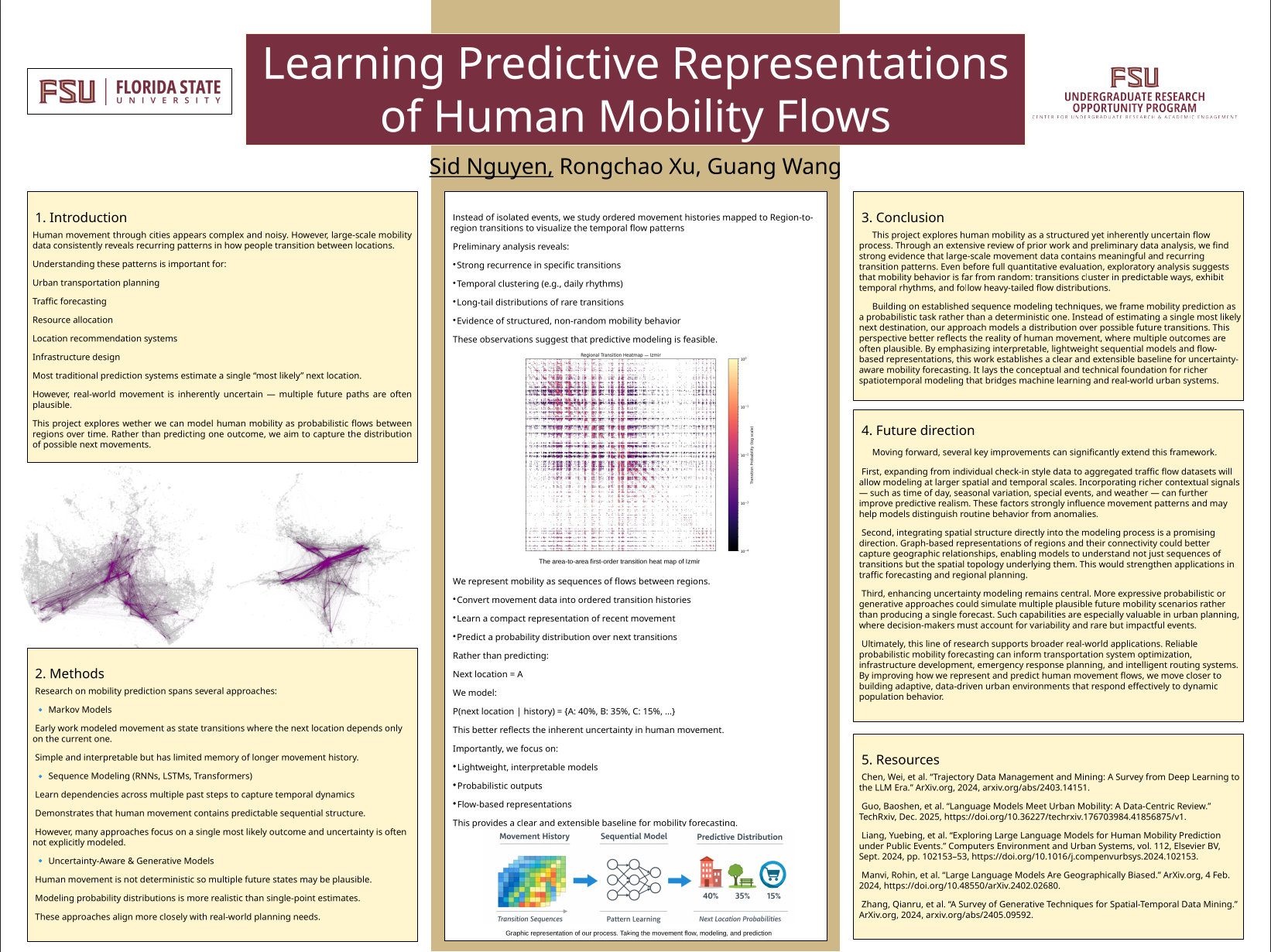
Human movement through space and time exhibits complex but recurrent patterns that can be leveraged to understand and anticipate behavior. We hope to explore whether large-scale time and location transition data can be effectively encoded into a predictive representation that reflects how people transition between locations based on their recent history. Drawing on techniques from sequence modeling and stochastic prediction, we transform real-world check-in data into structured movement histories and learn the relationships between past and future locations. The resulting representation highlights regularities in mobility behavior and demonstrates that even lightweight sequential models can capture meaningful predictive structure from noisy, irregular real-world data. Unlike deterministic approaches that only estimate a single expected outcome, our analysis underscores the importance of capturing the variety of possible next states, aligning conceptually with recent advances in uncertainty-aware and generative spatiotemporal models in the literature. This contributes an interpretable baseline for prediction of human movement and points toward richer, context-aware modeling. More broadly, the ability to capture human mobility in prediction is essential in urban transportation planning and point of interest recommendation.
Keywords: spacialtemporal data, computer science, neural networks, machine learning, urban mobility