
Research Symposium
26th annual Undergraduate Research Symposium, April 1, 2026
Kayla Gonzalez Poster Session 4: 3:00 pm - 4:00 pm / Poster #178

BIO
Kayla Gonzalez is a sophomore at Florida State University pursuing a Bachelor of Science in Biology. Originally from Miami, Florida, she is interested in public health, health disparities, and how social and environmental factors influence health outcomes. Kayla has contributed to research examining geospatial stigma and neighborhood-level influences on health under the mentorship of Dr. Casey D. Xavier Hall, where she assisted with screening and reviewing literature for a systematic review. After completing her undergraduate degree, Kayla plans to become a Dermatology Physician Assistant.
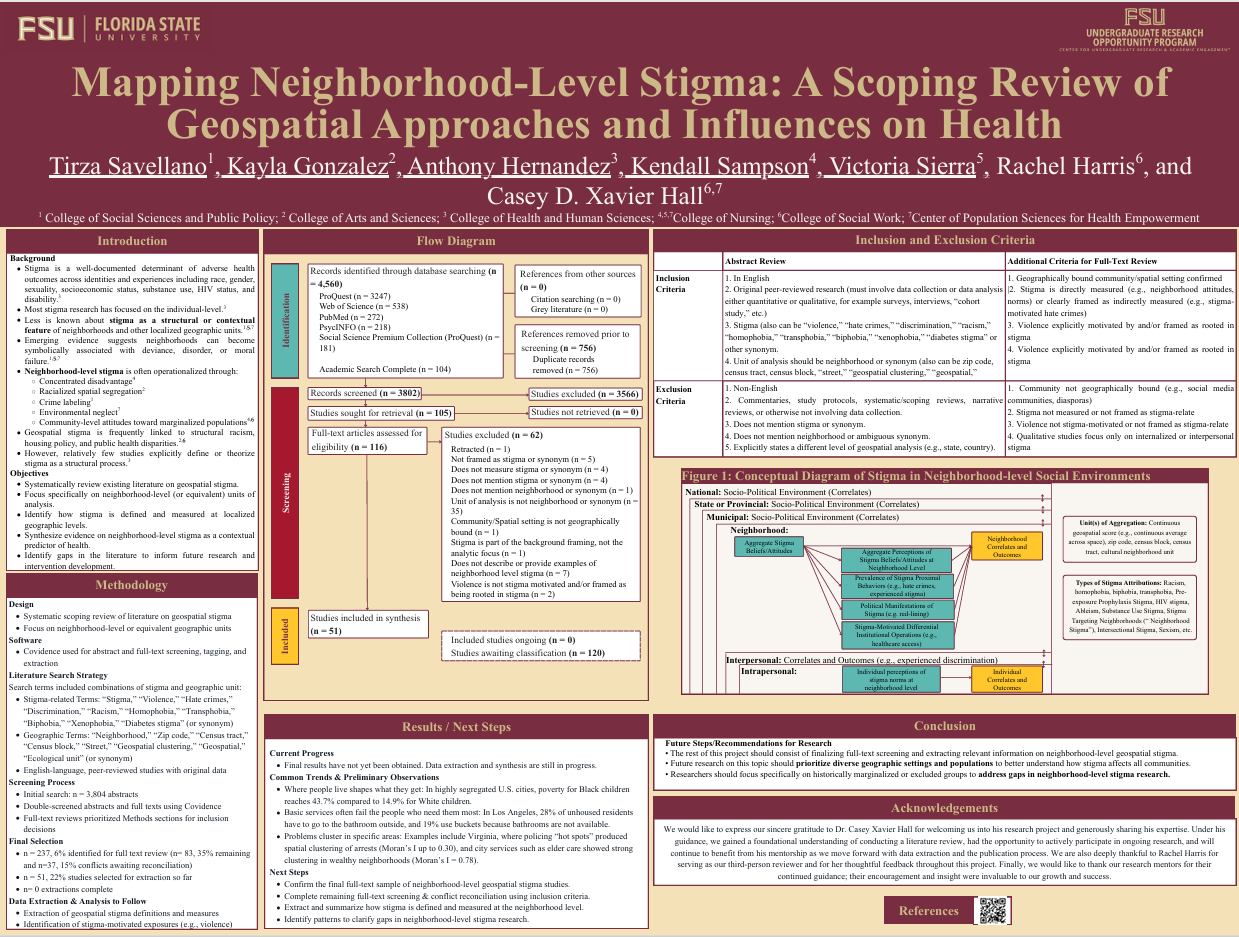
Mapping Neighborhood-Level Stigma: A Scoping Review of Geospatial Approaches and Influences on Health
Authors: Kayla Gonzalez, Casey D. Xavier Hall, Ph.D., M.P.H.Student Major: Biological Sciences
Mentor: Casey D. Xavier Hall, Ph.D., M.P.H.
Mentor's Department: Nursing Department Mentor's College: College of Nursing, Center of Population Sciences for Health Empowerment Co-Presenters: Tirza Savellano, Anthony Hernandez, Kendall Sampson, Victoria Sierra
Abstract
Background
Stigma is a well-documented determinant of adverse health
outcomes across identities and experiences including race, gender,
sexuality, socioeconomic status, substance use, HIV status, and
disability.3
Most stigma research has focused on the individual-level.3
Less is known about stigma as a structural or contextual
feature of neighborhoods and other localized geographic units. ⁵1, ,7
Emerging evidence suggests neighborhoods can become
symbolically associated with deviance, disorder, or moral
failure. ⁵1, ,7
Neighborhood-level stigma is often operationalized through:
Concentrated disadvantage4
Racialized spatial segregation2
Crime labeling1
Environmental neglect7
Community-level attitudes toward marginalized populations ⁶4,
Geospatial stigma is frequently linked to structural racism,
housing policy, and public health disparities. ⁶2,
However, relatively few studies explicitly define or theorize
stigma as a structural process.3
Objectives
Systematically review existing literature on geospatial stigma.
Focus specifically on neighborhood-level (or equivalent) units of
analysis.
Identify how stigma is defined and measured at localized
geographic levels.
Synthesize evidence on neighborhood-level stigma as a contextual
predictor of health.
Identify gaps in the literature to inform future research and
intervention development
Keywords: Geospatial Stigma