
Research Symposium
26th annual Undergraduate Research Symposium, April 1, 2026
Luis Acosta Poster Session 3: 1:45 pm - 2:45 pm / Poster #183

BIO
Luis Acosta is a sophomore at Florida State University pursuing a Bachelor of Science in Cell and Molecular Neuroscience on the pre-medical track. His academic interests focus on cognitive neuroscience, neurodegenerative disease, and early cognitive markers of neurological disorders. Luis plans to attend medical school and pursue a career in neurosurgery, with the goal of integrating clinical practice and research to improve the understanding and treatment of neurological disease.
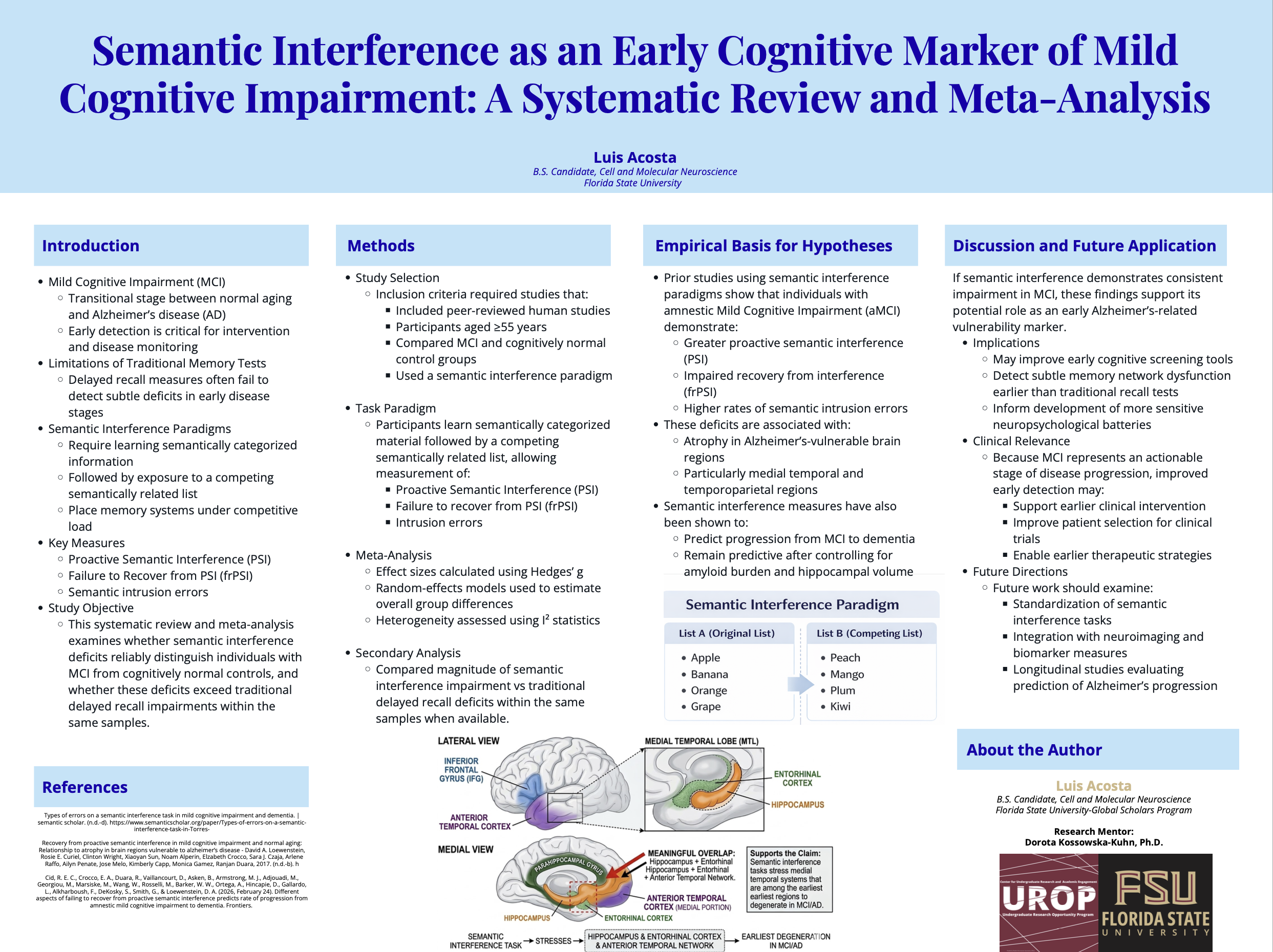
Semantic Interference as an Early Cognitive Marker of Mild Cognitive Impairment: A Systematic Review and Meta-Analysis
Authors: Luis Acosta, Dorota Kossowska-KuhnStudent Major: Cell and Molecular Neuroscience
Mentor: Dorota Kossowska-Kuhn
Mentor's Department: Psychology Mentor's College: Florida State University Co-Presenters:
Abstract
Mild Cognitive Impairment (MCI) represents a clinically critical stage between normal aging and Alzheimer’s disease (AD), during which intervention strategies may be most effective. Traditional delayed recall measures, however, may insufficiently detect early vulnerability in neural systems affected by AD-related pathology. Semantic interference paradigms, requiring encoding of semantically categorized material followed by exposure to a competing semantically related list, place memory networks under competitive load and may reveal deficits not captured by conventional recall testing.
Individuals with amnestic MCI demonstrate increased vulnerability to proactive semantic interference (PSI), impaired recovery from interference (frPSI), and elevated semantic intrusion errors relative to cognitively normal older adults. Prior studies report associations between interference vulnerability and atrophy in AD-sensitive medial temporal and temporoparietal regions, as well as predictive value for progression to dementia. However, the magnitude and consistency of these effects have not been quantitatively synthesized.
This project will conduct a systematic review and meta-analysis to evaluate semantic interference as a potential early cognitive marker of MCI. Following PRISMA guidelines, electronic databases (PubMed, PsycINFO, and Web of Science) will be systematically searched. Eligible studies must include clinically diagnosed MCI and cognitively normal comparison groups and report sufficient data to compute standardized mean differences. The primary outcome will be Hedges’ g comparing interference performance between groups using a random-effects model, with secondary analyses examining comparisons to traditional delayed recall.
By integrating findings across studies, this work aims to determine whether semantic interference demonstrates sufficient magnitude and consistency to support its role in early cognitive detection frameworks.
Keywords: Alzheimer’s; Cognition; Memory; Neurodegeneration; Neuroscience