
Research Symposium
26th annual Undergraduate Research Symposium, April 1, 2026
Gabriella Vega Poster Session 3: 1:45 pm - 2:45 pm / Poster #277

BIO
Gabriella Vega is a first-year senior pursuing a dual Bachelor of Science degree in International Affairs and Finance. She is an honors student and holds an Associate of Arts degree. Her academic work focuses on the intersection of public policy, international trade, and economic development. Gabriella complements her studies with hands-on experience in government and research. It has been a milestone for her to be working as a research assistant under Professor Chris Gahagan, for his research centered around the United States-Mexico-Canada trade agreement's effects on Mexico's labor market.
Gabriella’s interests include public policy, government, economic development, wealth management, and applied research. She plans to pursue a career in law and is particularly interested in areas that connect economic policy and legal frameworks. Gabriella aims to continue expanding her professional network while gaining practical experience in policy and legal institutions.
Enforcement, Displacement, and Informality: Labor Market Adjustment under the USMCA's Rapid Response Mechanism
Authors: Gabriella Vega, Chris GahaganStudent Major: International Affairs
Mentor: Chris Gahagan
Mentor's Department: Department of Political Science Mentor's College: College of Social Sciences and Public Policy Co-Presenters: Juan Lopez, Andrea Hernandez
Abstract
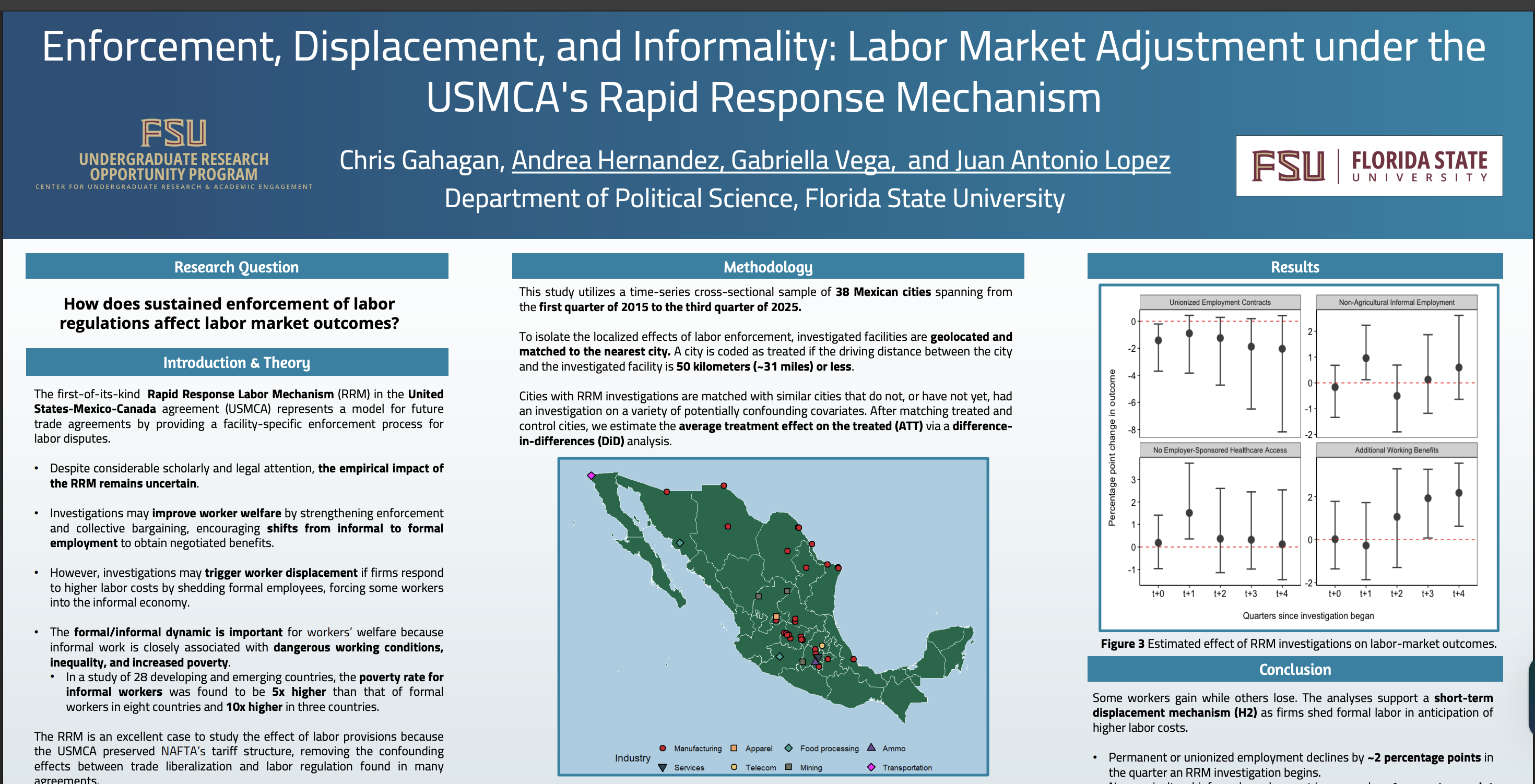
Designed to be at the vanguard of enforceable labor rights in trade agreements, the USMCA’s Rapid Response Mechanism (RRM) was conceptualized to protect collective bargaining rights and strengthen labor standards in Mexico. This project examines the cumulative impact of RRM investigations on wages, employment composition, and job quality across Mexican states and cities, leveraging facility-level case variation and quarterly labor data. The findings reveal a sequential adjustment process, rather than immediate, uniform gains for workers. In the short term, enforcement of the RRM appears to increase worker displacement reflected in an immediate decline in permanent or unionized employment contracts and a subsequent rise in non-agricultural informal employment. However, over longer post-treatment periods RRM enforcement correlates with improvements in reported job-quality indicators, including gains in non-mandated employment benefits. These patterns plausibly suggest the recognition and enforcement of collective bargaining agreements central to the RRM.
Keywords: Trade, Economy, Labor