
Research Symposium
26th annual Undergraduate Research Symposium, April 1, 2026
Alyssa Moodie Poster Session 3: 1:45 pm - 2:45 pm / Poster #90

BIO
Alyssa Moodie is a sophomore at Florida State University pursuing a Bachelor of Science in Biological Sciences with a minor in Chemistry. Originally from Pensacola, Florida, she conducted research in Dr. Brown’s lab investigating denervation in aged rats and its effects on the neuromuscular junction. Alyssa is a member of the Pre-Physician Assistant Club at Florida State University and plans to pursue a career as a Physician Assistant. She is also gaining clinical experience as a Certified Clinical Medical Assistant and will be working this summer as a Patient Care Assistant at Tallahassee Memorial Healthcare. In addition, she volunteers at Tallahassee Memorial Healthcare as a Clinical College Associate Volunteer, supporting hospital staff and assisting patients. Following this program, she plans to continue working in Dr. Brown’s lab as a research assistant.
Disuse-Atrophy Exacerbates Denervation in Aged Rats
Authors: Alyssa Moodie, Jacob BrownStudent Major: Biological Sciences
Mentor: Jacob Brown
Mentor's Department: Exercise Physiology Mentor's College: Anne's College Co-Presenters: Madisen C. Clark, Kaitlyn R. Harrison, Ava J. Sajovits, Catherine Zhou
Abstract
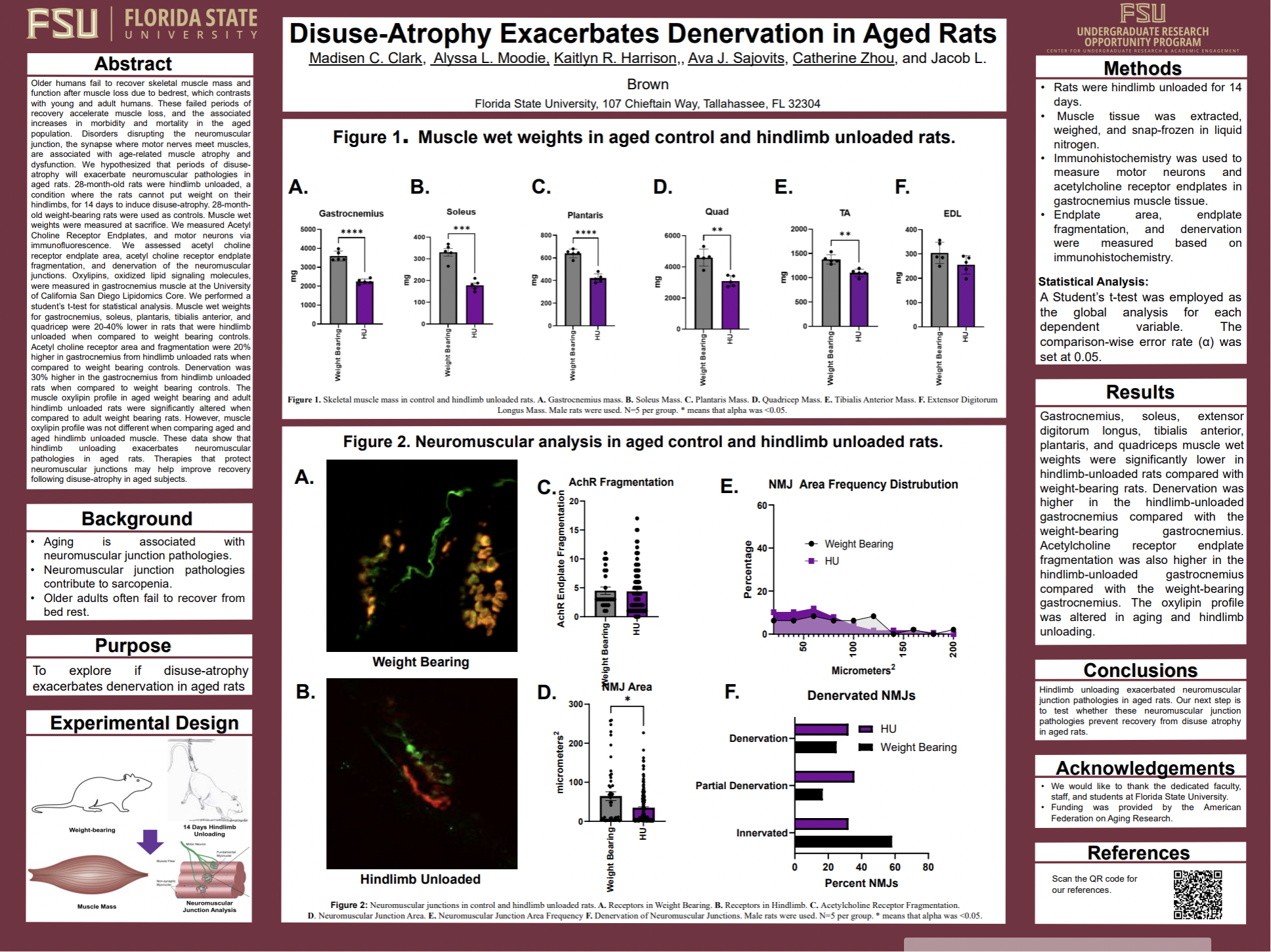
Older humans fail to recover skeletal muscle mass and function after muscle loss due to bedrest, which contrasts with young and adult humans, leading to muscle loss and an increase in morbidity and mortality in the aged population. Disorders disrupting the neuromuscular junction, the synapse where motor nerves meet muscles, are associated with age-related muscle atrophy and dysfunction. We hypothesized that periods of disuse-atrophy will exacerbate neuromuscular pathologies in aged rats. 28-month-old rats were hindlimb unloaded, a condition where the rats cannot put weight on their hindlimbs, for 14 days to induce disuse atrophy. 28-month-old weight-bearing rats were used as controls. Muscle wet weights were measured at sacrifice. Via immunofluorescence, we assessed acetyl choline receptor endplate area, acetyl choline receptor endplate fragmentation, and denervation of the neuromuscular junctions. Oxylipins, oxidized lipid signaling molecules, were measured in gastrocnemius muscle. We performed a student’s t-test for statistical analysis. Muscle wet weights were 20-40% lower in rats that were hindlimb-unloaded compared to controls. Acetyl choline receptor area and fragmentation were 20% higher in gastrocnemius from hindlimb-unloaded rats compared to controls. Denervation was 30% higher in the gastrocnemius from hindlimb-unloaded rats compared to controls. The muscle oxylipin profile in aged weight-bearing and adult hindlimb-unloaded rats were significantly altered when compared to adult weight-bearing rats. However, muscle oxylipin profile was not different when comparing aged and aged hindlimb unloaded muscle. These data show that hindlimb-unloading exacerbates neuromuscular pathologies in aged rats. Therapies that protect neuromuscular junctions may help improve recovery following disuse-atrophy in aged subjects.
Keywords: Muscle, Denervation, Neuromuscular Junction, Muscle mass, Rats