
Research Symposium
26th annual Undergraduate Research Symposium, April 1, 2026
Keanu Parsa Poster Session 3: 1:45 pm - 2:45 pm / Poster #9

BIO
Keanu Parsa is a first-year undergraduate Presidential Scholar and Honors student majoring in Biological Sciences. He hopes to become a Cardiologist, specializing in minimally invasive procedures. His research is currently focused in the Sport Psychology Laboratory under the guidance of Dr. Brady DeCouto, in which he aids in conducting trials that focus on neurofeedback through brain-computer interfaces.
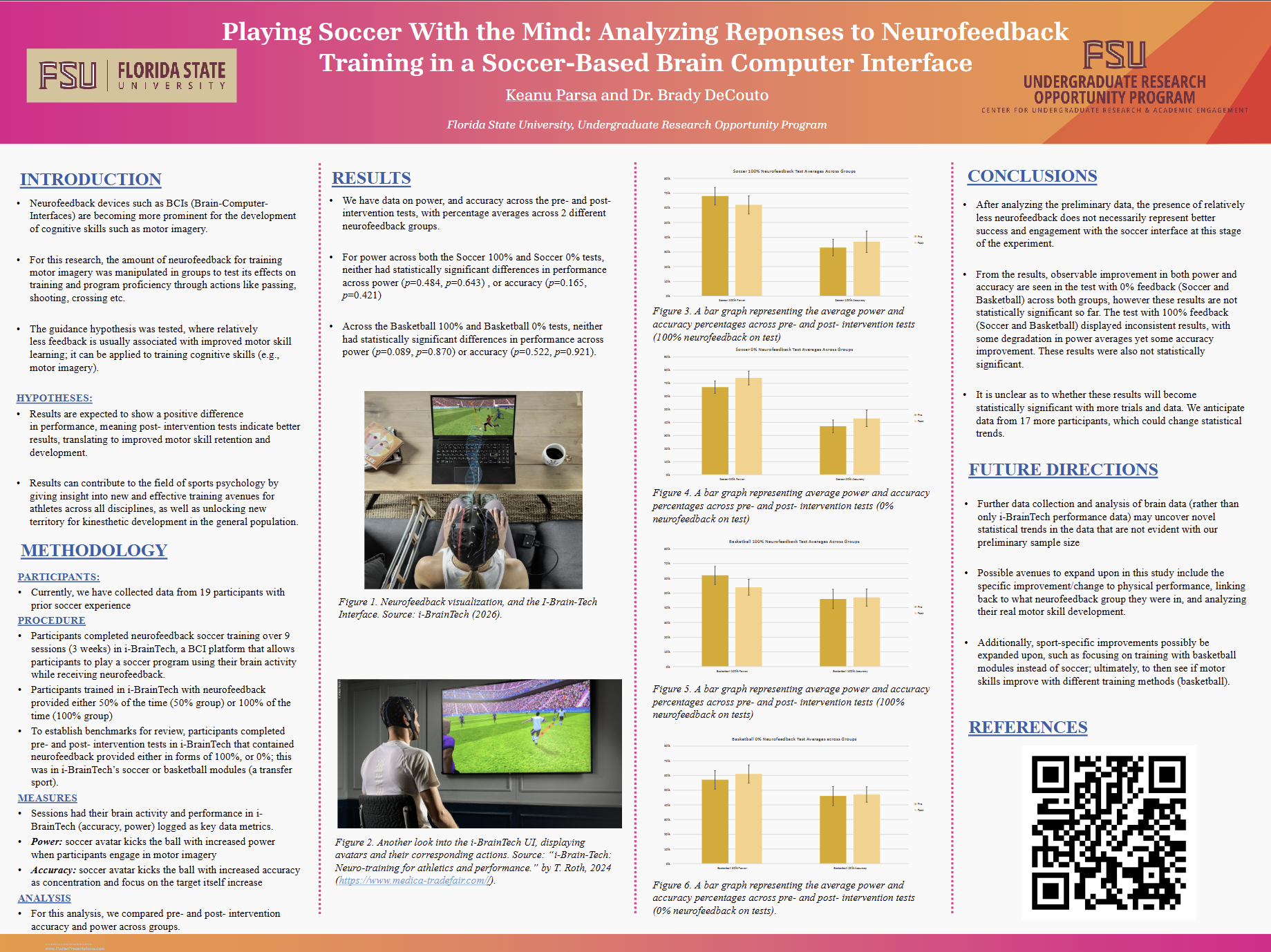
Playing Soccer With the Mind: Analyzing Reponses to Neurofeedback Training in a Soccer-Based Brain Computer Interface
Authors: Keanu Parsa, Brady DeCoutoStudent Major: Biological Sciences
Mentor: Brady DeCouto
Mentor's Department: Educational Psychology and Learning Systems Mentor's College: Anne Spencer Daves College of Education, Health, and Human Sciences Co-Presenters:
Abstract
Neurofeedback devices such as BCIs (Brain-Computer-Interfaces) are becoming more prominent for the development of cognitive skills such as motor imagery. For example, the use of i-BrainTech: a BCI platform that allows participants to play a soccer program using their brain activity while receiving neurofeedback. For this research, neurofeedback in i-BrainTech was manipulated in groups (present or absent) to test its effects on training and program proficiency through actions like passing, shooting, crossing, etc. We are testing if the guidance hypothesis, where relatively less feedback is usually associated with improved motor skill learning, can be applied to training cognitive skills (e.g., motor imagery). Over the course of 9 days, participants with prior soccer experience completed soccer training trials with neurofeedback using an electroencephalography (EEG) cap to control an avatar and complete tasks. The scores of power and accuracy were taken in addition to their overall success. Pre- and post-test sessions had basketball sessions as well as soccer, which were measured to determine any skill improvement and transfer. Additionally, on the pre- and post-test days, participants ventured outside to shoot a real soccer ball; scores were recorded to assess the “physical performance” aspect. Results are expected to show a difference in performance; however, it is yet to be determined if it is from neurofeedback. However, these results can contribute to the field of sports psychology by giving insight into new and effective training avenues for athletes across all disciplines, as well as unlocking new territory for kinesthetic development in the general population.
Keywords: Sports, Neurological, Psychology, Athletics, Mental