
Research Symposium
26th annual Undergraduate Research Symposium, April 1, 2026
Lauren Bell Poster Session 1: 9:30 am - 10:30 am / Poster #7

BIO
Lauren Bell is a second-year student from Central Florida pursuing a Bachelor of Science in Psychology with a minor in Child Development at Florida State University. She has been working in the Youth Adjustment, Resilience, and Development (YARD) Lab under Dr. Hua Luo and plans to continue as its purpose aligns with her research interests and professional goals. Lauren plans to attend graduate school and use her passion for youth developmental psychology to make an impact in her community. On campus, Lauren serves as the Videography Chair for Best Buddies, a non-profit organization dedicated to promoting inclusion for individuals with intellectual and developmental disabilities. In the fall, she will be a volunteer hotline counselor with 211 Big Bend, Tallahassee's mental health crisis hotline. Her research experience and campus involvements have greatly impacted and encouraged her desire to contribute to the youth development field.
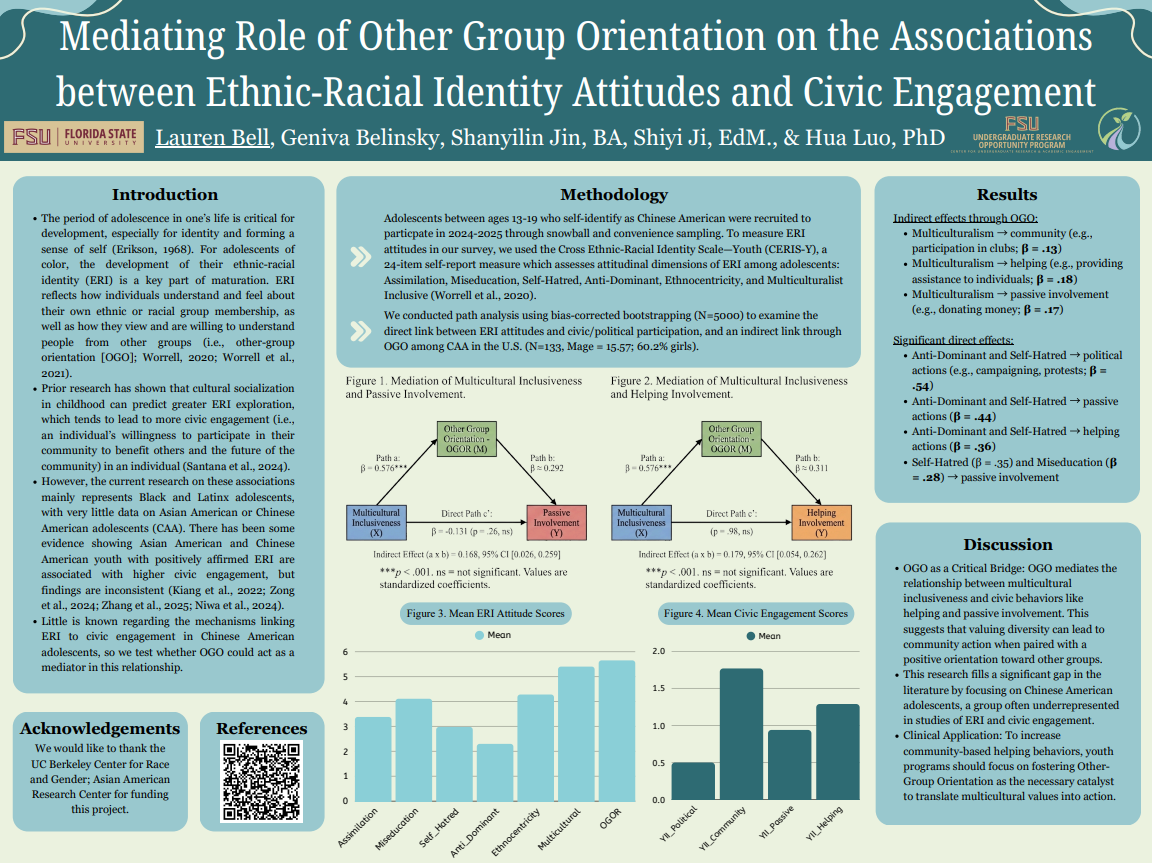
Mediating Role of Other Group Orientation on the Associations between Ethnic-Racial Identity Attitudes and Civic Engagement
Authors: Lauren Bell, Dr. Hua LuoStudent Major: Psychology
Mentor: Dr. Hua Luo
Mentor's Department: Educational Psychology & Learning Systems Mentor's College: Anne Spencer Daves College of Education, Health, and Human Sciences Co-Presenters:
Abstract
Adolescence is a critical period for identity formation, especially for adolescents of color developing their ethnic-racial identity (ERI; Erikson, 1968; Wantchekon et al., 2021). ERI encapsulates one’s views and attitudes about their own ethnic-racial membership and how they perceive peers outside their group (i.e., other-group orientation [OGO]; Worrell et al., 2019, 2021). Prior research has identified civic engagement as a coping strategy among people of color in response to injustice and is linked to positive developmental outcomes in adolescents (Santana et al., 2024). Research suggests links between positively affirmed ERI and civic engagement; however, little is known regarding the mechanisms linking the two. Existing research focuses on Black and Latinx adolescents with an underrepresentation of Chinese American adolescents (CAA). Therefore, we examine the association between ERI attitudes and civic engagement among CAA, viewing OGO as a potential mediator in this relationship by conducting path analysis (N=133, Mage = 15.57; 60.2% girls). Based on our results, multiculturalism indirectly affected community, helping, and passive involvement. Anti-dominant and self-hatred attitudes directly impacted political and helping actions, whereas Self-Hatred and Miseducation attitudes significantly predicted passive involvement. These results show differences in the drivers for civic engagement and account for CAA, which were gaps in the existing literature. Thus, this study helps us better understand how ERI attitudes influence diverse forms of civic engagement and highlights the importance of culturally specific approaches to supporting youth development.
Keywords: Ethnic-Racial Identity, Civic Engagement, Other-Group Orientation, Youth Development, Social Identity