
Research Symposium
26th annual Undergraduate Research Symposium, April 1, 2026
Sofie Szlezak Poster Session 1: 9:30 am - 10:30 am / Poster #297

BIO
Sofie Szlezak is a sophomore Honors student and Vires Scholar at Florida State University pursuing a Bachelor of Science in Computer Science, and has earned Dean’s List and President’s List honors during their time at FSU. Sofie is a student researcher in the Undergraduate Research Opportunity Program (UROP) under the mentorship of Dr. Xinyao Zhang and serves as the Industry Outreach Chair for the Association for Computing Machinery (ACM) at FSU. Originally from Palm Beach County, Florida, they are drawn to computer science for its meaningful applications across various fields and problems. Sofie is particularly interested in machine learning, robotics, and sustainable technologies. From training models to predict human motion to building algorithms that handle repetitive tasks, they are excited by the range of problems computing can tackle, including applications in robotics and environmental challenges. After completing their undergraduate degree, Sofie plans to pursue graduate study and continue researching and developing impactful solutions in computer science.
Comparing MLP and LSTM Models for Human Arm Trajectory Prediction
Authors: Sofie Szlezak, Xinyao (Cynthia) Zhang, Ph.D.Student Major: Computer Science
Mentor: Xinyao (Cynthia) Zhang, Ph.D.
Mentor's Department: IME - Industrial & Manufacturing Engineering Mentor's College: FAMU-FSU College of Engineering Co-Presenters:
Abstract
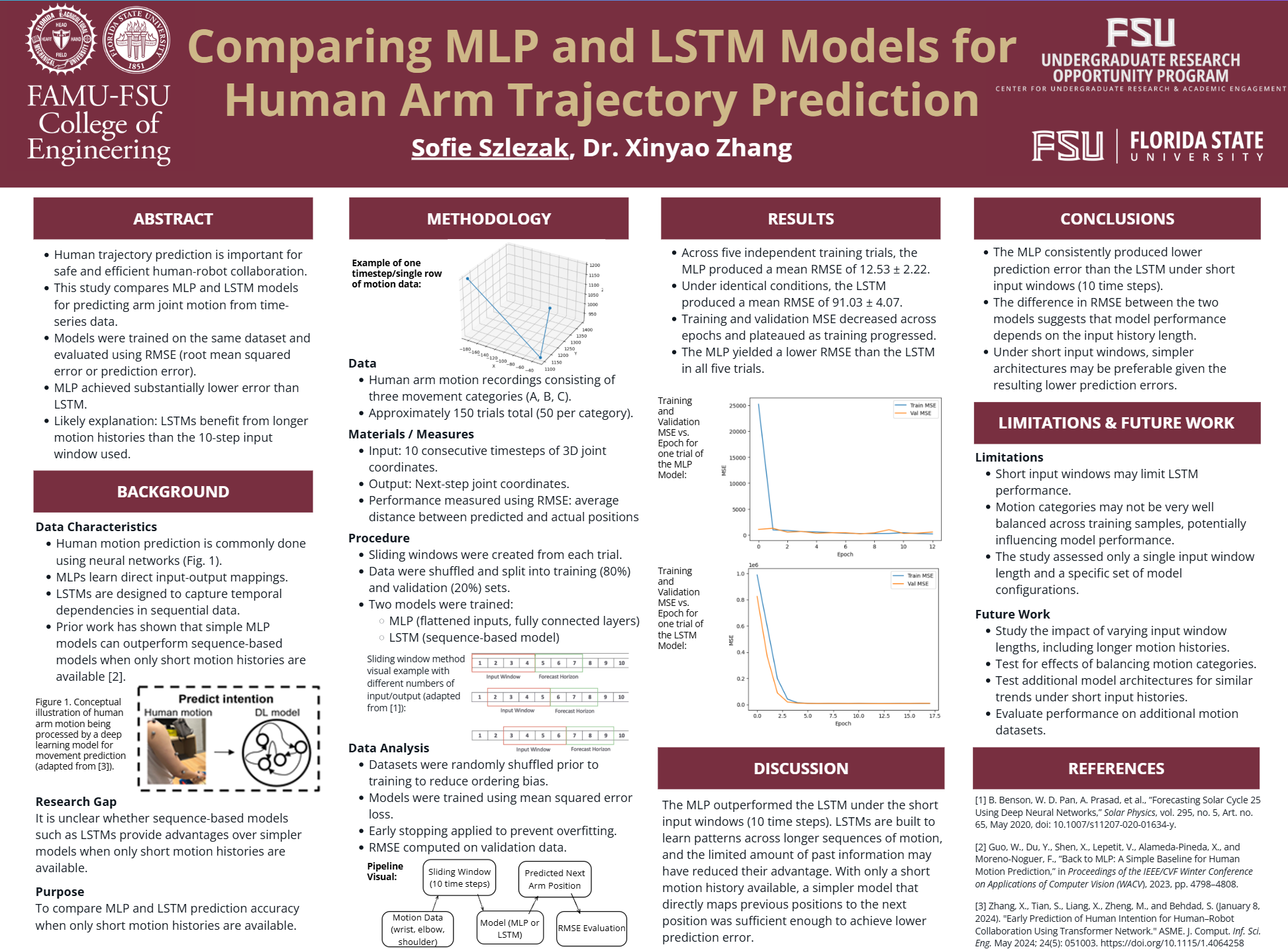
Human-robot collaboration relies on the accurate prediction of human motion to improve safety and efficiency. When robots can anticipate human movement, they can respond more smoothly, make decisions accordingly, and reduce the risk of collision or coordination issues. This study compares two types of machine learning models in predicting short-term human arm motion. Motion data consisting of wrist, elbow, and shoulder positions were segmented into short input windows of 10 time steps. Two predictive models were trained to estimate the next arm position based on this preceding motion history. One model is a Multilayer Perceptron (MLP), a feedforward network that processes past motion data as a single combined input. The other is a Long Short-Term Memory (LSTM) network, a sequence-based neural network that processes motion sequentially and maintains a memory of earlier time steps. Both models were trained under the same experimental conditions using the same dataset. Across five independent trials, the MLP achieved a mean root mean squared error (RMSE) of 12.53 ± 2.22, while the LSTM achieved a mean RMSE of 91.03 ± 4.07. The lower RMSE achieved by the MLP shows that under short input windows, simpler feedforward models can outperform more complex sequence-based models. This may be because LSTMs are designed to learn patterns across longer motion histories. These findings suggest that accurate human-motion prediction can be achieved using simpler models with lower computational cost, which is advantageous for real-time human-robot collaboration.
Keywords: machine learning, time-series analysis, human-robot collaboration, deep learning