
Research Symposium
26th annual Undergraduate Research Symposium, April 1, 2026
Cassidy Clarke Poster Session 4: 3:00 pm - 4:00 pm / Poster #36
BIO
Cassidy is a second-year Music major from West Palm Beach, Florida. Her research centers on Eatonville and its historical contributions to America’s democratic lineage. She hopes to continue studying and establish a career in the music and entertainment industry. In her free time, she enjoys traveling, drawing, playlist making, and visiting new restaurants around town.
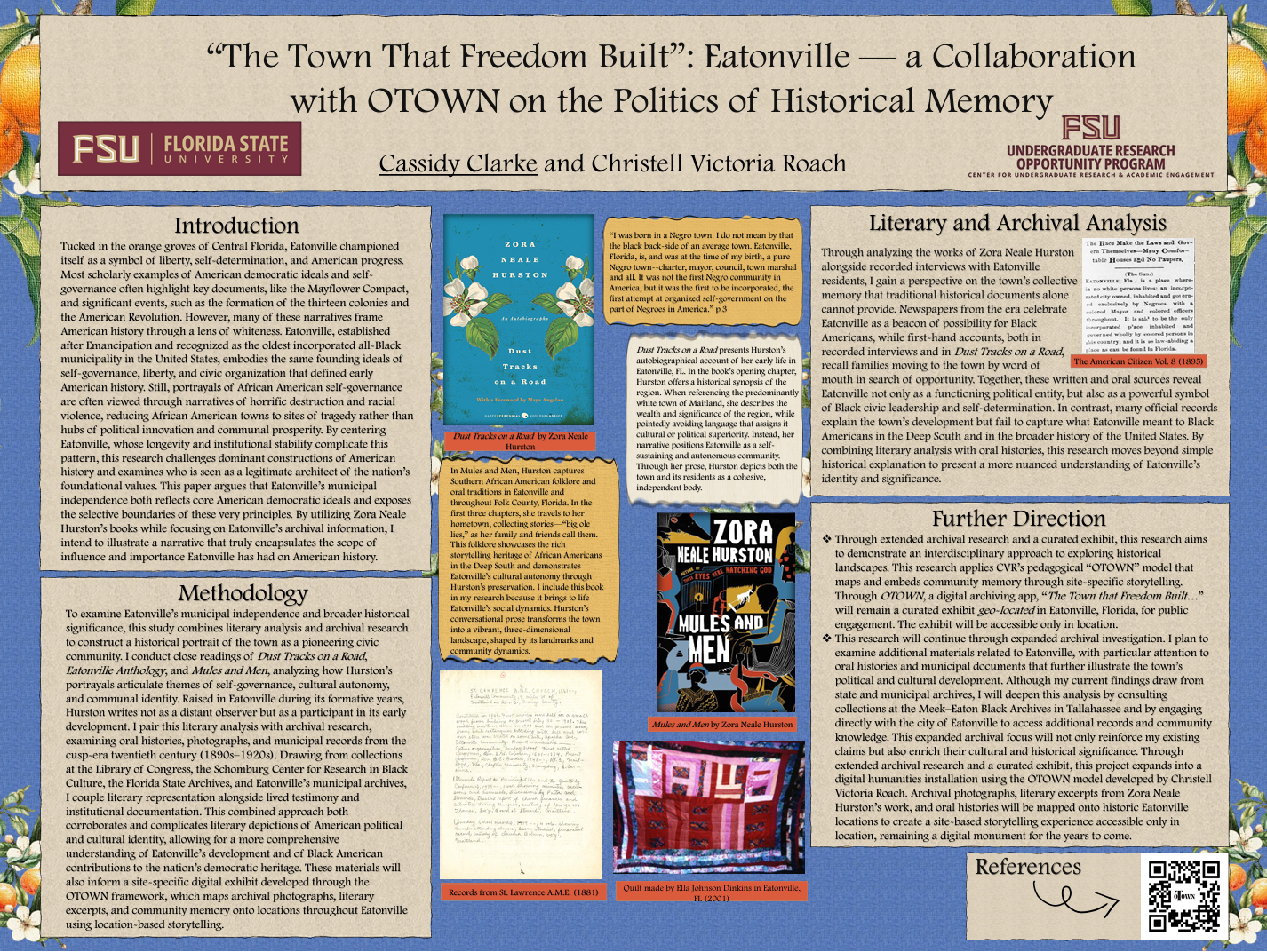
“The Town That Freedom Built”: Eatonville — a Collaboration with OTOWN on the Politics of Historical Memory
Authors: Cassidy Clarke, Christell Victoria RoachStudent Major: Music
Mentor: Christell Victoria Roach
Mentor's Department: English Mentor's College: College of Arts and Sciences Co-Presenters:
Abstract
In the heart of Orange County, Florida, a small incorporated town assumed the herculean task of reshaping the scope of American democracy. Founded in 1887, Eatonville emerged as the first self-governing all-black municipality in the United States. Most scholarly examples of American democratic ideals and self-governance in historical practice point to essential documents, such as the Mayflower Compact, and events, such as the American Revolution. However, many of these examples portray an American narrative through the lens of whiteness. My thesis argues that Eatonville’s municipal independence simultaneously enacted foundational American democratic ideals while critiquing the scope of these principles. In this paper, I provide both a literary analysis of Dust Tracks on a Road, Mules and Men, and Eatonville Anthology by Zora Neale Hurston and an archival analysis of audio and video interviews, photographs, and documents found in the Library of Congress, the Schomburg Center for Research in Black Culture, the Florida State Archives, and Eatonville’s municipal archives. My research concludes by recognizing how boldly Eatonville embraces these national ideals of liberty and democracy while also questioning American rhetoric surrounding African American history in the United States. By examining the town’s political autonomy, it is evident that it did more than just survive in a segregated country; it also implemented the very democratic ideals that Black Americans were excluded from. Eatonville’s existence challenges prevailing historical narratives surrounding American history and repositions Black civic leadership at the center of the nation’s founding democratic principles.
Keywords: eatonville, digital humanities, archival research