
Research Symposium
26th annual Undergraduate Research Symposium, April 1, 2026
Robert Dyer Poster Session 1: 9:30 am - 10:30 am / Poster #22

BIO
Robert Dyer is a freshman behavioral neuroscience major from Tampa, Florida. He is a Presidential Scholar who hopes to one day attend medical school and become a neurologist. This is Robert's first experience conducting research, and he is eager to gain experience collecting and analyzing data. His interest in Alzheimer's research began in high school, where courses like AP Psychology motivated him to study the brain and behavior. Robert hopes to deepen his understanding of neurological diseases and contribute to efforts to combat Alzheimer's through this research.
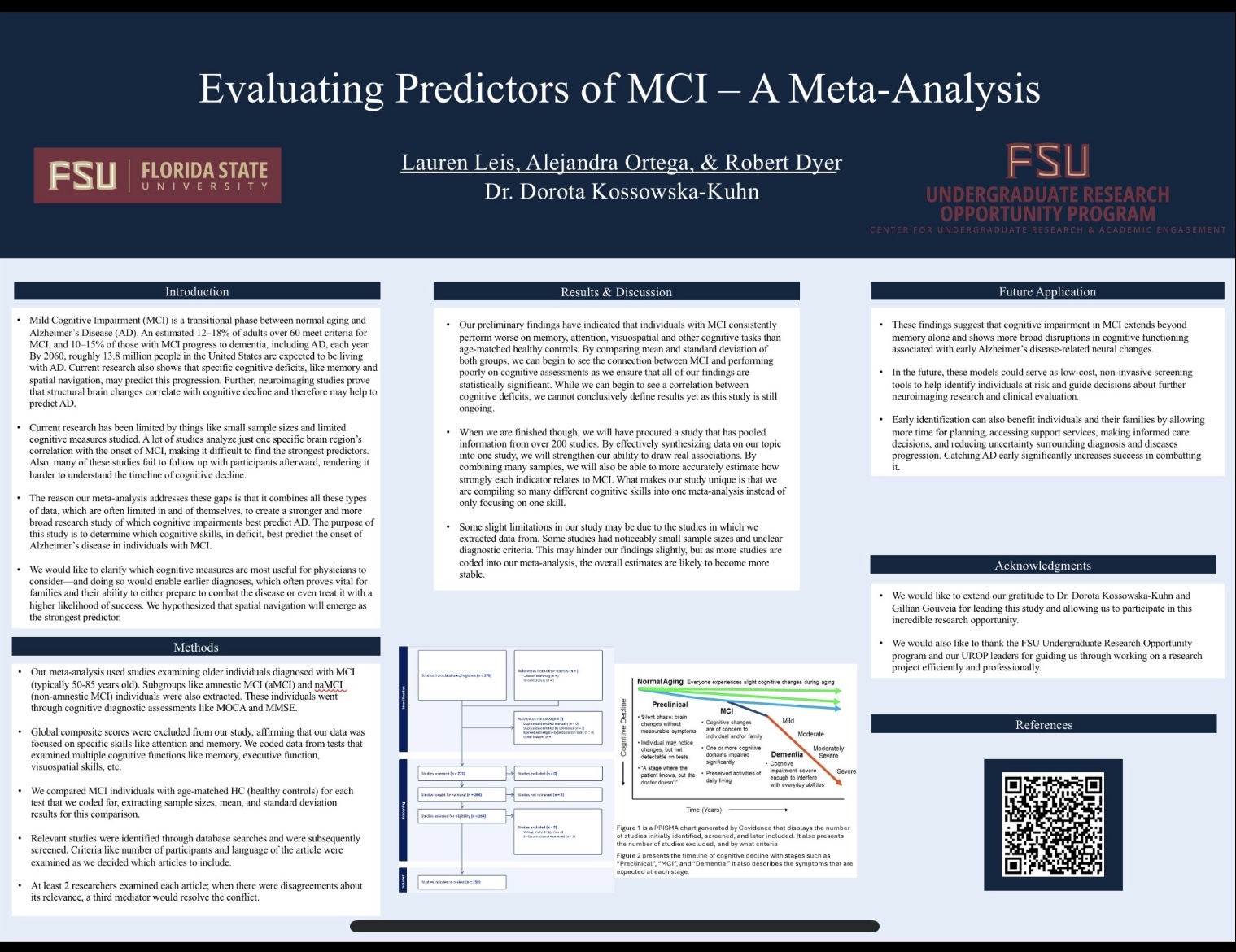
Evaluating Predictors of MCI—A Meta Analysis
Authors: Robert Dyer, Dorota Kossowska-KuhnStudent Major: Behavioral Neuroscience
Mentor: Dorota Kossowska-Kuhn
Mentor's Department: Department of Psychology Mentor's College: College of Arts and Sciences Co-Presenters: Lauren Leis, Alejandra Ortega
Abstract
Mild Cognitive Impairment (MCI) is a transitional phase between normal aging and Alzheimer's Disease (AD). An estimated 12-18% of adults over 60 meet criteria for MCI, and 10-15% of those with MCI progress to dementia, including AD, each year.
By 2060, roughly 13.8 million people in the United States are expected to be living with AD. Current research also shows that specific cognitive deficits, like memory and spatial navigation, may predict this progression. Further, neuroimaging studies prove that structural brain changes correlate with cognitive decline and therefore may help to predict AD. Current research has been limited by things like small sample sizes and limited cognitive measures studied. A lot of studies analyze just one specific brain region's correlation with the onset of MCI, making it difficult to find the strongest predictors. Also, many of these studies fail to follow up with participants afterward, rendering it harder to understand the timeline of cognitive decline. The reason our meta-analysis addresses these gaps is that it combines all these types of data, which are often limited in and of themselves, to create a stronger and more broad research study of which cognitive impairments best predict AD. The purpose of this study is to determine which cognitive skills, in deficit, best predict the onset of Alzheimer's disease in individuals with MCI. Doing so would enable earlier diagnoses, which often proves vital for families and their ability to either prepare to combat the disease or even treat it with a higher likelihood of success.
Keywords: Alzheimer’s, MCI, cognition