
Research Symposium
26th annual Undergraduate Research Symposium, April 1, 2026
Ava Sajovits Poster Session 3: 1:45 pm - 2:45 pm / Poster #90
BIO
Ava Jade Sajovits is a sophomore at Florida State University pursuing a Bachelor of Science in Psychology on the pre-medical track, with a minor in Criminology. She is expected to graduate in May 2028, and has received Dean’s List honors in Fall 2024, Spring 2025, and Fall 2025.
Ava is actively involved in clinical, research, and teaching experiences that support her goal of pursuing a career in medicine. She completed Clinical Medical Assistant (CCMA) training and holds BLS/CPR certification, with skills in patient care, medical terminology, EKG, phlebotomy, parenteral administration, and point-of-care testing.
Her clinical experience includes serving as a Clinical Intern at Tallahassee Orthopedic Clinic (TOC Now), where she performs patient intake, obtains vital signs, assists with triage, prepares and administers injections under physician supervision, and documents encounters in the AthenaHealth EMR system. She also shadows an orthopedic surgeon, observing surgical procedures including total knee, hip, shoulder, and reverse shoulder replacements.
Ava is involved in undergraduate research through the UROP program under Dr. Jacob Brown, studying neuromuscular aging and disuse atrophy using a hindlimb unloading rat model and immunofluorescence techniques.
Additionally, she serves as a Learning Assistant for Chemistry II, supporting student learning through guided problem-solving sessions.
Ava is also a member of Delta Zeta and contributes to the Delta Zeta Philanthropy Committee, supporting initiatives that promote service and community engagement.
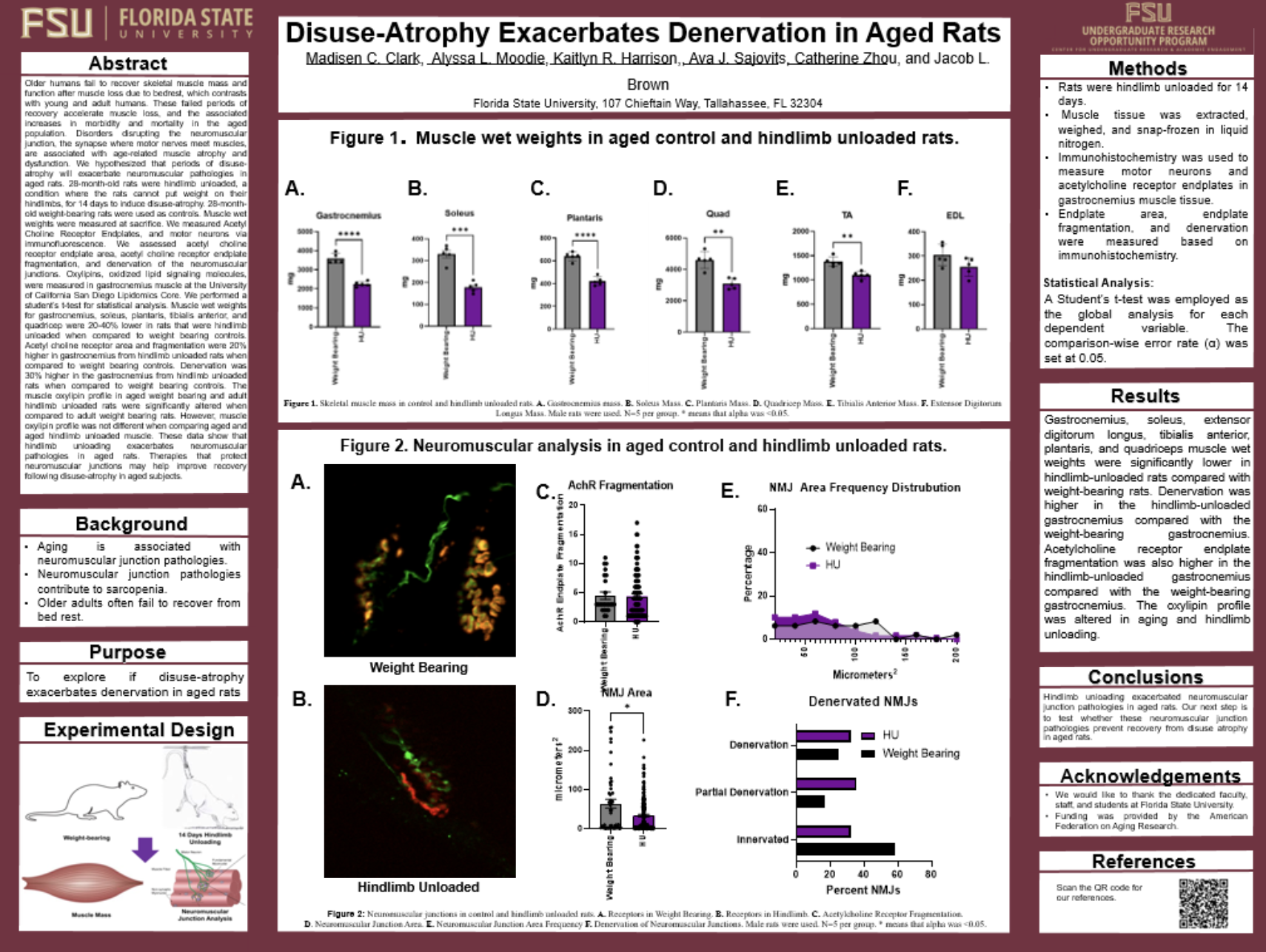
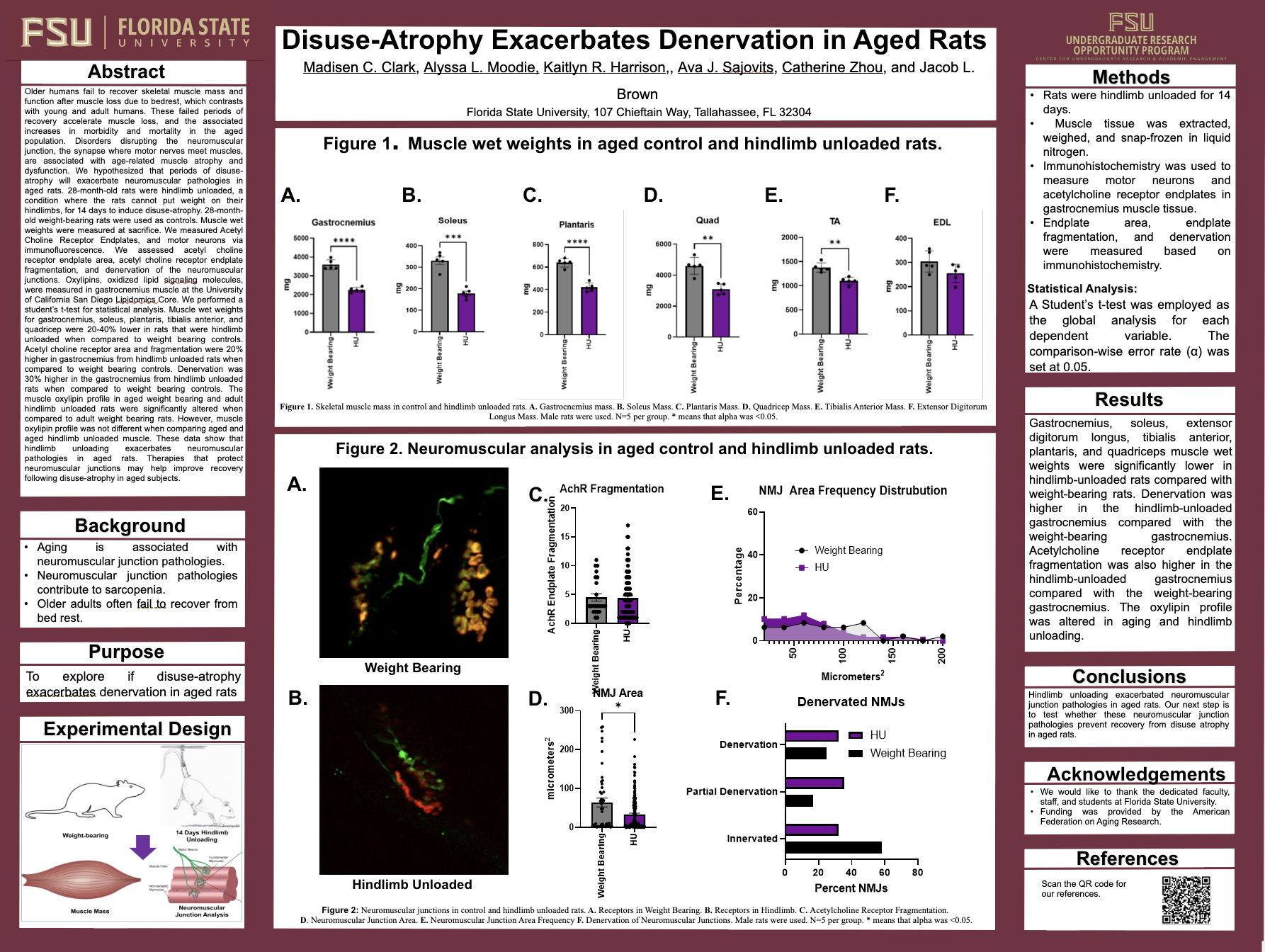
Disuse-Atrophy Exacerbates Denervation in Aged Rats
Authors: Ava Sajovits, Jacob BrownStudent Major: Psychology Pre-Medical
Mentor: Jacob Brown
Mentor's Department: Exercise Physiology Mentor's College: Anne Spencer Daves College of Education, Health, and Human Sciences Co-Presenters:
Abstract
Older humans fail to recover skeletal muscle mass and function after muscle loss due to bedrest, which contrasts with young and adult humans, leading to muscle loss and an increase in morbidity and mortality in the aged population. Disorders disrupting the neuromuscular junction, the synapse where motor nerves meet muscles, are associated with age-related muscle atrophy and dysfunction. We hypothesized that periods of disuse-atrophy will exacerbate neuromuscular pathologies in aged rats. 28-month-old rats were hindlimb unloaded, a condition where the rats cannot put weight on their hindlimbs, for 14 days to induce disuse atrophy. 28-month-old weight-bearing rats were used as controls. Muscle wet weights were measured at sacrifice. Via immunofluorescence, we assessed acetyl choline receptor endplate area, acetyl choline receptor endplate fragmentation, and denervation of the neuromuscular junctions. Oxylipins, oxidized lipid signaling molecules, were measured in gastrocnemius muscle. We performed a student’s t-test for statistical analysis. Muscle wet weights were 20-40% lower in rats that were hindlimb-unloaded compared to controls. Acetyl choline receptor area and fragmentation were 20% higher in gastrocnemius from hindlimb-unloaded rats compared to controls. Denervation was 30% higher in the gastrocnemius from hindlimb-unloaded rats compared to controls. The muscle oxylipin profile in aged weight-bearing and adult hindlimb-unloaded rats were significantly altered when compared to adult weight-bearing rats. However, muscle oxylipin profile was not different when comparing aged and aged hindlimb unloaded muscle. These data show that hindlimb-unloading exacerbates neuromuscular pathologies in aged rats. Therapies that protect neuromuscular junctions may help improve recovery following disuse-atrophy in aged subjects.
Keywords: Disuse-atrophy, neuromuscular junction, muscular atrophy