
Research Symposium
26th annual Undergraduate Research Symposium, April 1, 2026
Jaiden Giron Poster Session 2: 10:45 am - 11:45 am / Poster #248
BIO
Jaiden Giron is a first-year Civil Engineering student at Florida State University and the FAMU-FSU College of Engineering. He is a member of the Presidential Scholars Program and an undergraduate researcher in the Undergraduate Research Opportunity Program (UROP), where he works with Dr. Juyeong Choi in the Resilient Infrastructure & Disaster Response Center. His research focuses on post-disaster debris management and the use of simulation and digital twin models to improve disaster recovery logistics.
Beyond research, Jaiden is actively involved in service and leadership initiatives at Florida State University, including community volunteer work addressing food insecurity and outreach with local organizations. He is also interested in engineering design, data analysis, and the application of simulation tools to real-world infrastructure challenges.
Jaiden plans to pursue a Bachelor of Science in Civil Engineering and hopes to continue research in resilient infrastructure systems while preparing for a career focused on improving disaster preparedness and infrastructure reliability.
Improving the Operational Efficiency of Post-Disaster Debris Hauling using Digital Twins
Authors: Jaiden Giron, Juyeong ChoiStudent Major: Civil Engineering
Mentor: Juyeong Choi
Mentor's Department: Civil and Environmental Engineering Mentor's College: FAMU-FSU College of Engineering Co-Presenters:
Abstract
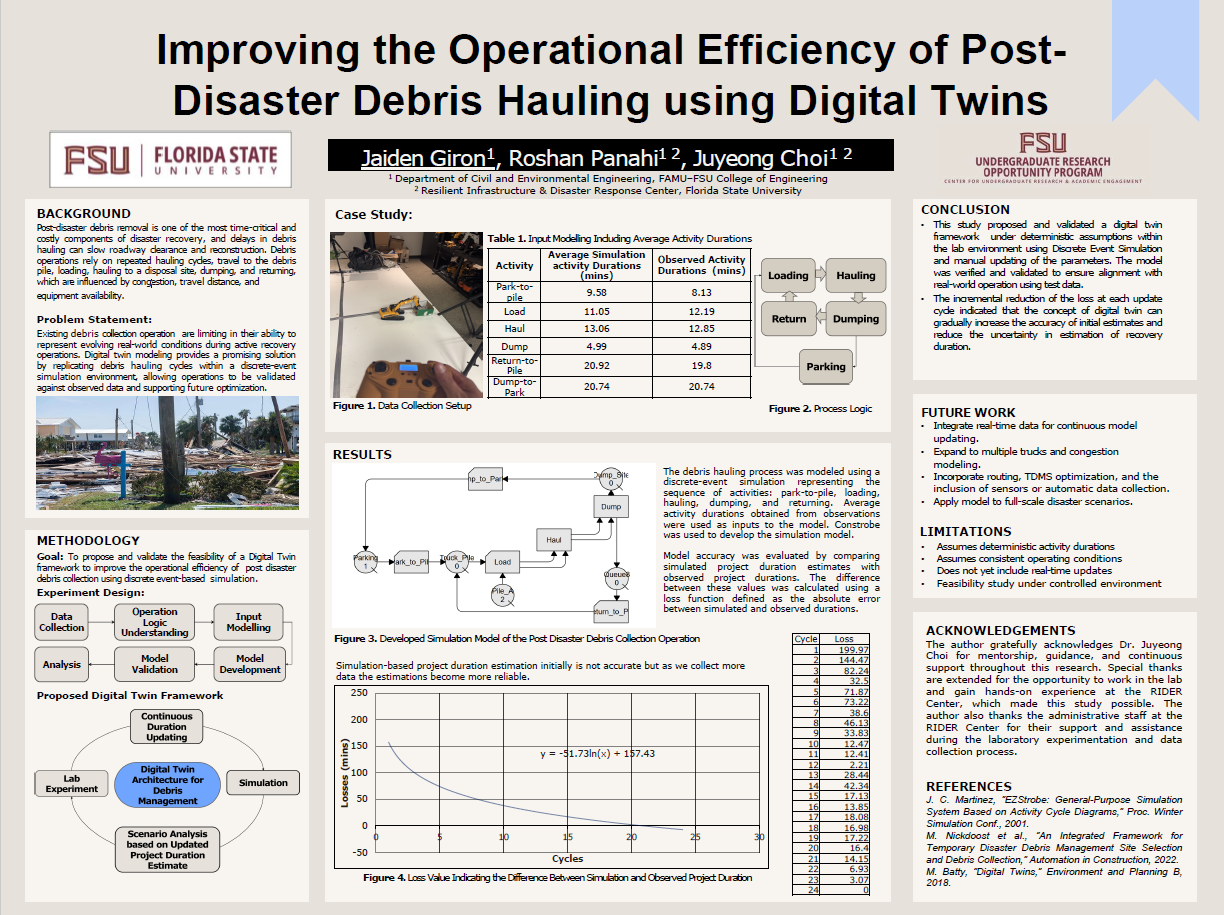
Post-disaster debris removal is a time-critical and costly component of disaster recovery, impacting expenses and delaying reconstruction. My research develops a simulation-based digital twin of debris hauling operations to replicate real debris collection cycles and evaluate operational improvements in Temporary Debris Management Site (TDMS) workflows. A digital twin is the virtual representation of a physical object, applying real-time data to reflect real-world behaviors, results, and conditions. The purpose is to validate a twin-model simulation against observed field cycle durations and assess how improved duration inputs can increase recovery efficiency.
A simulation model was built to represent a full debris hauling cycle, including park-to-pile, loading, hauling, dumping, and return-to-pile. Activity durations were collected across 23 observed cycles and summarized using average task times for the simulation parameters. The model structure enables validation by comparing one-cycle and average-cycle simulation outputs to observed durations. Preliminary average durations (min) were: park-to-pile 9.58, loading 11.05, hauling 13.06, dumping 4.99, and return-to-pile 20.92, for a total cycle time of about 57 minutes. These findings suggest that even small improvements in cycle timing can produce meaningful time savings for multi-day debris operations.
My study demonstrates that twin models provide a practical method for replicating real debris hauling scenarios and validating operational logic. As well, the simulation allows decision-makers to test changes in the operation without disrupting real work. The expected contribution of this project is a validated, updateable debris-management twin model that supports faster and more adaptive recovery planning for future operations.
Keywords: Post-Disaster Debris Management