
Research Symposium
26th annual Undergraduate Research Symposium, April 1, 2026
Mallory Sarfert Poster Session 3: 1:45 pm - 2:45 pm / Poster #159

BIO
Mallory is a first-year at Florida State University, majoring in Dietetics. Originally from Pensacola, FL, Mallory moved to Tallahassee to pursue her undergraduate education.
Her academic and professional interests include human nutrition, with a particular focus on eating disorders in adolescents. Mallory plans to pursue a career in eating disorder treatment, research, and recovery, with the goal of obtaining her Registered Dietitian certification and working in an inpatient clinical setting.
Currently, Mallory is involved in research on the human gut microbiome. Her work, under the mentorship of Cole Patoine (MS, RDN) and Dr. Ravinder Nagpal (PhD), explores the effects of ultra-processed food (UPF) intake in college-aged adults, examining the relationship between UPFs and gut microbial diversity, with larger global health implications for Western diet consumers.
She continues expanding her research skills and education at Anne’s College of Health and Human Sciences, where she will graduate in Spring 2028. She hopes to continue at Florida State University to obtain her Master’s degree in Food and Nutrition Sciences, as well as complete her Dietetic Internship.
Associations Between Ultra-processed Food Intake and Gut Microbiome Composition in Young Adults
Authors: Mallory Sarfert, Cole PatoineStudent Major: Dietetics
Mentor: Cole Patoine
Mentor's Department: Department of Health, Nutrition, and Food Sciences Mentor's College: Anne Spencer Daves College of Education, Health, and Human Sciences Co-Presenters:
Abstract
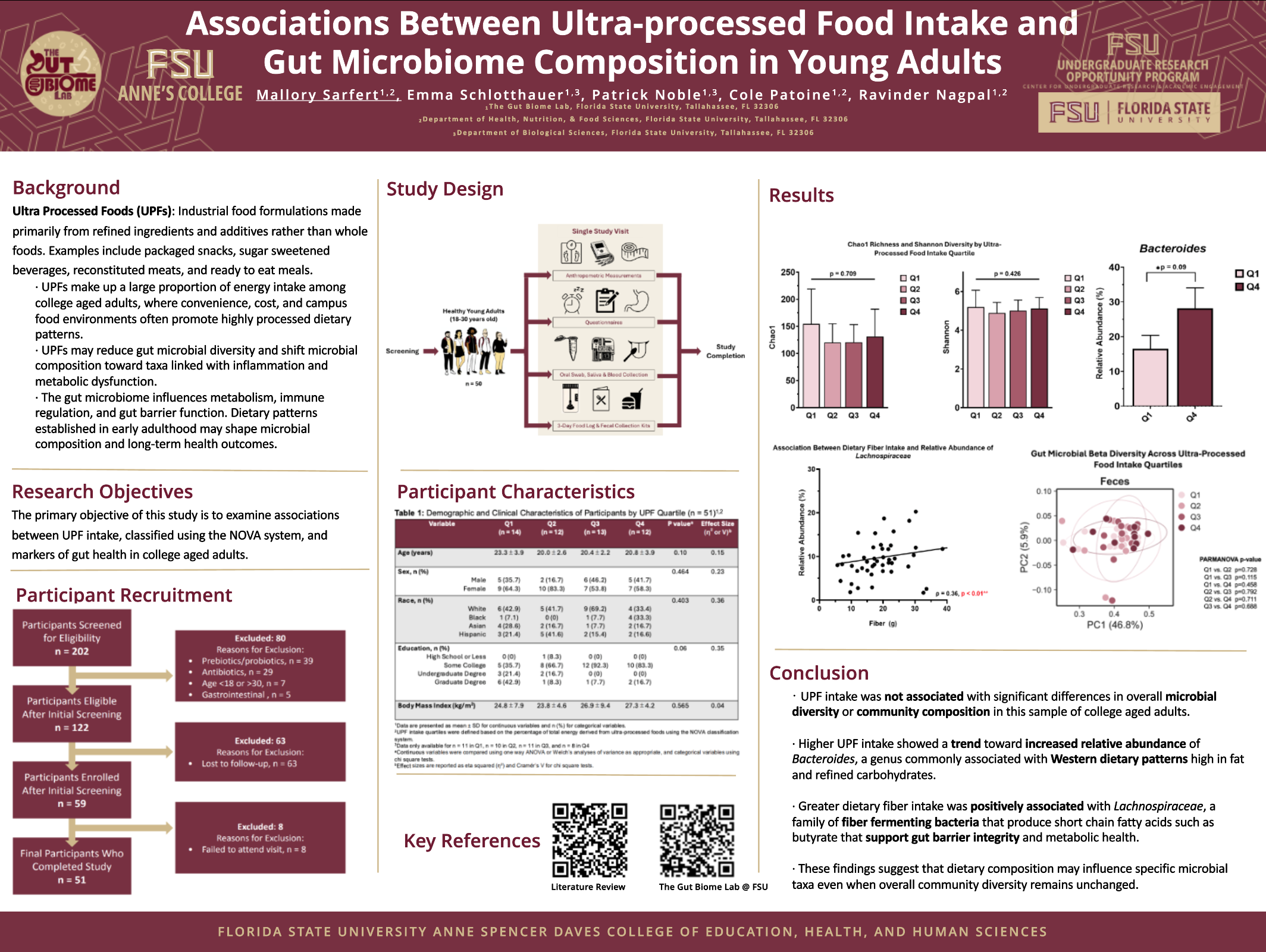
Objectives: Ultra-processed foods (UPFs) are industrial formulations low in fiber and rich in refined carbohydrates, fats, and additives that dominate young adult diets. Diet is a primary driver of gut microbiome structure, and high-UPF diets have been linked to reduced microbial diversity. However, data in healthy young adults remain limited. The primary objective of this study was to examine associations between UPF intake and gut microbiome composition and diversity in college-aged adults.
Methods: In this cross-sectional study, 51 adults aged 18-30 years completed a single study visit. Dietary intake was assessed using three-day diet records, classifying UPFs via the NOVA system. Participants collected a freshly voided fecal sample using standardized at-home collection kits. Samples were immediately cooled, transported under controlled conditions, and stored at -80 °C. Using extracted microbial DNA, the V3 to V4 region of the 16S rRNA gene was sequenced. Gut microbial alpha- and beta-diversity metrics and taxonomic composition were assessed using validated bioinformatics pipelines.
Results: UPF intake was not associated with significant differences in overall microbial alpha- or beta-diversity. Higher UPF intake showed a trend toward increased relative abundance of Bacteroides, a genus commonly associated with Western dietary patterns high in fat and refined carbohydrates (p<0.1). Greater dietary fiber intake was positively associated with Lachnospiraceae, a family of fiber-fermenting bacteria that produce short chain fatty acids such as butyrate that support gut barrier integrity and metabolic health (p<0.05).
Conclusions: Dietary composition and UPF intake may influence specific microbial taxa even when overall community diversity remains unchanged.
Keywords: Ultra-processed foods, Gut Microbiome, Nutrition