
Research Symposium
26th annual Undergraduate Research Symposium, April 1, 2026
Daniel Lang Poster Session 1: 9:30 am - 10:30 am / Poster #281
BIO
Daniel Lang is a sophomore Honors student and Presidential Scholar at Florida State University, pursuing a major in Behavioral Neuroscience. Originally from Miami, Florida, he is deeply engaged in both academic and extracurricular leadership on campus. Daniel serves as the Vice President of Recruitment for Phi Delta Epsilon, where he helps foster a supportive pre‑medical community and coordinates initiatives that promote professional development among future physicians.
In addition to his leadership roles, Daniel is an undergraduate researcher in the Riddle Lab, where he contributes to a clinical trial using transcranial alternating current stimulation, MRI, and EEG. His research interests center on understanding the biological and cognitive mechanisms that shape human behavior, with a particular focus on working memory and depression. Daniel intends to pursue a career in medicine, integrating scientific inquiry with compassionate clinical practice.
Theory of Mind on Working Memory in late adolescence and emerging adulthood.
Authors: Daniel Lang, Justin RiddleStudent Major: Behavioral Neuroscience
Mentor: Justin Riddle
Mentor's Department: Psychology Mentor's College: Arts and Sciences Co-Presenters:
Abstract
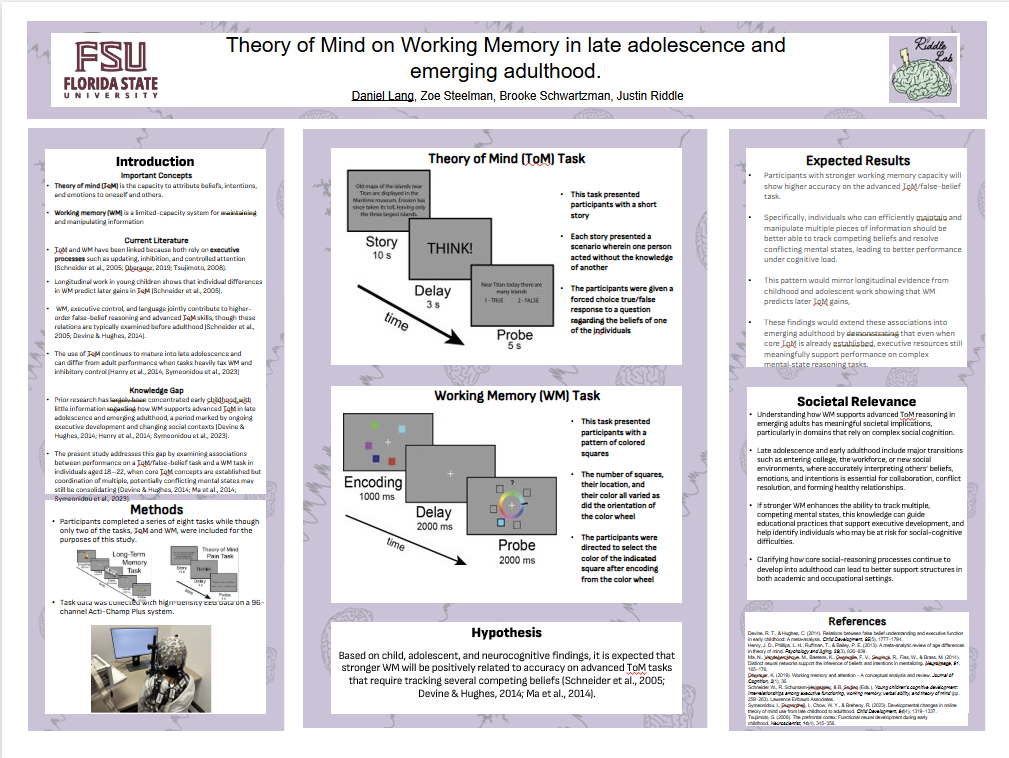
Theory of mind (ToM) is the capacity to infer and reason about others’ mental states. It has been extensively studied in early childhood, where it is reliably associated with executive functions such as working memory (WM); however, it is unknown whether this association persists into late adolescence and emerging adulthood. These developmental periods are characterized by continued prefrontal cortical maturation and refinement of higher-order social cognition, both of which are involved in these higher order cognitive tasks. The present study examines the correlation between WM capacity and ToM performance in individuals aged 18–22. Participants completed WM tasks and ToM tasks assessing mental state through pattern recognition, color persistence, and false-belief paradigms. Based on prior developmental findings in childhood, we hypothesize that improved WM task scores will be positively correlated with ToM task performance in participants ages 18-22, reflecting the need to maintain and manipulate multiple, potentially conflicting representations of beliefs, intentions, and perspectives.
Keywords: Working Memory, Theory of Mind, Pattern Recognition